// data-verified

7 Best Battery Tester of 2026: No-Battery, One-Handed Testers

Find the best battery tester for your mixed drawer: self-powered digital options that never need a AAA, and magnetic analog picks for one-handed checks.

Few tools create as much quiet frustration as a common analog battery tester. You press a wiry spring against a round cell, chase a shaky needle, and then—when the tester's own AAA dies—you're left with a useless plastic brick.

That changes quickly. A few recent designs tackle both headaches head-on. Magnetic contacts let you drop a battery onto the tester and get a steady reading with one hand—no awkward pressing or rolling. Self-powered digital testers draw just enough current from the cell under test to show an exact voltage on an LCD, so the tool stays ready years later.

That means you can sort a junk drawer of alkalines and rechargeables quickly, without hunting for a fresh battery to power the tester itself.

#01

Best Overall

La Crosse 911-65557-INT

91 /100
Kirk Score Outstanding
Display Type
Digital LCD
Load Testing
No
Rechargeable Testing
Yes, 1.2V setting
Battery-Free Operation
Yes, self-powered
Check Details on Amazon

Pros

  • Highly accurate digital voltage readout with clear good/weak/replace indication — 152 mentions, 84% positive on accuracy
  • Completely self-powered—uses the battery under test, no extra batteries to maintain — 81 mentions, 73% positive on being self-powered
  • Compact, easy to use, and fits in a battery drawer — 163 mentions on ease of use, 96% positive; 96 mentions on size, 92% positive
  • Tests rechargeable NiMH batteries with a dedicated 1.2V setting for realistic voltage assessment — 53 mentions versatility, 81% positive

Cons

  • Larger C and D batteries may not make solid contact, requiring careful positioning for a steady reading — Reviews note contact issues with C/D cells

The La Crosse 911-65557-INT draws its operating power directly from the battery under test, so there's no internal battery to replace or charge before you can check a cell. A small LCD shows voltage to two decimal places with a simple good/weak/replace indicator, eliminating guesswork and the wobbly needle of analog testers.

A selector wheel moves between 1.5V (alkaline), 1.2V (NiMH), and 3V (lithium button cells), covering nearly every battery found in a typical home—AAA, AA, C, D, N, 9V, and button cells. The dedicated 1.2-volt setting for rechargeable batteries provides a more realistic voltage threshold than generic testers that treat all 1.5-volt cells the same; this prevents the common mistake of tossing a rechargeable that merely needs a recharge.

Measuring only a few inches, the tester stores effortlessly in a battery drawer or junk bin. Operation is a matter of touching the battery's terminals to the exposed contacts—no buttons to press, no settings to remember beyond the voltage selector wheel. The clear digital readout updates instantly and the good/weak/replace legend makes the reading interpretable even for kids or occasional users. Backed by a two-year limited warranty, the build is appropriately sturdy for household handling.

The self-powering circuit needs just enough current to boot the display, which is never a problem with AAA, AA, 9V, or button cells. C and D cells, with their larger terminals and heavier bodies, can require a deliberate push to make solid contact; a loose grip may cause the reading to drop out. Once seated, the reading is just as precise as it is for smaller batteries.

This tester is built for everyday households that mix alkaline and rechargeable cells. It won't test CR123A, CR2, or other specialty cylindrical batteries—those need a tester with different contact spacing. It also skips load testing, meaning a borderline battery with high internal resistance may still read 'good' by voltage alone. For the common task of sorting freshly charged rechargeables from spent alkalines, those omissions won't matter.

At a mid-range price, the tester pays for itself by preventing the unnecessary recycling of partially charged rechargeables and identifying truly dead cells without the irony of a dead tester battery.

💡 💡 Tip: For C and D cells, press the battery firmly against both contacts and hold steady for a second to get a consistent reading.

Bottom line: If your battery drawer is a mix of alkalines and rechargeables, this self-powered digital tester removes the annoyance of a dead tester battery and gives a clear yes/no on each cell—just be prepared to hold large C and D cells firmly for a steady reading.

Check Latest Price
#02

Best No-Battery Analog Tester

Dlypow B1T Magnetic Tester

89 /100
Kirk Score Excellent
Display Type
Analog needle
Load Testing
No
Rechargeable Testing
Yes, voltage only
Battery-Free Operation
Yes, magnetic contacts
Check Details on Amazon

Pros

  • Magnetic contact holds batteries securely, eliminating the typical slipping and fumbling of analog testers. — 15 mentions, 80% positive on magnetic feature; functionality rated highly (95% positive)
  • No battery required—runs off the tested cell, so it’s always ready without dead-battery irony. — Battery life mentions confirm no battery requirement (12 mentions, 92% positive)
  • Compact, lightweight, and extremely easy to use with minimal dexterity needed. — 51 mentions, 96% positive on ease of use; compact design praised

Cons

  • Plastic construction can feel lightweight, and long-term durability under frequent handling remains unclear. — A few top reviewers mention 'cheaply made' and 'hope it lasts'; not a high-frequency complaint but notable given category norms

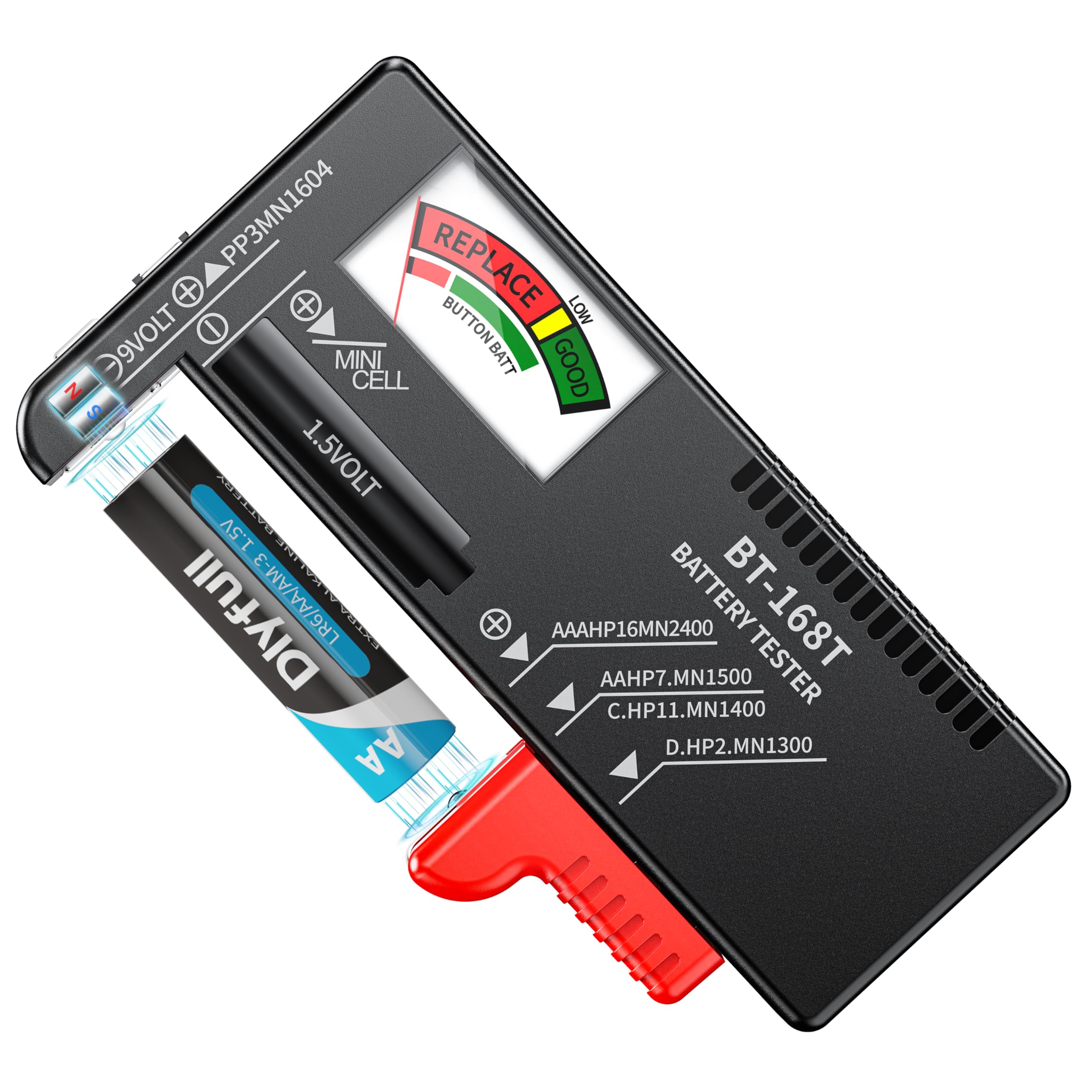
Magnetic contacts finally solve the most maddening part of testing household batteries—the struggle to keep the cell in place while reading a bouncing needle. Where generic cheap analog testers demand two hands to pinch a AAA against tiny contacts, the Dlypow’s magnetic tip grabs the terminal and lets you press, read, and sort with one hand. The color-coded needle display is instant, and the device requires no battery of its own, so it’s always ready the moment you pull it from the drawer.

This tester shines for anyone who has ever fumbled with a budget analog checker. Quick pass/fail screening of AA, AAA, C, D, 9V, and button cells becomes effortless—just touch the magnet and glance at the scale. It’s especially practical for teaching kids or assisting seniors with reduced dexterity, because the magnet handles the grip work that usually causes frustration. The compact, lightweight body slips into a kitchen junk drawer without adding bulk.

The trade-off is materials and test depth. The plastic shell feels light, and while immediate breakage isn’t a noted problem, long-term durability under frequent drawer rattling remains unproven. The analog needle gives a clear good/weak/replace indication but won’t report exact voltage, so if you need precise readings for rechargeable cell health or specialty sizes, a digital tester with a numeric display is a better match. For rapid household sorting, though, the simplicity is an advantage, not a shortcoming.

Bottom line: If you’ve ever battled a cheap analog tester that makes every battery feel like a game of Operation, this magnetic option is the no-fuss upgrade—as long as you accept its light plastic shell.

Check Latest Price
#03

Best for Load Testing Enthusiasts

KKEANIC SL-049 Professional Digital Battery Checker

86 /100
Kirk Score Excellent
Display Type
Digital LCD
Load Testing
Yes (real resistors)
Rechargeable Testing
Yes, load-tested
Battery-Free Operation
No, needs AAA battery
Check Details on Amazon

Pros

  • Applies actual load resistors to measure battery health under drain—more accurate than voltage-only testers — 30 mentions accuracy, 80% positive
  • Supports AA, AAA, AAAA, C, D, N, 9V, button cells, CR2, CR123A, and 1.2V rechargeable types — 50 mentions functionality, 86% positive
  • Bright LCD with color-coded bar and simple type selection, plus auto-shutoff — 36 mentions ease of use, 97% positive

Cons

  • Weak contact pressure can cause erratic readings unless you hold the battery in place — A couple of reviewers reported intermittent readings from weak spring contact tension
  • Battery drain can occur even with auto-shutoff, leaving the tester unresponsive — 21 mentions, 48% negative on battery life — some reports of drain when not in use

Real load testing separates the KKEANIC SL-049 from voltage-only testers that can misread a battery's usable capacity. The unit applies a resistive load appropriate to each cell size—discharging current specified for AA, AAA, C, D, 9V, and 1.2V rechargeable types—so the digital reading reflects how a battery performs under actual drain rather than just resting voltage.

Compatibility spans nearly every common household size: AA, AAA, AAAA, C, D, N, 9V, plus button cells, CR2, and CR123A. The LCD shows exact voltage and a colored power bar; operation is straightforward—select battery type, insert, and read. Auto-shutoff preserves the internal AAA battery, though drain can occur even when idle, so occasional replacement may be necessary.

This tester suits households that rely on rechargeable NiMH or lithium cells and want a load-informed decision before recycling. It requires a AAA battery to operate—a minor irony that may frustrate casual users who just need a quick pass/fail. Occasional contact pressure issues with the spring-loaded terminals can produce intermittent readings unless the battery is positioned carefully.

💡 💡 Tip: Hold the battery flat against the contacts with gentle pressure for a steady reading—intermittent display usually disappears with a slight adjustment.

Bottom line: If you regularly test NiMH or lithium rechargeables and want a load-based health reading that voltage-only testers miss, the KKEANIC SL-049 justifies its premium. Casual users who just need a pass/fail for alkalines may prefer a simpler, self-powered digital.

Check Latest Price
#04

Best Digital Tester for Mixed Battery Drawers

Tenergy T-333 Tester

93 /100
Kirk Score Outstanding
Display Type
Digital LCD
Load Testing
No
Rechargeable Testing
Yes (voltage)
Battery-Free Operation
No, needs own battery
Check Details on Amazon

Pros

  • Loads CR123A, CR2, button cells, and 9V batteries alongside standard alkaline sizes — 472 mentions, 85% positive on battery testing
  • Simple insertion and clear Poor/Weak/Good LCD bar meter — 343 mentions, 96% positive on ease of use
  • Mid-range price helps reduce waste by identifying reusable batteries — 164 mentions, 88% positive on value

Cons

  • Accuracy can slip with borderline cells, occasionally showing false Good or prematurely Weak readings — 184 mentions, 32% negative on accuracy

Typical digital testers stop at AA/AAA; the Tenergy T-333 adds presets for CR123A, CR2, CRV3, and button cells, plus a dedicated 9V slot. Unlike self-powered alternatives, this one relies on its own battery, but that trade-off buys you a wider compatibility roster that covers odd lithium sizes most other digital units skip.

A slide-out tray makes inserting AA/AAA/C/D cells straightforward, and the LCD's three-step bar reads out Poor, Weak, or Good without guesswork. The large display removes the ambiguity of analog needle meters. It works with rechargeable NiMH cells, which broadens its usefulness, and at a mid-range price it helps avoid tossing half-used batteries, quickly paying for itself.

This tester is built for households with a drawer full of mixed alkalines, rechargeables, and specialty lithium cells who want a quick digital read. It's not for users who resent the irony of a battery-dependent tester; you'll need to keep a spare on hand. Accuracy is generally dependable, but borderline cells may occasionally give a false sense of charge, so for critical devices, a double-check with a known good cell is wise.

💡 💡 Tip: For smoke detectors or medical devices, verify a borderline reading with a known fresh battery.

Bottom line: A sensible pick for the household that juggles alkalines and obscure lithium coin cells, provided you don't mind the occasional battery swap and double-check borderline readings for critical devices.

Check Latest Price
#05

Best Budget Two-Pack

VTECHOLOGY BT-168 2-Pack

89 /100
Kirk Score Excellent
Display Type
Analog needle
Load Testing
No
Rechargeable Testing
Yes, voltage only
Battery-Free Operation
Yes
Check Details on Amazon

Pros

  • Battery-free — powered by the cell being tested, so you never buy or swap a dedicated battery — 244 mentions, 72% positive on battery-free convenience
  • Two testers for a budget-friendly price, ideal for scattering around the house — 672 mentions, 85% positive on value for money
  • Simple color-coded analog display delivers an instant Good/Low/Replace verdict — 762 mentions, 84% positive on ease of use
  • Compatible with AA, AAA, C, D, 9V, and 1.5V button cells

Cons

  • Accuracy can be hit-or-miss; some testers show 'Good' for batteries that are nearly dead — 416 mentions, 28% negative on accuracy — false good readings documented by several users
  • Voltage-only check — no load test to reveal how a battery performs under real drain

This 2-pack pushes the analog tester formula to its value extreme — two units for less than a pack of premium AAs. While magnet-grip designs chase one-handed convenience, the VTECHOLOGY pair doubles down on multi-room coverage, letting you keep a checker in the kitchen, garage, and travel bag without ever worrying about a dead tester battery. The needle swings across a color-coded Good/Low/Replace scale as soon as you press a cell to the contacts, and it works with rechargeable NiMH and lithium chemistries, though only voltage is shown.

The right buyer treats these as quick sorting tools, not lab instruments. Batteries are hard to hold in place; readings can be inconsistent. You'll need both hands to steady the cell, and borderline batteries may occasionally fool the needle into a 'Good' zone when they're actually weak. That makes the set a fit for households that want to sweep through a drawer of loose batteries and separate the clearly dead from the probably alive — not for anyone who needs digital precision or battery-health tracking.

💡 💡 Tip: Hold the battery firmly against the contacts with your thumb — this tester has no clamp, so one-handed checking doesn't work.

Bottom line: For the occasional battery roundup, this 2-pack removes every excuse to not test — it's battery-free, dirt cheap, and always ready. You'll put up with jiggly contacts and an occasional false positive, but when the goal is just a quick Good-or-Toss answer, the price seals it.

Check Latest Price
#06

Disposable-only users

Dlyfull B2 Tester

93 /100
Kirk Score Outstanding
Display Type
Digital LCD
Load Testing
No
Rechargeable Testing
No
Battery-Free Operation
No, needs AAA battery
Check Details on Amazon

Pros

  • Clearly labeled slots and large LCD make it simple to check any battery type in seconds. — 744 mentions, 98% positive on ease of use
  • Battery status is instantly visible with a Poor/Weak/Good bar — no needle guesswork. — 170 mentions, 82% positive on readability
  • Compatible with less common cylindrical batteries like CR123A and CR2, plus button cells. — 268 mentions, 96% positive on battery testing; works with CR2, CR123A, etc.

Cons

  • Requires its own AAA battery to run, so you'll need to keep a spare on hand — a minor irony for a battery checker. — 299 mentions, 43% negative on battery life; multiple comments about requiring a battery for a battery tester
  • Accuracy can differ unit to unit; some units may show a reading that doesn't agree with a multimeter. — 303 mentions, 32% negative on accuracy — inconsistent results for a portion of users

The Dlyfull B2 handles the common task of sorting through a mixed drawer of disposable batteries with a large LCD and clearly labeled slots. Its slide-loaded contacts accept AA, AAA, C, D, 9V, and a range of specialty cylindrical cells like CR123A and CR2, plus most button cells — wider compatibility than many digital testers.

What holds it back is a deliberate boundary: it cannot test rechargeable NiMH cells, and the manufacturer advises against even trying. It also needs its own AAA battery to operate, which means keeping a spare around. Occasional unit-to-unit accuracy differences mean readings may not perfectly match a multimeter, but for a quick pass/fail in an alkaline-only household, it still works. That makes it a better fit if you primarily use disposable batteries and just want an immediate Poor, Weak, or Good bar without settings.

Bottom line: If your drawer is filled with alkaline AAs, AAAs, 9Vs, and occasional CR123A or button cells, the Dlyfull B2 delivers a quick digital pass/fail — as long as you don't need to analyze NiMH rechargeables.

Check Latest Price
#07

Emergency backup

D-FantiX BT-168 Tester

91 /100
Kirk Score Outstanding
Display Type
Analog needle
Load Testing
No
Rechargeable Testing
Yes, voltage only
Battery-Free Operation
Yes
Check Details on Amazon

Pros

  • Activates instantly without any onboard battery, so it is always ready when you need it. — 294 mentions, 76% positive on being battery-free
  • Works with AAA, AA, C, D, 9V, and 1.5V button cells — one tester for almost every household battery.
  • Priced low enough to keep in a drawer for emergencies without guilt. — 851 mentions, 88% positive on value for money

Cons

  • Plastic housing feels light and may crack if dropped on a hard surface. — 262 mentions, 89% negative on build quality — repeated complaints of cheap plastic and fragile feel
  • Battery contacts require two hands and careful pressure to hold cells steady for an accurate reading. — Ease of use topic has 198 negative mentions out of 1335, many referring to difficulty holding batteries in place

The D-FantiX BT-168 is a battery-free analog tester that checks AA, AAA, C, D, 9V, and button cells with a simple color-coded needle. It's always ready because it draws power from the inserted battery, and a quick glance at the color zones gives a go/no-go readout. The plastic body feels light and fragile, and holding a battery steady against the contacts demands two hands and some care. For a once-in-a-while drawer toolkit, the low price and battery-free convenience make sense. Stepping up to a more robust analog tester like the Dlypow two-pack is worthwhile if you test batteries regularly.

💡 💡 Tip: Press down firmly and hold the battery at a slight angle against the metal contacts for a steadier needle reading.

Bottom line: As an emergency backup tester that costs pocket change and never needs its own battery, the BT-168 earns its keep in a junk drawer. Anyone testing batteries more than a few times a year will find the flimsy feel and two-handed grip wearisome.

Check Latest Price

How to Choose

Analog Needle or Digital LCD?

Analog testers show a needle that points to a color band (green/red), giving a quick pass/fail. Their simplicity means no screen to break or battery to feed, but the needle's position depends on how firmly you press the battery against the contact—a light touch can make a weak battery look good.

Digital LCD testers display an exact voltage and are more repeatable because they measure electronically, not mechanically. The trade-off: most digital units require their own battery to power the screen and circuit, which creates a dependency you'll have to babysit.

Does It Need Its Own Battery?

Testers that run on no internal battery are always ready, but they usually sip just enough current from the cell to deflect a needle or light an LCD. A few self-powered digital models draw operating power directly from the battery under test, completely eliminating the dead-battery-in-a-tester irony.

If you choose a tester that needs a AAA or coin cell, plan on checking that internal battery periodically—a dead tester is invisible until you really need it.

Rechargeable Battery Support

NiMH and lithium-ion rechargeables have a different voltage curve than alkalines. A voltage-only tester may show a rechargeable as 'good' when it's nearly depleted because the resting voltage still looks high. Dedicated 1.2V settings or load-tested modes give a more realistic status by accounting for that lower nominal voltage.

Load Testing vs. Voltage Only

A voltage reading without a load only tells you the battery's surface charge. Load testing applies a small resistor during measurement, mimicking the current draw of a real device. This reveals whether a cell's voltage sags under load—a sign of high internal resistance—even if its resting voltage looks fine.

For rechargeable batteries that can hold a misleading surface charge, a load test is often the only way to spot a dying cell. If you rely on NiMH cells in high-drain devices like flashlights or camera flashes, a load-tested reading is far more trustworthy than a simple voltage check.

Specialty Battery Compatibility

Many testers handle AA, AAA, C, D, and 9V, but compatibility with CR123A, CR2, and button cells varies. If your gadget drawer contains lithium photo batteries or coin cells, check the product's listed sizes. A tester with a dedicated 3V range and adjustable contacts will cover more odd shapes without guesswork.

Frequently Asked Questions