// data-verified

Best Garden Hose Nozzles of 2026

The tell is the drip on your wrist. You're halfway through watering the tomatoes, the spray has collapsed into a fat, useless fan, and cold water is creeping down your forearm — not from the head, from the connection. A hose nozzle is a cheap little part that decides whether watering takes two minutes or ten, and plenty of what people blame on weak water pressure is really a stripped thread, a cracked collar, or a spray head that only ever does one thing well.

Material is the first thing I check. Brass and zinc hold their threads season after season; the plastic-bodied nozzles I've owned split the first time they hit a patio. "High pressure" on the box tells you almost nothing — what matters is whether the fitting seals at the spigot, and whether the pattern you actually use holds without your thumb babysitting the trigger. My team ran 16 nozzles from early spring into summer — raised beds, cars, patios, and one very muddy dog — and the ones worth keeping were obvious within a week.

#01

Best Overall

Twinkle Star Brass Twist 2-Pack

95 /100
Kirk Score Outstanding
Material
Solid brass
Pack Size
2 nozzles
Connection
3/4 in. GHT
Spray Control
Twist barrel
Check Details on Amazon

Pros

  • Solid brass body that shrugs off drops
  • Twist adjustment from soft cone to hard jet
  • Replaceable O-rings front and back
  • Two nozzles for front and back hoses

Cons

  • Sold only as a pair

The best nozzle in this group is the one with the least to go wrong. There is no trigger, no spring, no dial with seven detents — just a brass barrel you twist, four holes at the tip, and O-rings doing the sealing at both ends. That is why we kept reaching for it: pick it up, twist, water, nothing in between.

Twisting the barrel walks the spray from a soft, wide cone down to a hard, tight jet, and turning it the rest of the way shuts the water off completely. The four-hole tip keeps the stream full instead of thinning it to a needle, so it clears grit off a step and waters a hanging basket in the same minute. It threads onto a standard 3/4-inch hose, and the whole nozzle is about an inch and a half long — small enough to tuck in a pocket when you coil the hose.

Brass is what makes this the default rather than just a good cheap option. It takes a drop on concrete, it does not mind being left out in the rain, and when the seal finally weeps the O-rings are a two-minute swap instead of a reason to buy a new nozzle. One piece of care: the barrel keeps turning past the stop, and if you crank it, it backs itself off the body. Twist it back on and leave it there.

You get two, which is either the best part or beside the point depending on how many hoses you keep. The second one goes on the back spigot so the front nozzle never migrates, and if one disappears under a shrub there is another on the shelf. For a yard with a single tap, that is a spare you will be glad about eventually.

Bottom line: Our pick for most yards: a brass twist nozzle that seals hard, sprays from mist to jet, and has no trigger to break. Buy it for the simplicity, keep the second for the back hose.

Check Latest Price
#02

Best for High-Pressure Cleaning

MAXFLO Brass Hose Nozzle

91 /100
Kirk Score Outstanding
Length
4.1 in.
Material
Solid brass
Pack Size
1 nozzle
Spray Control
Twist barrel
Check Details on Amazon

Pros

  • Tight, hard jet for concrete and fencing
  • All-brass body with front and rear O-rings
  • No trigger to fatigue your hand

Cons

  • Only one nozzle in the box

Washing a season of grime off a driveway is a different job from watering a bed of annuals, and it is the job this nozzle is built for. It is the same brass twist design as our top pick, with a slightly longer barrel and one nozzle to a box instead of two.

Aim it at concrete and the difference is obvious: the jet stays tight and hits hard rather than fanning out into a spray that pushes dirt around. We found it earned its place on fencing and a set of patio chairs, and it is the one we hand over when someone asks for the nozzle that blasts. The limit is range — a twist barrel runs from a fine cone to a hard stream, and you do not get the flat fan or shower settings a dial head offers.

The seals are the same arrangement that keeps the brass picks here dry: an O-ring at the back and one at the front, both replaceable, neither buried in a housing. One thing to weigh before you buy is your supply — the pressure you feel depends on what the tap and hose deliver, and on a long run or a weak line no nozzle turns into a pressure washer.

Bottom line: If your nozzle spends more time on concrete than on flowers, this is the one — a hard, tight jet with brass everywhere and no trigger to wear out.

Check Latest Price
#03

Best Classic Pistol Grip

Gilmour Zinc Pistol Grip

89 /100
Kirk Score Excellent
Material
Metal (zinc)
Front End
Threaded for tools
Pack Size
1 nozzle
Flow Control
Rear dial
Check Details on Amazon

Pros

  • Threaded nose takes brush and sweeper tools
  • Lifetime replacement warranty from Gilmour
  • Metal body that handles being dropped
  • Rear dial caps flow for gentler work

Cons

  • No selectable spray patterns

Unscrew the front cap and there is a male thread underneath — that is the detail that keeps this inexpensive zinc nozzle in the roundup. A sweeper, a soft brush, a foam gun: they screw straight onto the nose and the nozzle becomes the handle. Nothing else here does that, and Gilmour backs the pistol grip with a lifetime replacement warranty, an unusual vote of confidence at this end of the price range.

The rest is deliberately old-fashioned. A rear trigger you squeeze harder for more flow, a dial behind it to cap the pressure, and no pattern selector at all — the stream is whatever your hand does. We like that for washing and rinsing, where you are changing force constantly anyway, and less for anything that wants a real mist. Keep a spare hose washer in the drawer: the connection at the back is where a drip shows up first.

Bottom line: Screw a brush or a sweeper onto the front and this becomes a two-in-one tool — the plainest, longest-warranted metal pistol grip here.

Check Latest Price
#04

Best Budget Two-Pack

Hourleey Brass Twist 2-Pack

95 /100
Kirk Score Outstanding
Material
Solid brass
Pack Size
2 nozzles, 10 washers
Connection
3/4 in. GHT
Spray Control
Twist barrel
Check Details on Amazon

Pros

  • Two brass nozzles plus ten spare washers
  • Four-hole tip keeps the stream full
  • Twist shutoff closes completely

Cons

  • Useful spray range sits in a narrow band

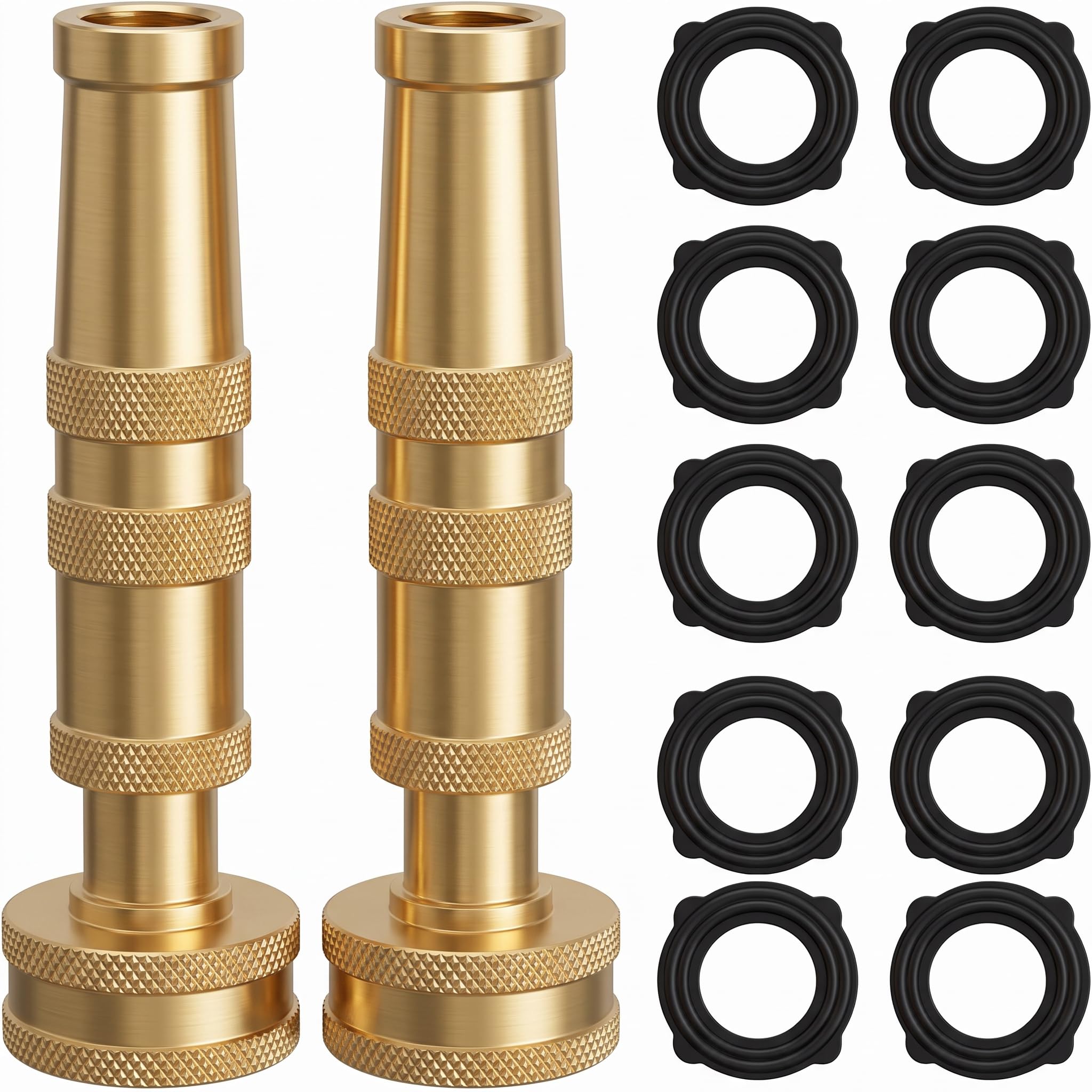
Open the box and you get two brass nozzles and ten rubber washers. The washers are the part that usually goes in the bin with the old nozzle, so bundling a decade of them is a practical touch: when the connection starts to weep, you swap a rubber disc instead of driving to the hardware store.

The nozzles themselves are the classic four-hole brass twist: a 3/4-inch intake, a barrel you rotate from mist to jet, and a shutoff that closes completely. They are small and slightly barrel-shaped, easy to spot in a bucket full of water, and the brass takes a knock without complaint. As a pair, this is the least expensive way here to put a good nozzle on two hoses.

The adjustment is the part to think about. The twist runs smoothly, but the useful range sits in a narrow band of the turn — a little past mist is already a jet, and the fine end is coarser than a dial head's. For beds, buckets and rinsing that is plenty. If you are starting seedlings under a gentle spray, a dial gives you more control, at the cost of more parts that can leak.

Bottom line: Two brass nozzles and a stack of spare washers make this the cheapest way to fit out two hoses, with a coarser adjustment than a dial head.

Check Latest Price
#05

Long, hands-free soaks

FANHAO Metal Hose Nozzle

89 /100
Kirk Score Excellent
Material
Zinc alloy and brass
Patterns
4
Trigger Lock
Lock bar
Rated Pressure
250 psi
Check Details on Amazon

Pros

  • Lock bar holds the trigger open hands-free
  • Four spray patterns on a rotating head
  • Metal body with spare O-rings included

Cons

  • Firm trigger pull; lock bar is fiddly

The lock bar under the handle is the reason this one is on the page. Squeeze the trigger, flip the bar, and the water keeps running without your hand doing anything — useful for a long soak, for filling a bucket, or for washing a car when your grip has already had enough.

Everything else is a step up in complexity from the brass twists. The body is zinc alloy with brass at the working end, the head rotates through four patterns, and the flow responds to how hard you squeeze. It threads onto a standard 3/4-inch hose without an adapter, and it ships with two spare O-rings and a one-year warranty.

The place to look first is the seal at the hose end. Dripping is the weakest part of this nozzle's record here, and the fix is usually the washer and the O-rings rather than the body — fit the spares it comes with, snug it down by hand, and do not force the thread.

What you are paying for is the lock and the pattern dial, and both work; this is a comfortable nozzle for a long session with a hose. But a brass twist with two O-rings and no lever is the safer bet for a decade of use, and it costs less — so we rank this one behind the twists for anyone buying once and keeping it.

Bottom line: Set the water running and walk away — the lock bar is the reason to pick this one, though the hose-end seal asks for a careful hand.

Check Latest Price
#06

One-hand shutoff

Bon-Aire Ultimate Aluminum

91 /100
Kirk Score Outstanding
Weight
10.1 oz
Shutoff
Two-way twist
Material
Aircraft-grade aluminum
Patterns
5
Check Details on Amazon

Pros

  • Shuts off by twisting either way
  • Aluminum body with five patterns
  • Just over ten ounces with a soft rubber grip

Cons

  • Inlet threads wear if cross-threaded

Twist this one shut in either direction and the water stops. That reads like a gimmick until you are holding a bucket in one hand and the hose in the other — with a one-way twist you have to find the right turn; here you just turn.

The body is aluminum with a stainless and fiberglass valve, the shape is the fire-hose style, and the five patterns come from the same continuous twist as the brass picks, with no clicks and no dial to line up. At just over ten ounces it feels substantial without being a chore to hold, and the soft rubber grip is there for wet hands.

The one thing it will not do is a true fog. The finest end of the adjustment is a light spray — fine for pots, hopeless for seed trays, and the reason to look elsewhere if you are raising seedlings. Everything else about that adjustment is smooth and continuous, from a dribble to a stream long enough to reach the back of a bed without stepping into it.

Bottom line: A fire-hose-style nozzle that closes either way and throws a long stream — the pick for anyone who has fought a one-way twist with full hands.

Check Latest Price
#07

Light, quick watering

Green Mount Metal Nozzle

89 /100
Kirk Score Excellent
Material
Zinc alloy
Connection
Standard GHT
Trigger Lock
Top-mounted bar
Check Details on Amazon

Pros

  • Light enough to hold up one-handed
  • Strong jet for its size
  • Trigger lock on top of the handle

Cons

  • Plastic clips inside the trigger housing

This is the lightest thing in the group at the end of a hose. The body is small, the grip sits comfortably in the hand, and it does not drag a hose down when you hold it up to a hanging basket — a small point that stops being small on the fourth basket.

For its size the jet has real force, and the trigger lock on top of the handle holds the water on for a soak. We liked it for short bursts of work — filling a can, knocking dust off a patio, rinsing a bucket — where a heavier brass body is more nozzle than the job needs. The rubber washers it ships with are the same ones every nozzle here uses, so spares are not a scavenger hunt.

One habit worth adopting: store it with the handle released rather than clamped onto the hose, so the trigger is not sitting under load between uses. That is the kind of small thing that keeps a light, inexpensive nozzle working longer than you might expect.

Bottom line: Light, inexpensive, and stronger on the jet than its size suggests; the plastic inside the trigger is the part to go in knowing about.

Check Latest Price

How We Picked and Tested Garden Hose Nozzles

We started with roughly 60 nozzles and cut the list by reading the one- and two-star reviews first: anything with plastic internal threads, a sealed body that can't be opened or cleaned, or a pattern of collar cracks got dropped before it was ordered. Sixteen made the cut, spanning brass twist styles, zinc and aluminum pistol grips, and adjustable multi-pattern heads. Several arrived as pairs, which let us split them between two spigots — one at the house and one at the end of a 75-foot run, where pressure is weakest — so the same model could be compared under two very different flows.

Testing ran from early spring into summer, and almost none of it looked like a lab bench. Nozzles watered raised beds and containers on a soft setting, filled five-gallon buckets and a kiddie pool, rinsed a car (fan for the soap, jet for the wheels), hosed down a patio and a set of gutter guards, and bathed a dog who had found the one mud puddle on the property. Between uses they stayed attached to the hose and out in the sun, the way most people actually store them.

Leaks were judged with a dry hand and a paper towel: we wrapped the collar and the spigot connection for a full watering session, then checked for dampness, and we noted whether the rubber washer stayed seated when the hose was dragged around a corner. For spray performance, we watched whether the head moved smoothly from shower to jet or jumped through dead spots, and whether a narrow stream held without spitting. To gauge how much each nozzle throttled the water, we timed how long it took to fill a five-gallon bucket compared with a bare hose. Durability testing was mostly clumsy: drops on concrete, drags across gravel, and a close look at the threads at the end of the season for cross-threading and corrosion.

How to Choose a Garden Hose Nozzle

Twist, Pistol, or Thumb Control

A twist barrel has no trigger, no spring, and no detents: you rotate the body to open, adjust, and close, and there is almost nothing inside to fail. A pistol grip is faster in the hand and lets you change force by squeezing, but the trigger linkage and the seals behind it are where these nozzles break. Thumb control adds the most parts of all.

If you stand and water beds, buy a twist. If you switch the water on and off constantly while you work — filling cans, rinsing tools — a pistol grip earns its extra risk, and a trigger lock is worth looking for.

A Drip Is Usually the Washer, Not the Nozzle

Most leaks at the hose end come from a flattened or missing rubber washer, not from the body. Fit a fresh one, thread the nozzle on by hand until it is snug, and stop — cranking down on a brass thread distorts the seal and makes the next leak worse.

The same logic applies inside. O-rings are a wear item, they cost very little, and on a twist barrel they are replaceable in minutes. A nozzle you can re-seal is worth more than one with a fancier spray head, and it is the single biggest reason three of our picks are brass.

Brass, Zinc Alloy, Aluminum, or Plastic

Brass holds a thread, resists rust, and takes a drop on concrete without cracking. Zinc alloy is strong but usually painted, and the coating is what wears first; aluminum is light and corrosion-resistant but its threads are softer. Plastic is the lightest and cheapest and the first thing to fail.

You do not need to spend a lot to get metal. What you are buying with brass is a body that will still be square to its threads in five years, which matters more than any pattern count on the box.

How Many Spray Patterns Do You Actually Need

Most watering happens on two settings: a soft cone for beds and pots, and a hard jet for the driveway. A dial with seven or nine patterns adds joints and seals for settings you will try once and then leave alone.

If you clean as much as you water, put the money into a genuinely tight jet rather than pattern count. If you raise seedlings, a real mist is the one setting worth paying for, and a dial head is the only way to get one — with more parts that can leak.

Frequently Asked Questions

Final Verdict

For most yards, the Twinkle Star pair is the answer: a brass twist nozzle that seals hard, sprays from mist to a jet, and has nothing inside it to break, with a second one for the back spigot. Buy metal and buy a nozzle you can re-seal, and you stop replacing it every spring.

Choose the MAXFLO if the nozzle is mostly a cleaning tool and you want the hardest jet here, or the Gilmour if you want a pistol grip with a threaded nose for brush and sweeper attachments. Both are decisions about the work, not about the settings list.