// data-verified

9 Best Oil-Based Deck Stains of 2026: Deep Penetration, True Color

Find the best oil-based deck stain for your wood: penetrating formulas that dry without tackiness, hold true color, and protect through seasons.

The promise of an oil-based deck stain is simple: deep penetration that feeds the wood and a rich, lasting hue. The reality can be a sticky surface that never quite cures, or a color that dulls months ahead of schedule—both often traced to a mismatch between the stain's chemistry and the wood it's applied to.

Many of these troubles start with confusion about what 'oil-based' actually means. Some products labeled 'oil-modified' behave more like water-based coatings, and ultra-dense tropical hardwoods like ipe demand a specialist formula where a common softwood stain would just sit on top.

This guide breaks down the key factors—wood density, climate, and application method—so you can pick an oil stain that truly penetrates, dries hard, and holds its tone. Whether you're refreshing a weathered cedar deck or protecting an exotic hardwood, there's a match for the job.

#01

Best Overall

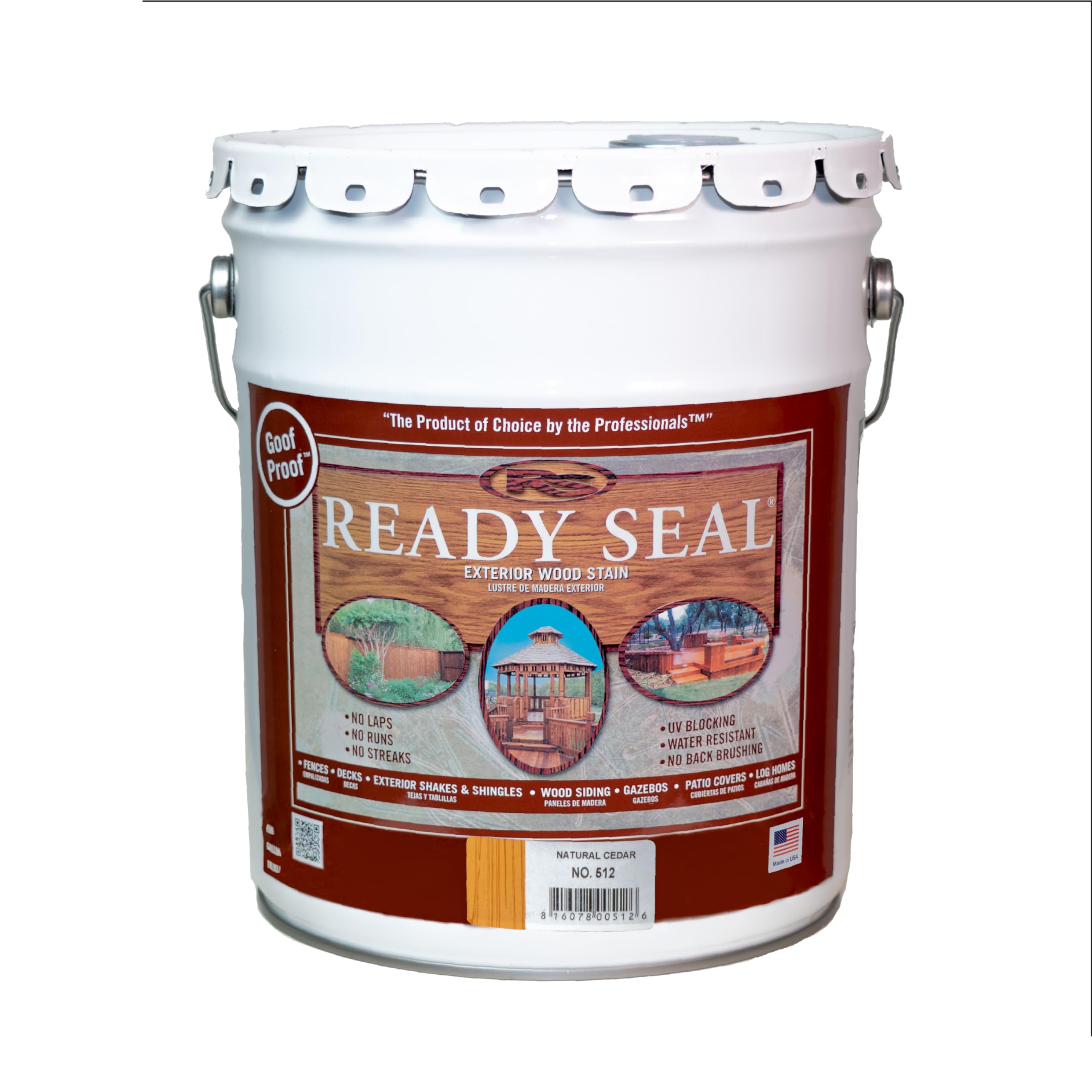
Ready Seal Exterior Wood Stain | Semi-Transparent Oil-Based Formula | Professional Grade Stain and Sealer in One | Ideal for Decks, Fences, Pergolas, Wood Siding & More | 5 Gallon | Natural Cedar

93 /100
Kirk Score Outstanding
Base Material
Oil-based semi-transparent
Wood Compatibility
Softwoods, pine, cedar, most hardwoods
Coverage Efficiency
~125 sq ft/gal
Ease of Application
Goof-proof, no back-brushing
Check Details on Amazon

Pros

  • Extremely easy application with any tool; no lap marks or streaks regardless of technique — 914 mentions, 98.6% positive — users highlight spray, roll, or brush simplicity
  • High-quality, factory-fresh look on weathered decks and fences — 824 mentions, 96.6% positive — consistently described as an amazing product
  • Deep, even cedar tone that enriches wood grain without hiding it — 659 mentions, 95.4% positive — decks, fences, and siding all praised
  • Absorbs readily into dry, aged boards, delivering effective water repellency — 335 mentions, 83.1% positive — soaks in well and waterproofs effectively

Cons

  • Color may fade in direct sun sooner than expected; a recoat every 2–3 years can be needed to keep the original shade — 169 mentions negative — 'fades after a few weeks' and 'color doesn't hold' appear; durability is mixed

Spray, roll, or brush without back-brushing—Ready Seal drops the usual stress of oil-based staining. The formula tolerates being applied in direct sun and can go down within minutes of rain, so you are not hostage to a perfect weather window. It self-levels and dries to an even sheen, eliminating lap marks and blotchiness that plague many stains. Even first-timers report uniform results without the need for meticulous overlapping technique.

Coverage is generous; the 5-gallon pail treats up to 625 sq ft, soaking into thirsty, aged wood with minimal runoff. The semi-transparent finish brings out the grain while delivering a warm Natural Cedar tone that evens out weathered boards and hides minor imperfections. When dry, the surface repels water effectively, and the oil base continues to condition the wood rather than forming a brittle film that can peel. It works well on cedar, pine, and pressure-treated lumber, and the natural colour suits a wide range of siding and trim.

The stain goes on equally well with a pump sprayer, roller, or brush—no back-brushing required, which saves time on sprawling surfaces. The 5-gallon pail offers strong per-square-foot value compared to buying smaller containers, and the product can be applied to slightly damp wood after a rain shower, keeping projects on schedule. Leftover material stores well if the pail is kept sealed and away from extreme temperatures, so future touch-ups are practical.

This stain is intended for DIYers tackling large decks, fences, or pergolas who want a fast, forgiving application without specialized tools. The trade-off is colour durability: in full-sun exposures, the tint can lighten noticeably within weeks or months, and you should plan on a recoat every 2–3 years to keep the fresh look. If your deck sees relentless southern exposure and you demand years of unchanged colour, a premium UV-resistant formula might serve you better. Owners of ultra-dense exotic hardwoods will get better penetration from a dedicated oil formulated for ipe or mahogany.

Bottom line: For large DIY projects where ease of application and weather tolerance outweigh premium colour longevity, the 5-gallon pail of Ready Seal delivers a low-stress, high-coverage result that turns weathered wood into a richly toned outdoor surface.

Check Latest Price
#02

Best for Rich, Deep Color on Hardwoods

Cabot Australian Timber Oil

92 /100
Kirk Score Outstanding
Base Material
3-way linseed/tung/alkyd oil
Wood Compatibility
Cedar, mahogany, dense hardwoods
Coverage Efficiency
Varies; deep penetration
Ease of Application
Brush/spray; fast dry
Check Details on Amazon

Pros

  • Deeply penetrates dense, resin-rich woods like mahogany and cedar for lasting protection — 166 mentions, 96.5% positive — described as better than varnishes
  • Straightforward application by brush or spray with fast dry times — 103 mentions, 83.1% positive — simple brush or spray application
  • Delivers a rich, low-luster finish that makes wood look like high-end furniture — 105 mentions, 97.2% positive — boards 'shine like new'
  • Excellent water repellency; beads up rain and protects through seasons — 63 mentions, 92.6% positive — keeps decks water-proof through seasons

Cons

  • Cans may arrive dented or leaking during shipping
  • On old, particularly dry wood, coverage can be unpredictable
  • High-exposure decks may require yearly reapplication — 107 mentions, 31.8% negative — mixed feedback on longevity

Cabot's 3-way linseed, tung, and alkyd oil blend penetrates dense hardwoods more thoroughly than the top pick's forgiving formula, producing a color depth that elevates cedar, mahogany, or furniture-grade pieces to a warm, furniture-level luster. Where the top pick prioritizes no-drama application across any wood, this oil rewards careful prep and wipe-off with richer, more nuanced tone that enhances grain rather than masking it.

Application is straightforward by brush or spray, with fast dry times that keep projects moving. The oil wicks into dense, resin-rich woods like ipe or mahogany, delivering strong water repellency — water beads up on finished surfaces through rain and snow. A single quart goes far on smooth dense stock, though thirsty old wood can soak up more than expected.

Woodworkers and homeowners prioritizing appearance over sheer coverage economy will find this a compelling choice for deck furniture, railings, architectural accents, and small to medium dense-hardwood decks. The tradeoff: longevity varies. In harsh direct sun or extreme weather, you may be recoating every year. This isn't a set-it-and-forget-it solution for a massive pine deck; it's a high-impact finish for projects where beauty leads.

💡 💡 Tip: Wipe off excess oil after 30-60 minutes to prevent a tacky or uneven finish, especially on dense hardwoods.

Bottom line: For hand-selected hardwoods, furniture, and accent pieces, Cabot's rich, penetrating formula delivers a finish that makes the extra effort worthwhile — just factor in potential annual upkeep.

Check Latest Price
#03

Best Performance for Softwoods

TWP 101 Cedartone

88 /100
Kirk Score Excellent
Base Material
Oil-based semi-solid
Wood Compatibility
Cedar, softwoods
Coverage Efficiency
Up to 300 sq ft/gal
Ease of Application
Two wet coats; brush/roll
Check Details on Amazon

Pros

  • Two wet coats penetrate deep into cedar and softwoods, providing lasting water repellency. — 9 mentions, 90% positive on coverage
  • Traditional high-VOC chemistry outperforms many low-VOC alternatives in protective durability. — 8 mentions, 88.9% positive on quality
  • Semi-solid Cedartone tint unifies weathered grain while preserving natural wood texture.

Cons

  • Color can vary between containers — a batch may appear darker or thinner than expected. — 2 mentions negative on color
  • Cannot be shipped to states with strict VOC regulations (California, Colorado, etc.); verify local eligibility before ordering.

Unlike the clear natural oil in this set that leaves the wood's raw appearance untouched, TWP 101 Cedartone uses a semi-solid pigment to unify weathered cedar grain while still letting the wood texture show through. The high-VOC formula penetrates aggressively, bonding into softwood fibers rather than forming a limp surface film.

Two wet coats applied one after the other soak deeply into the wood, creating a water-repellent barrier that lasts. One gallon covers up to 300 square feet, putting it at a cost-effective mid-range for medium decks. The traditional chemistry resists washout longer than many low-VOC alternatives, a difference that shows up after a season or two of rain.

This stain is built for cedar and softwood deck owners in states that still permit high-VOC products. It cannot be shipped to California, Colorado, Connecticut, and similar regulated markets — a hard boundary. The deeper protection comes with a minor caveat: color can vary between containers, so blending multiple cans before starting is a practical step. Performance-focused DIYers who value deep, long-lasting protection over wide availability will find the logistics worthwhile.

💡 💡 Tip: Blend multiple containers in a large bucket before application to even out any color variation.

Bottom line: TWP 101 Cedartone remains a compelling option for cedar deck owners outside strict-VOC states, delivering noticeably deeper protection and richer color than many lower-VOC contenders. Its limited shipping footprint is the price of that performance.

Check Latest Price
#04

Best for Exotic Hardwood Decks

Runner-Up

92 /100
Kirk Score Outstanding
Base Material
Oil-based semi-transparent
Wood Compatibility
Ipe, tigerwood, cumaru
Coverage Efficiency
Up to 250 sq ft/gal
Ease of Application
Roll/brush; forgiving
Check Details on Amazon

Pros

  • Restores faded ipe to a rich, uniform tone with natural sheen. — 63 mentions, 96.9% positive — 'deck looks fantastic' and 'beautiful sheen'
  • Penetrates dense exotic hardwoods without beading, unlike many oil-based stains. — 47 mentions, 94% positive — soaks into ipe where competing products bead up
  • Applies evenly with roller or brush, forgiving for DIYers. — 38 mentions, 97.4% positive — good coverage, no back-brushing needed
  • Dries to a non-tacky surface within 48 hours, even in high-UV exposure. — 26 mentions, 74.3% positive — dries to a non-tacky surface

Cons

  • Applied color may read darker than expected on some wood, shifting the deck's look. — 14 mentions, 50% negative on color
  • Yearly reapplication is common for the deepest hue, especially on fully exposed decks. — 14 mentions — durability varies
  • The oil-based formula gives off a strong, lingering solvent-like smell for the first few days.

Unlike thick film-building stains that can trap moisture in dense hardwoods, DeckWise Ipe Oil absorbs into the grain without forming a surface skin. Its low-viscosity blend penetrates ipe, tigerwood, and cumaru where many oils bead up on the surface — a common frustration with species that barely accept finish.

Application is forgiving: a roller or brush lays down an even coat with minimal lap marks, and the oil levels out while still wet. It dries to a non-tacky surface within two days and reveals a semi-transparent finish that enhances the wood's natural grain. On decks that bake under full sun, it holds a subtle sheen for a season before beginning to weather softly rather than crack.

This oil suits owners of ipe, tigerwood, and cumaru decks who prioritize deep penetration and a natural look. The tint can appear darker than anticipated on some boards, and many users choose to recoat annually to keep the rich appearance at its peak. The solvent odor fades after a few days of ventilation, so plan accordingly. If your deck is pine or cedar, look to a film-building or softwood-specific stain instead — this formula's thin consistency won't offer the same protection.

💡 💡 Tip: Keep windows open and allow 72 hours of dry weather after application to clear the odor and ensure a full cure.

Bottom line: For exotic hardwood decks that reject film-forming stains, DeckWise Ipe Oil delivers the deep penetration and natural luster you're after — just plan on a yearly ritual to keep it looking its best.

Check Latest Price
#05

Best Clear Natural Finish

Penofin Red Label Clear

88 /100
Kirk Score Excellent
Base Material
Oil-based clear penetrating
Wood Compatibility
Cedar, redwood, mahogany
Coverage Efficiency
Up to 250 sq ft/gal
Ease of Application
Brush/roll; dries ~2hr
Check Details on Amazon

Pros

  • Superior absorption that revives even dry, dense cedar, drawing oil deep into the grain. — 21 mentions, 95.5% positive on quality; 11 mentions positive on absorption
  • Brings out the richest natural wood color without adding tint; wood looks bright and renewed. — 12 mentions, 92.3% positive on appearance; 7 mentions positive on color
  • Easy to apply and dries tack-free in about two hours under good conditions. — 7 mentions, 77.8% positive on application; 5 mentions positive on durability/drying

Cons

  • Over-application or high humidity can leave a gummy, never-cured surface; meticulous wipe-off is required. — 1 mention negative on durability; 3 mentions negative on color

Penofin Red Label Clear is a no-tint penetrating oil designed to bring out the natural color and grain of cedar and other softwoods, leaving zero pigment behind. Unlike the tinted formula meant for ipe and exotic hardwoods in this comparison, this gallon is specifically formulated for softwoods, preserving the wood’s original hues while adding a warm, wet-looking richness that dries to a natural luster.

Application is straightforward with a brush or roller, and when applied in thin coats followed by a diligent wipe-off after about 30 minutes, the oil penetrates deeply and dries to a clear, non-film finish that won’t peel. Coverage is up to 250 sq ft per gallon, making it suitable for large fences and decking. Under sunny, dry conditions, it becomes tack-free in roughly two hours.

This is the right choice for homeowners who want a clear, oil-based finish that highlights the natural variation in cedar boards — not a tinted stain — and are prepared to follow precise application steps, especially in damp climates. It’s less suited for high-humidity areas without controlled application conditions or for anyone looking to unify mismatched wood tones with color.

Bottom line: For cedar deck owners who want a clear oil that lets the wood’s natural character shine through, the higher price is justified by the deep penetration and bright, renewed appearance — as long as you’re meticulous with thin coats and wipe-off in damp conditions.

Check Latest Price
#06

Best for Large-Scale Projects

Outlast Q8 Log Oil

91 /100
Kirk Score Outstanding
Base Material
Oil-based copper-infused
Wood Compatibility
Redwood, cedar, treated lumber
Coverage Efficiency
Ease of Application
Spray-ready, self-leveling
Check Details on Amazon

Pros

  • Gorgeous, even finish that revives redwood and cedar with a professional sheen. — 54 mentions, 100% positive on appearance
  • Easy pump-sprayer application with no lap marks and only one coat needed. — 35 mentions, 92.1% positive on easy apply
  • Excellent water beading and sealing that can stretch reapplications to 3 years. — 29 mentions, 100% positive on water absorption; 20 mentions positive on longevity
  • Low odor for an oil-based stain and a warm dark-brown color. — 6 mentions, 85.7% positive on odor; 14 mentions positive on color

Cons

  • The 5-gallon pail may arrive with packaging leaks from transit. — 2 mentions negative on leakage

Outlast Q8 brings copper-infused preservative chemistry and self-leveling spray application to log homes and expansive decks — a different approach from the top pick’s broad-compatibility ease. The oil-based formula penetrates deep into wood fibers, creating a waterproof barrier that beads water aggressively for up to three years. The copper infusion extends the protection of pressure-treated lumber, helping maintain warranty compliance on large-scale builds.

Application is as simple as a pump sprayer pass: the stain levels itself without back-brushing, leaving no lap marks. The result is a dark-brown, professional sheen that makes redwood and cedar look freshly restored. Low odor sets it apart from many oil-based competitors, and the rich hue holds up season after season.

This 5-gallon pail is built for owners of large decks, log homes, timber frames, or commercial wooden structures who want a one-product preservative, colorant, and sealer. The upfront cost is substantial, and the 5-gallon size is wasteful for small decks or occasional use. For those projects, the top pick offers a more practical alternative. But for spans measured in hundreds of square feet, the per-gallon price is competitive, and the longevity reduces the frequency of reapplication.

Bottom line: A justifiable investment for log home owners and large-deck builders seeking a copper-infused preservative that stretches time between coats — provided the 5-gallon pail matches the project’s scale.

Check Latest Price
#07

Teak & Fine Wood

Star brite Teak Oil

95 /100
Kirk Score Outstanding
Base Material
Tung oil blend with UV polymers
Wood Compatibility
Teak, acacia, eucalyptus
Coverage Efficiency
Ease of Application
Cloth/brush; excess must be wiped
Check Details on Amazon

Pros

  • Restores greyed, weathered teak to a warm golden tone that highlights wood grain. — Outdoor furniture shows renewed color and depth after treatment.
  • High-grade tung oil formula penetrates deeply and outlasts generic teak oils. — Described as a pure blend that maintains its finish longer.
  • Yields a non-film, peel-free surface that lets the wood's character show. — Results in a deep honey luster without a plastic-like coating.

Cons

Star brite Premium Golden Teak Oil revives dense hardwoods—teak, acacia, eucalyptus—soaking in to restore a warm honey tone while blocking UV damage. It is a marine-grade formula designed for boat trim and outdoor furniture, not broad deck staining on softwood. The pure tung oil blend demands a careful wipe-off after application; skipping this step can leave a tacky residue that needs extra drying time. Followed correctly, it penetrates deeply, outlasts generic oils, and produces a peel-free, natural luster. For those with teak decks or fine hardwood pieces, the results justify the extra care. If you're staining a large pine or cedar deck, a more universally formulated oil stain will be more cost-effective and forgiving.

💡 💡 Tip: Apply with a cloth or brush, then thoroughly wipe off all excess within 15–30 minutes. Full cure can take 24–48 hours—plan around use of the surface.

Bottom line: If your project involves a teak deck, boat trim, or fine hardwood furniture, this oil delivers professional restoration; for standard pine or cedar decks, choose a more universally formulated oil stain.

Check Latest Price
#08

Budget 5-Gal

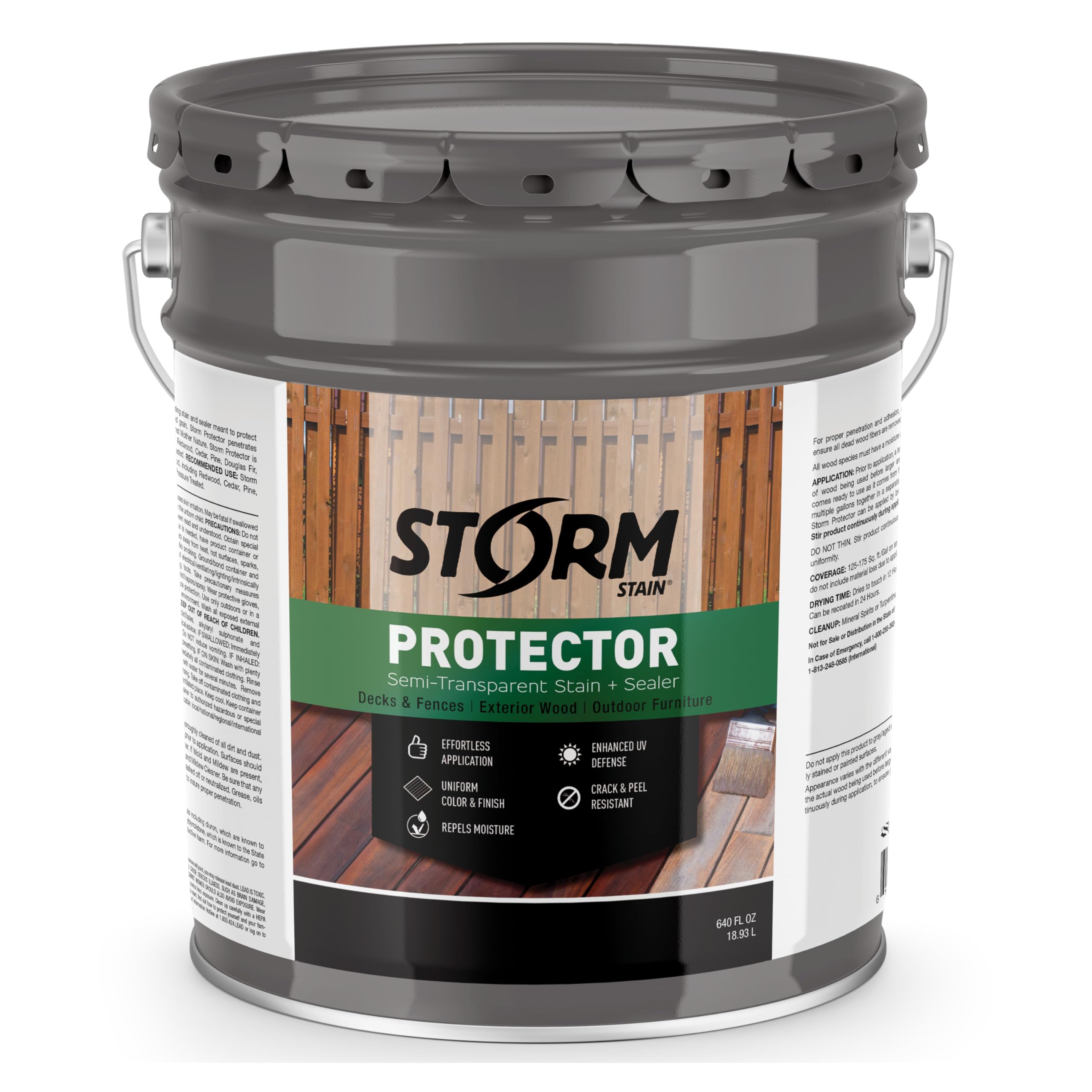
Storm Stain Protector - Golden Oak

88 /100
Kirk Score Excellent
Base Material
Oil-based semi-transparent
Wood Compatibility
All wood types
Coverage Efficiency
High per pail
Ease of Application
Spray/roll; thin coats needed
Check Details on Amazon

Pros

  • Rich Golden Oak tone that highlights wood grain on new or weathered boards. — 82 mentions, 85.4% positive
  • Excellent coverage from the 5-gallon pail, stretching further than many competitors. — 30 mentions, 88.2% positive
  • Smooth application with a sprayer and even flow when applied correctly. — 51 mentions, 89.5% positive

Cons

The Storm Stain Protector covers large areas efficiently with a warm, wood-enhancing tone that brings weathered boards back to life. Spray application goes on smoothly and sets within hours when conditions align. The tradeoff is that the oil-based formula can stay tacky for days or even fail to fully cure if coats aren't paper-thin and humidity is present. That makes this stain a poor match for first-time users or those in humid climates, but a viable bulk option for experienced stainers who can time applications around dry, moderate weather.

💡 💡 Tip: Apply paper-thin coats with a sprayer and avoid staining during humid or cool spells to prevent extended drying times.

Bottom line: For large decks where budget is tight and you're confident you can apply feather-light coats in ideal weather, this stain delivers a warm, rich finish at a hard-to-beat price — but skip it if you're in a humid region or new to oil-based stains.

Check Latest Price
#09

Water-Based Option

DEFY Extreme Wood Stain

88 /100
Kirk Score Excellent
Base Material
Water-based acrylic
Wood Compatibility
All wood types
Coverage Efficiency
100-150 sq ft/gal
Ease of Application
Sprayer/brush; easy
Check Details on Amazon

Pros

  • Applies effortlessly with sprayer or brush, leaving an even, natural-looking finish — 215 mentions, 84.3% positive
  • Revitalizes weathered wood to a fresh appearance without hiding the grain — 143 mentions, 89.9% positive on appearance
  • Sheds water immediately after drying, even in rainy conditions — 62 mentions, 72.1% positive

Cons

  • Annual reapplication may be needed to keep the deck looking fresh

Spraying or brushing on, this low-VOC stain levels out evenly and revives greyed wood with a natural semi-transparent glow. Rainwater beads immediately after curing, and the zinc-infused formula blocks UV fading without heavy fumes. It's a water-based film former, however, which sits on the surface rather than soaking deep into grain like an oil. In some cases, the coating can peel within months, and an annual recoat may be needed to keep protection intact. For decks where deep oil penetration is non-negotiable, this isn't the right fit, but it's a strong alternative if eco-friendliness and low-odor application matter more.

Bottom line: An eco-friendlier pick for homeowners open to a water-based alternative that simplifies application and cleanup, as long as they're prepared for potential recoating every year.

Check Latest Price

How to Choose

Base Material: Oil, Water, or Hybrid?

True oil-based stains penetrate wood fibers, feeding them from the inside, but they require wiping off excess to avoid gumminess. Water-based versions sit on the surface, dry faster, and clean up with soap, but offer less long-term conditioning.

Many 'oil-modified' products are water-borne with a small oil dose; they don't behave like traditional penetrating oils. For deep protection on weathered wood, choose a 100% oil or high-oil-content formula.

Wood Compatibility: Softwoods vs. Hardwoods

Cedar and pine absorb oil readily, so standard oil stains work well. Dense exotics like ipe have tight grain that resists penetration; they need lighter, specialized oils that can seep in without sitting on top.

Using a softwood stain on ipe leads to poor adhesion and premature wear, while an exotic-wood formula on a thirsty pine deck can over-absorb and become sticky. Match the product’s recommendation to your lumber.

Application Ease: Goof-Proof or Requires Technique?

Goof-proof formulas can be sprayed or rolled without back-brushing, eliminating lap marks and cutting labor dramatically. These are ideal for first-timers or large, timed projects.

Traditional oils demand methodical wiping after a short dwell time; skip this step, and you’ll get a tacky, uneven coating. If you’re working in humid conditions, stick to formulas known for forgiving application.

Color & Fade Resistance

Pigmented oil stains block UV rays better than clear oils, extending the time between recoats. However, even semi-transparent stains will lighten under intense sun, especially on southern exposures.

Expect to recoat every 2–4 years. If color consistency is critical, test a small patch first, as the final shade depends on wood age and species. Clear oils enhance natural tone but offer the least fade protection.

Coverage Efficiency

Rough-sawn or weathered boards drink more stain, sometimes halving the coverage rate. Check the product’s stated square footage per gallon on similar wood, then add 10–15% buffer.

Larger projects can save by buying 5-gallon pails, but only if the stain has a long-enough shelf life to use it within a season. Leftover oil-based stain can gel if not sealed tightly.

Frequently Asked Questions