// data-verified

12 Best Flux Core Welding Wire of 2026: Ships Intact, Welds Clean

Which flux-core wires actually survive shipping and produce low-spatter welds on 110V welders, for hobbyists and home repair projects.

Nothing sours a weekend project like opening a new spool of flux-core wire only to find it cracked and tangled. The reality is that most of the wire on store shelves comes from the same few overseas suppliers, rebranded for different labels. What separates good wire from frustrating wire is quality control, vacuum sealing, and a durable spool that survives the trip to your door.

Flux-core performance also hinges on machine setup — an electrode-positive polarity or a feed speed slightly off can make even premium wire spatter and bird-nest. The picks in this guide are chosen for how they perform in the real world: with 110V welders in garages, on dirty steel, and through shipping that tests every plastic spool. None are magic, but they consistently deliver clean welds and easy slag removal when your settings are right.

Match the right wire diameter and classification to your projects, and you'll spend less time grinding spatter and more time laying clean beads.

#01

Best Overall

YESWELDER .030 2lb

95 /100
Kirk Score Outstanding
Spool Weight
2 lb
Wire Diameter
0.030 in
Classification
E71T-GS
Check Details on Amazon

Pros

  • Runs exceptionally clean with low spatter and slag that nearly falls off on its own. — 162 mentions, 72% positive on spatter; 38 mentions, 95% positive on cleanup
  • Produces strong, good-looking welds even on modest 110V flux-core machines. — 175 mentions, 93% positive
  • Delivers name-brand bead quality at a budget-friendly price, a clear value win. — 232 mentions, 97% positive

Cons

  • Plastic spool may crack during transit, causing wire to unwind before first use. — 72 mentions, 57% negative — some users report broken spools upon delivery

This .030 flux-core wire runs with minimal spatter and slag that lifts off in long strips, producing clean beads on 110-volt welders that are often prone to messy results. The wire feeds smoothly from the 2-pound ABS spool and delivers bead quality that holds its own against more expensive options, without paying a premium. The self-shielded chemistry creates less smoke and faster cleanup, so you spend less time chipping and more time welding. On entry-level machines that can be finicky, this wire stays cooler and more forgiving, helping beginners get consistent, presentable welds sooner.

This wire is a strong match for DIY hobbyists, garage repair work, and anyone learning flux-core MIG on a budget-priced 110V welder. The E71T-GS classification is intended for single-pass welds, which covers typical thin-metal projects, auto body patches, and light fabrication. The one handling caveat: the plastic spool can arrive with a hairline crack from rough shipping, which may allow wire to loosen and feed erratically. A quick visual inspection right out of the box catches this before it causes trouble, and the spool itself holds up fine under normal shop use.

💡 💡 Tip: Inspect the spool for cracks right after unboxing; a simple check prevents feed headaches.

Bottom line: For budget-minded hobby welders, this YESWELDER wire turns a 110V machine into a far more enjoyable tool — just glance at the spool for cracks before loading, and you’re set for clean, frustration-free beads.

Check Latest Price
#02

Best American Brand

Forney .030 2lb

93 /100
Kirk Score Outstanding
Spool Weight
2 lb
Wire Diameter
0.030 in
Classification
E71T-GS
Check Details on Amazon

Pros

  • Produces smoother welds with less spatter on entry-level machines. — 115 mentions, 86% positive
  • Runs smoothly on Harbor Freight and budget 110V welders. — 105 mentions, 90% positive
  • Less spatter than many competing flux-core wires. — 47 mentions, 77% positive

Cons

  • Spool can crack in transit, potentially causing wire tangles. — 23 mentions, 91% negative

The Forney wire brings a noticeable improvement in arc stability and weld bead appearance over the spools that come packed with many budget welders. It runs well on 110V machines from Harbor Freight and similar imports, producing less spatter than many flux-core options.

For welders loyal to an American brand or those who've been struggling with stock wire, this offers a solid step up. The main caveat is the plastic spool, which can arrive cracked — an annoyance, but the wire itself performs well once the spool is intact.

💡 💡 Tip: Inspect the spool upon arrival; if the plastic flange is cracked, contact the seller for a replacement before unspooling wire.

Bottom line: For welders upgrading from stock wire who prioritize consistent arc quality and low spatter on budget machines, Forney delivers — assuming the spool arrives intact.

Check Latest Price
#03

Best Italian Quality

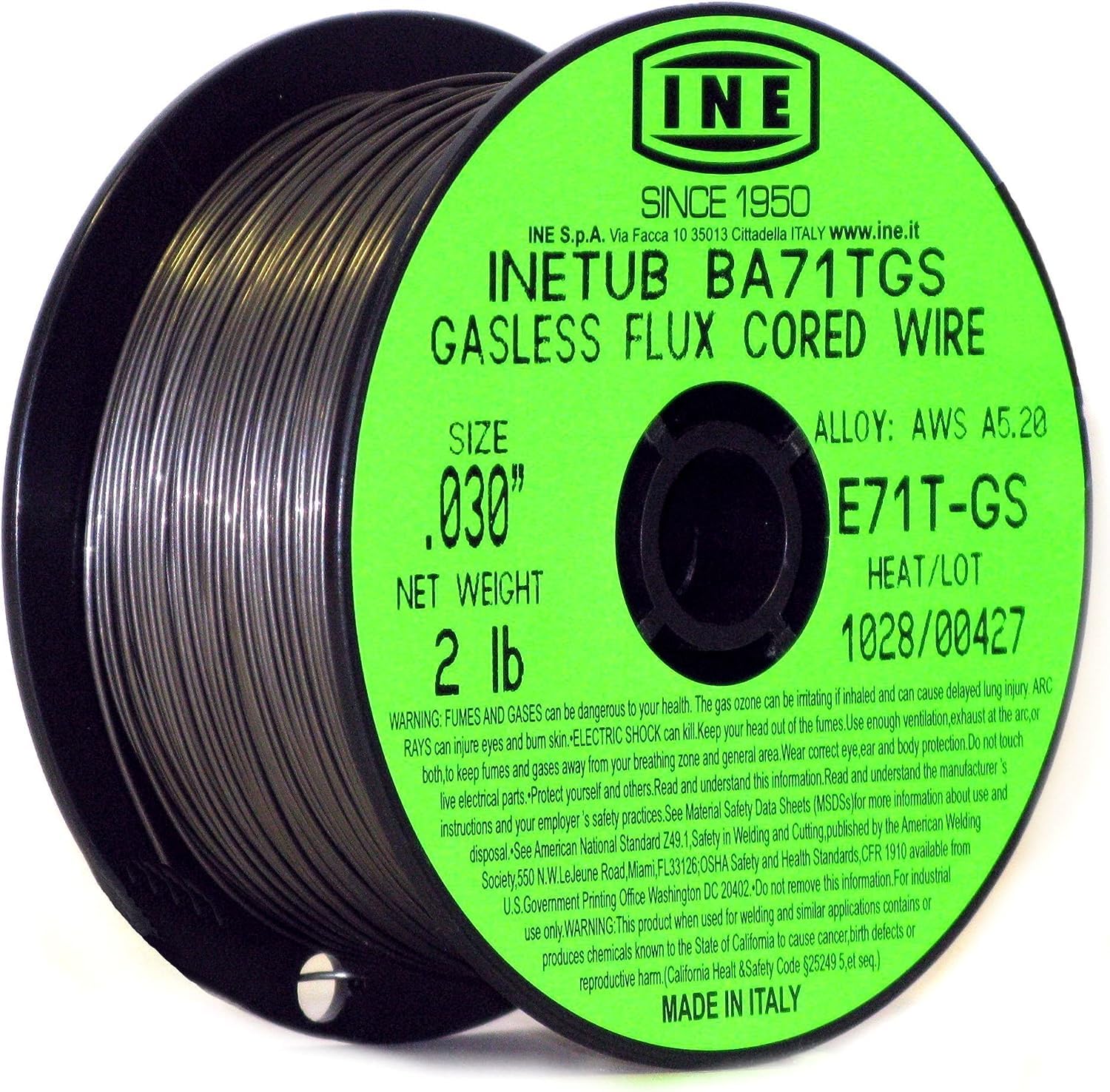
INE INETUB .030 2lb – Runner-Up

95 /100
Kirk Score Outstanding
Spool Weight
2 lb
Wire Diameter
0.030 in
Classification
E71T-GS
Check Details on Amazon

Pros

  • Exceptionally clean, low-spatter welds with slag that lifts off easily. — 267 mentions, 93% positive on quality; 102 mentions on splatter/penetration, 71% positive
  • Performs as well as or better than Lincoln and Hobart flux-core wire. — 206 mentions, 96% positive on functionality
  • Good value for Italian-made wire at a mid-range price. — 143 mentions, 97% positive

Cons

  • Costs more than most .030 flux-core spools of similar weight.
  • Plastic spool can arrive cracked, which may cause wire binding if not caught early.

This Italian-made flux-core wire produces exceptionally clean, low-spatter welds with slag that nearly falls off. It matches or surpasses the performance of Lincoln and Hobart equivalents, delivering consistent arc quality that narrows the gap between gasless and gas-shielded MIG.

Welders doing auto body, restoration, or visible repairs will value the bead appearance and reduced cleanup. The trade-off is a higher price than most 2lb spools, and the plastic spool can crack in shipping — a quick inspection before loading avoids snags.

💡 💡 Tip: Inspect spool edges for transit damage before loading — a damaged flange can snag wire.

Bottom line: For visible welds where bead appearance and minimal cleanup matter, this INE wire delivers results that rival gas-shielded MIG — at a premium over budget spools.

Check Latest Price
#04

Best Bulk Value for .035 Users

SONNLER .035 3-Pack

94 /100
Kirk Score Outstanding
Spool Weight
2-lb x3, 6 lb total
Wire Diameter
0.035 in
Classification
E71T-GS
Check Details on Amazon

Pros

  • Outstanding bulk value from three 2-lb spools — 92 mentions, 93% positive
  • Works great in 120V gasless welders — 66 mentions, 98% positive
  • Low-spatter welds with easy slag removal — 34 mentions, 71% positive

Cons

  • Occasional loose winding on the spool can cause feeding pauses — 11 mentions, 55% negative

Where premium Italian wires chase bead cosmetics, this three-spool pack delivers raw bulk value — six pounds of .035 E71T-GS wire, each 2-lb spool vacuum-sealed to stay rust-free on the shelf. It’s built for hobbyists and DIYers who burn through .035 wire quickly on 120V gasless welders and want an economical reserve. The wire can occasionally unwind loosely from the spool, which may cause minor feeding pauses — a small tradeoff for the price and storage convenience.

💡 💡 Tip: When loading, check the spool tension and re-tighten if needed — a quick pre-feed adjustment avoids most feeding disruptions.

Bottom line: If you go through .035 flux-core wire regularly and want to stock up at a low cost without spools rusting open, this six-pound pack is the practical choice.

Check Latest Price
#05

Best for Multi-Pass Welds

Blue Demon E71T-11 .030 2LB Spool

90 /100
Kirk Score Outstanding
Spool Weight
2 lb
Wire Diameter
0.030 in
Classification
E71T-11 (multi-pass)
Check Details on Amazon

Pros

  • Handles multiple passes without losing strength — prequalified for structural work. — 52 mentions, 85% positive
  • Feeds smoothly through popular 110V welders like the Titanium 125. — 31 mentions, 81% positive
  • Multi-pass certification at a mid-range price point. — 21 mentions, 90% positive

Cons

  • Spool may crack during shipping, risking wire tangles. — 15 mentions, 87% negative

This E71T-11 wire earns its place with a multi-pass rating often absent from budget flux-core spools, making it a go-to for trailer repairs, gate building, and farm fabrication where weld strength matters. Unlike heavier-gauge wires that skip certification to cut costs, Blue Demon prints the classification directly on the spool — peace of mind for anyone whose work must pass inspection. The catch: the plastic spool can crack during transit, causing wire tangling. That makes this wire less than ideal for casual single-pass bead practice or for users who can't risk a damaged spool on delivery day; in those cases, a sturdier-packed competitor might be a safer bet.

💡 💡 Tip: Unpack the spool carefully; if the flange is cracked, transferring the wire to a known-good empty spool can prevent tangling and wasted material.

Bottom line: For structural jobs that demand multi-pass certification, this Blue Demon wire delivers — just have a contingency for a cracked spool if shipping takes a toll.

Check Latest Price
#06

Best 2-Pack Value

WelderElite .030 2-Pack

90 /100
Kirk Score Outstanding
Spool Weight
2-lb x2, 4 lb total
Wire Diameter
0.030 in
Classification
E71T-GS
Check Details on Amazon

Pros

  • Works great with very low splatter — 28 mentions, 100% positive on functionality
  • Excellent value for a two-spool pack — 15 mentions, 100% positive
  • Good quality wire that feeds smoothly — 14 mentions, 93% positive on wire quality

Cons

WelderElite's two-spool offering delivers smooth wire feeding and low spatter that budget-conscious hobbyists will appreciate. Unlike .035 bulk packs aimed at fabricators, this .030 wire works well with the majority of 110V MIG welders for light steel projects. Both 2-pound spools are sealed, and the gasless E71T-GS formulation eliminates the need for shielding gas.

Frequent hobby welders get the convenience of a spare spool and consistent arc performance that avoids the popping of cheap wire. If your work demands .035 diameter or the glass-smooth bead of Italian-made wire, this isn't the right pick.

Bottom line: Two spools at a budget price that keep you welding without a second thought — an easy stock-up for .030 users.

Check Latest Price
#07

Budget Hobbyists

ARCCAPTAIN .030 2lb

92 /100
Kirk Score Outstanding
Spool Weight
2 lb
Wire Diameter
0.030 in
Classification
E71T-GS
Check Details on Amazon

Pros

  • Produces smooth, low-spatter welds with minimal post-weld cleanup. — 62 mentions, 97% positive on performance; 32 mentions on spatter reduction, 81% positive
  • Easy to use with reliable flux flow and slag release. — 20 mentions, 95% positive on flux flow

Cons

  • On some machines, wire feed may be inconsistent and occasionally bird-nest. — 11 mentions, 36% negative — some feeding issues reported

At a low price, the ARCCAPTAIN .030 wire produces clean, low-spatter welds with easy slag removal and smooth flux flow. Feed inconsistency can surface on fussier machines, making it less suited for welders that demand perfectly consistent wire cast. For budget-conscious hobbyists with forgiving setups, that tradeoff is easy to accept.

Bottom line: For budget-minded hobbyists with welders that aren't picky about wire feed consistency, this spool offers clean, low-spatter welds at an entry-level price.

Check Latest Price
#08

Occasional Use

Lincoln .030 1lb

93 /100
Kirk Score Outstanding
Spool Weight
1 lb
Wire Diameter
0.030 in
Classification
NR-211 (E71T-11 equiv.)
Check Details on Amazon

Pros

  • Runs smoothly even with imperfect technique or machine setup, producing clean beads.
  • Low-spatter performance reduces post-weld cleanup compared to generic flux-core wire.

Cons

  • The small spool size drives up the per-pound cost and runs out quickly beyond occasional repairs.

Lincoln's NR-211 formula tolerates uneven gun angle and speed, running with less spatter than budget alternatives. The forgiving nature comes in a 1-pound spool that costs more per pound and depletes fast — practical only for infrequent touch-ups, not sustained work.

Bottom line: A fit only if you need a small amount of Lincoln wire for a single project or occasional garage fixes; for any regular welding, a larger spool delivers the same quality at much better value.

Check Latest Price
#09

Light Fabrication

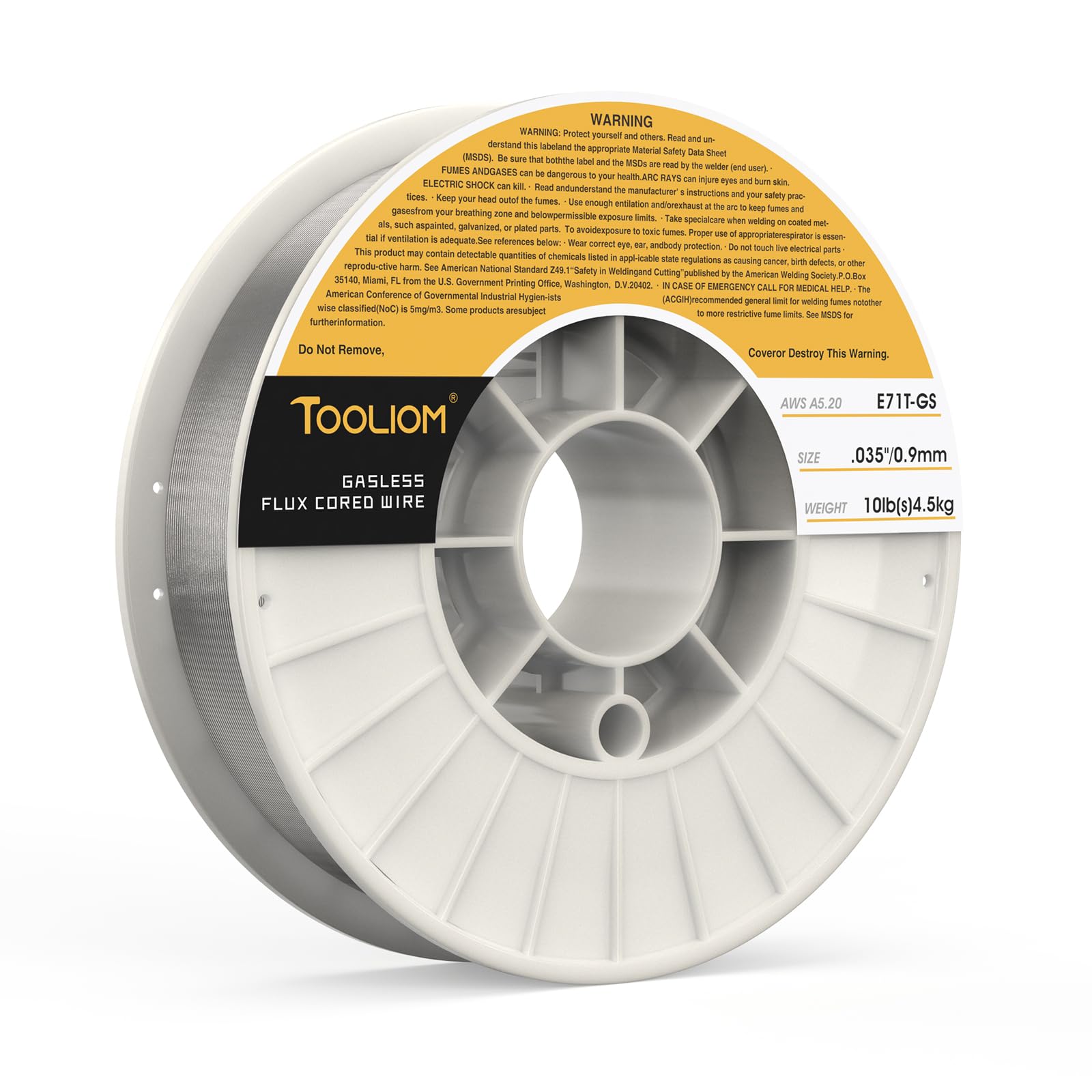
TOOLIOM .035 10lb

92 /100
Kirk Score Outstanding
Spool Weight
10 lb
Wire Diameter
0.035 in
Classification
E71T-GS
Check Details on Amazon

Pros

  • Works across many welder brands, supporting reliable feeding on small machines. — 32 mentions, 97% positive on reliability
  • Great cost per pound for a 10-pound spool, keeping material costs low during long projects. — 36 mentions, 94% positive

Cons

  • Plastic spool may arrive cracked, and wire can occasionally catch during feeding. — 11 mentions, 64% negative on durability; 7 mentions, 57% negative on ease of use

TOOLIOM's .035 10lb spool runs reliably on many welders, including Lincoln and compact machines, making it a practical choice for light fabricators who want to avoid frequent run-outs. The ABS plastic spool can arrive cracked from shipping, and wire may bind occasionally — a trade-off for the cost-effective bulk quantity.

Bottom line: Light fabricators who want to reduce spool changes and can inspect the reel for shipping cracks will find this spool cost-effective across many welder brands.

Check Latest Price
#10

Heavy Fab

Blue Demon .045 10lb

92 /100
Kirk Score Outstanding
Spool Weight
10 lb
Wire Diameter
0.045 in
Classification
E71T-GS
Check Details on Amazon

Pros

  • Runs on both 110V and 220V machines without separate wire spools. — 156 mentions, 95% positive
  • 10-pound spool provides a cost-effective supply for heavy users. — 155 mentions, 93% positive

Cons

  • Spatter levels can be inconsistent, requiring more setup time than some competitors. — 91 mentions, 53% negative — spatter varies widely among users

Blue Demon's .045 wire lays heavy beads on thick steel, and the 10-pound spool keeps per-pound cost low. Spatter can be inconsistent, so fine-tuning settings is necessary, and the thick diameter limits it to heavy fabrication. Spools sometimes crack in transit, but for deep-penetration jobs, it's a sensible bulk option.

Bottom line: When you're welding thick stock regularly and need an .045 wire that won't drain your budget mid-project, this spool delivers. Plan to dial in your settings to keep spatter down and inspect the spool on arrival.

Check Latest Price
#11

Farm Repairs

VEVOR .035 10lb

89 /100
Kirk Score Excellent
Spool Weight
10 lb
Wire Diameter
0.035 in
Classification
E71T-GS
Check Details on Amazon

Pros

  • Excellent value for a 10-pound spool — 22 mentions, 100% positive
  • Feeds smoothly in many welders with low spatter for budget wire — 12 mentions, 83% positive; 7 mentions, 86% positive

Cons

  • Weld quality varies; excessive spatter and rough bead appearance may surface — 12 mentions, 33% negative on weld performance — mixed results

VEVOR’s 10-pound spool delivers some of the lowest per-pound cost you’ll find, and the wire feeds smoothly in many MIG machines with manageable spatter. Weld consistency varies — excessive spatter and poor bead appearance can appear — so it’s best reserved for non-critical, cosmetic-agnostic fixes where value matters more than a pristine weld.

Bottom line: If you need to lay down a lot of filler on non-critical farm or garage projects and can live with occasional ugly welds, this spool’s price is a strong draw.

Check Latest Price
#12

First-Time Users

GZ GUOZHI .030 1lb

92 /100
Kirk Score Outstanding
Spool Weight
1 lb
Wire Diameter
0.030 in
Classification
E71T-GS
Check Details on Amazon

Pros

  • Weld quality rivals pricier name-brand wires, with easy slag release. — 9 mentions, 100% positive
  • Minimal spatter and solid penetration, even on thinner sheet metal. — 5 mentions, 100% positive on value

Cons

  • High per-pound cost makes it uneconomical for anything beyond occasional touch-ups.

This wire welds cleaner than its no-name price suggests—minimal spatter and consistent penetration make it a solid companion for a budget machine. The catch: at 1 pound, you pay a premium per foot. It's the sensible choice only if you weld a few times a year and don't want a large spool sitting around collecting rust.

Bottom line: If you only grab the welder a handful of times a year and a full 2-lb spool feels like overkill, this 1-pounder delivers clean arcs without the waste.

Check Latest Price

How to Choose

Wire Diameter

0.030-inch wire is the default for most 110V hobby welders; it runs cooler, penetrates thin sheet metal well, and is more forgiving on mill scale. The trade-off is lower deposition rate, so filling gaps on thicker plate takes longer.

0.035-inch wire carries more current, melting faster for heavier single-pass joints. On 120V machines, it can push the duty cycle, but the payoff is a higher travel speed. If you often weld 1/8-inch steel or thicker, .035 is the better match; for auto body patches, .030 reduces blow-through risk.

Spool Weight

A 2-pound spool is the workhorse size: enough wire for a weekend of projects without hogging space on small machines. Ten-pound spools slash the per-pound cost, but they demand a welder with a sturdy spindle and often break spools during shipping because of their weight.

One-pound spools are tempting for the price tag but vanish quickly; they are best for someone who welds once or twice a year and can't justify a larger spool that might rust from humidity.

Classification

E71T-GS is the most common flux-core wire, rated for single-pass welding only. It works perfectly for nearly all home and light repair work, but putting a second pass over it can compromise strength — the slag chemistry isn't designed for re-melting.

If you're building a trailer, gate, or anything structural that needs multiple passes, choose an E71T-11 wire. It's designed to hold up through successive passes, though you'll pay a small premium for that certification.

Spool Durability & Packaging

The biggest hidden cost in flux-core wire is shipping damage: a cracked plastic spool can let the wire unravel into a tangled nest that jams the feeder. ABS spools survive better than brittle polystyrene, and vacuum-sealed bags keep out moisture that can degrade the flux.

No brand is immune, but buying from vendors with good return policies and inspecting the spool immediately on arrival lets you catch a break before you load the wire. Some users transfer wire to aftermarket metal spools for extra reliability.

Frequently Asked Questions