// data-verified

6 Best Metal Chop Saws of 2026: Clean Cuts Without the Sparks

The best metal chop saws for your workshop: which leave metal cool and square—from affordable abrasive models to clean-cutting carbide dry-cut saws—and how to keep teeth from chipping.

Many shops still rely on abrasive chop saws for metal cutting, but they're slow, throw sparks everywhere, and leave burrs that need grinding. At the same time, the upgrade path to dry-cut carbide-tipped saws sounds appealing—clean, cool cuts with no sparks—but it comes with a hidden catch: if the workpiece isn't clamped dead-rigid or you feed too aggressively, those expensive carbide teeth can chip.

This guide helps you find a metal chop saw that matches your stock, your shop, and your workflow—whether that means a budget-friendly abrasive workhorse for occasional use or a premium dry-cut saw that keeps angle iron cool and square all day. You'll know which features matter most for straight cuts and blade longevity, without paying for voltage conversions you don't need.

#01

Best Overall

Evolution S355CPSL 14 Inch Metal Cutting Chop Saw

92 /100
Kirk Score Outstanding
Vise
Cast steel quick-release
Motor
15A, 1450 RPM
Voltage
120V
Blade Type
14" Carbide-Tipped (6T)
Check Details on Amazon

Pros

  • Slices mild steel cleanly and precisely with minimal burr — 87 mentions, 93% positive
  • Leaves work cool to the touch, ready to weld without grinding — 18 mentions, 83% positive (Temperature topic)
  • Cast steel vise and rigid fence deliver accurate, repeatable miter cuts — 18 mentions, 89% positive (Accuracy topic)

Cons

  • Chip and spark deflector does not fully contain debris — cleanup area can be large — Multiple mentions in build quality comments

The Evolution S355CPSL’s 14-inch carbide-tipped blade slices mild steel cleanly, leaving the piece cool to the touch and virtually burr-free — welders often skip grinding and start fabricating immediately. The cast steel vise and quick-release clamp grip tube, angle, and flat stock securely, and the 0–45° miter detents hold square and 45-degree cuts without drift. A 15-amp motor at a controlled 1450 RPM keeps the kerf narrow and heat low, while the 3-year warranty backs the saw’s build quality and long-term alignment.

Professional fabricators and serious hobbyists upgrading from abrasive chop saws get a plug-and-play 120V saw that delivers finished cuts without an expensive 220V line. The dry-cut blade requires rigid workpiece clamping and a steady feed rate — carbide teeth can chip if the stock shifts or you force the saw — so users tackling hardened steel or stainless should look elsewhere. Expect some debris scatter; the deflector reduces sparks but won’t fully contain the mess, so your cutting station will need a broom nearby.

Bottom line: The S355CPSL swaps abrasive wheel mess and post-cut grinding for cool, square cuts that fabrication shops can act on immediately — a worthy upgrade that a 3-year warranty helps safeguard.

Check Latest Price
#02

Budget Pick

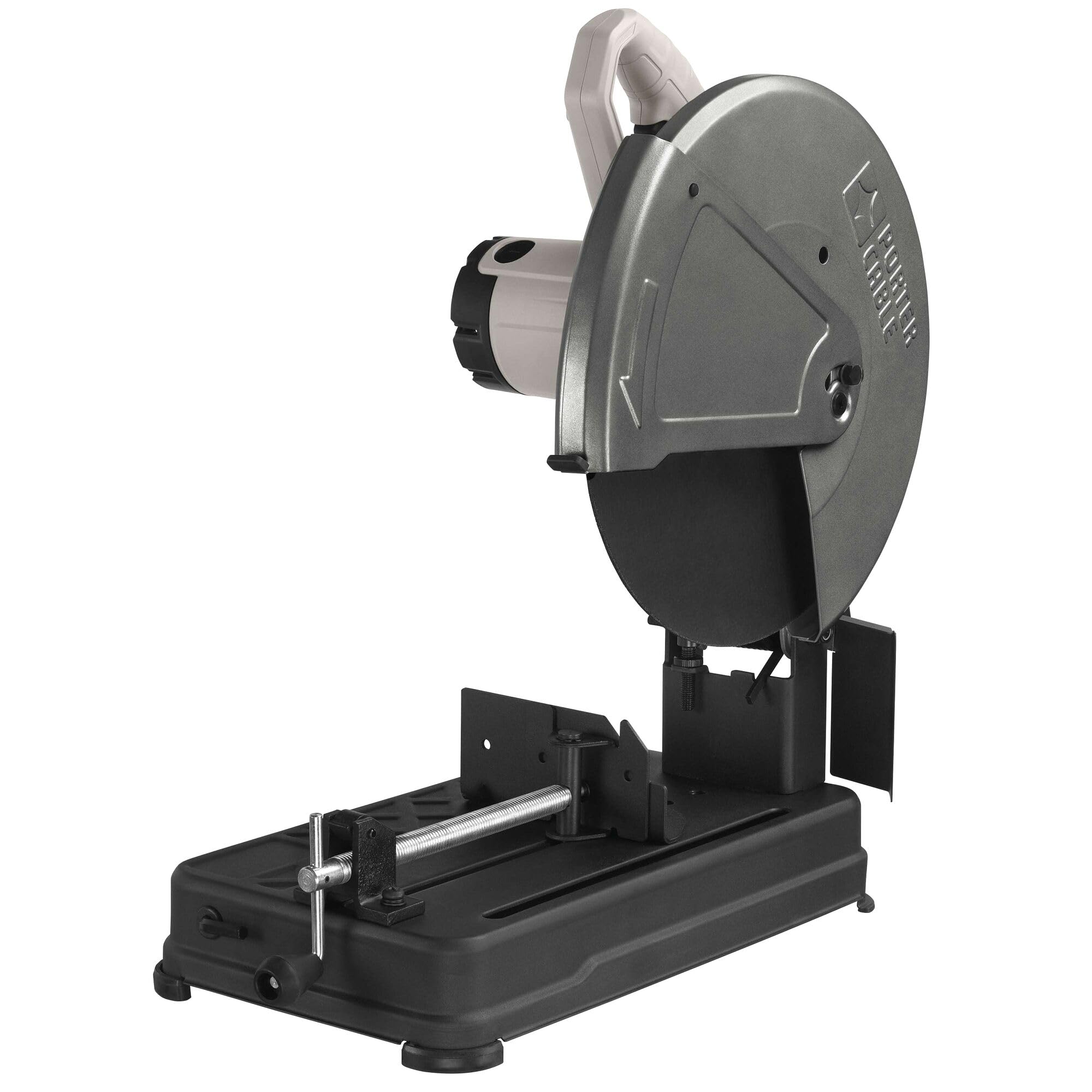
PORTER-CABLE PCE700

90 /100
Kirk Score Outstanding
Vise
Quick-release clamp
Motor
15A, 3800 RPM
Voltage
120V
Blade Type
14" Abrasive Wheel
Check Details on Amazon

Pros

  • Outstanding value for a name-brand chop saw — 141 mentions, 92% positive
  • Solid all-around functionality for general metal cutting and DIY — 111 mentions, 90% positive

Cons

  • Cut accuracy may require occasional recalibration – some units can cut slightly off-square — 109 mentions, 34% negative
  • Motor bogs down on thick stock, making cuts slower than thin-stock work — 32 mentions, 75% negative on speed; 48 mentions, 58% negative on power

At the lowest price in the category, the PORTER-CABLE PCE700 brings a 15-amp motor and a sturdy 32-pound base to thin mild steel cutting. It won’t match the clean, fast cuts of the top pick’s dry-cut blade, but for occasional angle iron and tubing in a home shop, the trade-off is acceptable. The abrasive wheel is messier and the motor can bog down on anything beyond medium stock – expect slower feed rates. That makes it a fit for DIYers and hobbyists who value low cost over production speed, not for those running repeated cuts on thick bar.

💡 💡 Tip: Square the fence and use the quick-release clamp before first use – a small setup step helps keep cuts accurate.

Bottom line: The PCE700 is the right abrasive saw for a home shop that expects occasional thin-metal cutting and values budget over speed. Stepping up to the top pick’s dry-cut precision makes sense if you’ll be cutting anything thicker than angle iron regularly.

Check Latest Price
#03

Heavy-Duty Dry-Cut Alternative

DEWALT DW872

90 /100
Kirk Score Outstanding
Vise
Quick-lock vise
Motor
15A, 1300 RPM
Voltage
120V
Blade Type
14" Carbide-Tipped (70T)
Check Details on Amazon

Pros

  • Very fast cutting speed, noticeably quicker than abrasive saws and clean through steel — 29 mentions, 93% positive on Cutting Speed
  • Clean, precise cut quality on mild steel and aluminum pipe — 116 mentions, 83% positive on Cutting Performance
  • Robust construction and high overall build quality — 90 mentions, 82% positive on Quality

Cons

  • Miter detents may not hold 45° consistently; a square is needed to verify angles — 26 mentions, 50% negative on Blade Adjustment
  • Blade teeth can chip or dull early if the workpiece is not clamped rigidly — 34 mentions, 41% negative on Blade Durability

The DEWALT DW872 pairs a 70-tooth carbide blade with a high-torque 1300 RPM motor for remarkably fast, cool cuts on steel, aluminum, and plastic. It cuts quicker than abrasive saws and rivals cold saws in edge quality, but the tradeoff is that miter detents can shift and blade life depends on dead-tight clamping. This saw suits fabrication shops where speed outweighs built-in miter precision. Verifying angles with a square and clamping stock rigidly become part of the routine to protect blade teeth and maintain cut accuracy.

💡 💡 Tip: Always clamp material tightly and double-check miter angles with a square before cutting — this preserves blade life and precision.

Bottom line: A dry-cut workhorse for shops that favor speed over miter repeatability and are willing to manage blade setup carefully.

Check Latest Price
#04

Pro-Grade Abrasive Pick

Makita LW1401 14-Inch Cut-Off Saw

89 /100
Kirk Score Excellent
Vise
Tool-less vise
Motor
15A, 3800 RPM
Voltage
120V
Blade Type
14" Abrasive Wheel
Check Details on Amazon

Pros

  • Sturdy cast base and 15-amp motor deliver consistent cutting performance. — Consistent positive feedback in performance and quality topics
  • Tool-less vise speeds up workpiece clamping between cuts. — Multiple top reviews praise ease of use and safety
  • Adjustable spark guard deflects debris away from the operator. — Multiple top reviews praise ease of use and safety

Cons

  • Out-of-box squareness can vary — shimming the fence may be needed for true 90-degree cuts. — Top review: 'Doesn't cut straight, cuts at an angle.'

The tool-less vise and adjustable spark guard make setup and cleanup faster than on entry-level abrasive saws. The 15-amp motor powers through mild steel and pipe, though expect slower cuts and abrasive dust compared to dry-cut saws. The fence may need shimming for true 90-degree cuts — a quick calibration step for anyone comfortable with basic tuning. For home metalworkers who value Makita's sturdy build and don't mind verifying squareness, this saw fits between budget throwaway models and high-end dry-cut machines.

💡 💡 Tip: Check the fence alignment with a square before your first cut. A thin shim can correct any angle without major fuss.

Bottom line: For home shops that want Makita toughness and tool-free adjustments without paying for dry-cut precision, this saw makes sense — just budget a few minutes to verify the fence before your first project.

Check Latest Price
#05

5" Round Stock

DEWALT D28715

90 /100
Kirk Score Outstanding
Vise
Quick-lock vise
Motor
15A, 4000 RPM
Voltage
120V
Blade Type
14" Abrasive Wheel
Check Details on Amazon

Pros

  • Keyless blade change shaves minutes off abrasive wheel swaps. — 37 mentions, 92% positive on Performance
  • Heavy steel base and 15-amp motor damp vibration and cut steadily. — 56 mentions, 89% positive on Quality

Cons

  • Miter fence lacks positive stops and can deflect during cuts, so squareness must be checked with a speed square. — 8 mentions, 75% negative on Blade Deflection; miter gauge complaints in top reviews

The DEWALT D28715 abrasive saw delivers quick, tool-free blade changes and a generous 5-inch round capacity, catering to home shops that prioritize convenience over carbide-cut cleanliness. However, its older design shows its age in heavy-use scenarios — motor or switch wear can appear sooner than expected, making it a poor fit for continuous production or daily professional use.

Bottom line: This DEWALT suits the hobbyist fabricator who values fast blade changes and can compensate for a drifting miter fence with a speed square; if precise, repeatable angles matter, step up to a dry-cut saw with a rigid fence system.

Check Latest Price
#06

220V Pro Shops

Makita LC1230

89 /100
Kirk Score Excellent
Vise
Quick-release vise
Motor
15A, 1300 RPM
Voltage
220V
Blade Type
12" Carbide-Tipped (60T)
Check Details on Amazon

Pros

  • Leaves metal clean and burr-free, even at high feed rates — 114 mentions, 91% positive on Cutting Performance
  • Heavy-duty construction holds up to repeated, precise cuts in pro shops — 97 mentions, 95% positive on Quality

Cons

  • Securing non-standard stock can be fiddly; the vise may bind on odd shapes — 22 mentions, 41% negative on Clamping

The Makita LC1230 delivers industrial-grade dry-cut performance with a 12-inch carbide blade that leaves steel cool and nearly burr-free, even at high production speeds. Its heavy-duty construction and precise miter adjustments suit professional fabricators who run hundreds of cuts per day. The 220-volt motor requires a dedicated outlet or step-up transformer, which excludes garages with only 120V service. For shops already wired for 220V, this saw's speed and cut quality are hard to match, but 120V buyers should consider the top pick Evolution S355CPSL or DEWALT DW872.

Bottom line: For professional shops with 220V power, the LC1230 offers high-speed, burr-free cuts that justify the premium price and extra electrical setup.

Check Latest Price

How to Choose

Blade Type

Abrasive wheels cut by friction, generating high heat, showers of sparks, and slow material removal. They wear down over time and can leave a burr that needs grinding, but they're affordable and forgiving on thin stock or rebar.

Dry-cut carbide-tipped blades slice cleanly through mild steel, leaving metal cool and virtually burr-free with almost no sparks. However, carbide is brittle—any workpiece movement or heavy feed pressure can chip teeth, turning an expensive blade into scrap.

Motor Amperage and RPM

Abrasive saws typically spin at 3800–4000 RPM; high speed can help a sharp wheel cut, but a 15-amp motor may bog down in thick solid bar. Look for saws that maintain torque under load—a motor that stalls leads to crooked cuts and wheel binding.

Dry-cut saws run at lower RPM (1300–1450) with higher torque to avoid work hardening and heat buildup. This design makes them ideal for thicker mild steel and angle iron, provided the motor doesn't struggle with startup amps on a shared circuit.

Miter Accuracy and Fence Quality

A fence with cast steel construction and positive stops holds angles far better than a pressed-steel friction fence that can drift from side pressure. Many saws ship out-of-square; look for a rigid fence that you can calibrate and lock tightly.

On 45° cuts, even slight fence deflection twists the stock and ruins squareness. Choose a saw whose miter mechanism and vise work together to eliminate any side play—this is invisible before you own the tool but decides every cut's accuracy.

Vise Clamping

A quick-release, tool-less clamp speeds up setup and reduces fatigue, but clamping force matters even more. Cast steel vises dampen vibration and keep the workpiece from shifting, which is critical for dry-cut carbide blades where movement chips teeth instantly.

Check maximum jaw opening and whether the vise can securely grip odd shapes like unistrut or angle iron without slipping. A vise that binds or fails to hold stock encourages dangerous blade contact and inaccurate cuts.

Voltage Compatibility

Most home and small pro shops operate on 120V outlets, and many premium dry-cut saws are plug-and-play on that standard. If you step up to an industrial unit that requires 220V, you'll need a dedicated circuit or step-up transformer, adding cost and complexity.

Unless you have 220V service and high-volume production, a 120V dry-cut saw delivers clean, cool cuts without electrical work. Confirm voltage before purchase, as 220V listings are not always obvious on retail pages.

Frequently Asked Questions