// data-verified

10 Best Multimeter of 2026: Pro Features, Not Pro Prices

Which multimeters deliver accurate true RMS and safe auto-ranging for home wiring and appliance repair, without the flaky budget failures or pro price tags.

Walk the tool aisle and you'll find multimeters anywhere from $15 to $400, all promising to read voltage and continuity. The catch: many of the cheapest options drift from their calibration within months or fail entirely after a handful of uses, leaving you chasing phantom electrical problems. Yet the high-end pro meters, while nearly indestructible, pack certifications and features that most homeowners will never tap.

The sweet spot sits in the mid-range, where auto-ranging, True RMS, and robust input protection become standard. These meters handle nearly every home electrical, automotive, and appliance repair task without the reliability roulette of the ultra-budget tier or the overkill of equipment costing five times as much. This guide sorts the field by the jobs you actually do, so you invest in a meter that lasts.

#01

Best Overall

AstroAI 6000 Counts

93 /100
Kirk Score Outstanding
True RMS
Yes
Auto-Ranging
Auto/manual selectable
Safety Certification
Measurement Functions
Capacitance, temperature
Check Details on Amazon

Pros

  • True RMS, auto-ranging, and temperature measurement normally found on pricier meters — a strong value. — 675 mentions, 95% positive on value
  • Large backlit display stays readable in dim garages or direct sun. — 190 mentions, 82% positive
  • Accuracy holds up for household, automotive, and electronics diagnostics. — 336 mentions, 75% positive
  • Included magnetic strap and multi-function socket add hands-free convenience. — 119 mentions, 82% positive in magnetic topic

Cons

  • Plastic housing and test lead jacks may loosen or crack under daily job-site abuse. — 147 mentions, 48% negative — reports of broken cables and fragile housing

The AstroAI TRMS 6000 Counts brings auto-ranging, True RMS, temperature, and capacitance into a single tool that normally costs far more. The 6000-count display gives you enough resolution to spot small voltage fluctuations in sensitive electronics, while auto-ranging removes the guesswork of manual dial settings. It handles AC/DC voltage up to 1000V, current up to 10A, and includes a thermocouple for direct temperature readings — capabilities that push well beyond typical entry-level meters.

The oversized backlit screen and included magnetic strap transform how you use it on site. Clip it to a car hood while testing battery health, or hang it on a breaker panel to free both hands. The bundled multi-function socket adds convenience for checking transistors and capacitors without separate test fixtures. In well-lit garages or bright sunlight, the display remains legible where smaller screens wash out. Accuracy across voltage and resistance modes is solid enough for nearly all household and automotive tasks — consistent and accurate enough for diagnosis.

This meter is built for advanced DIYers, automotive hobbyists, and homeowners who want one tool for electronics repair, appliance diagnostics, and vehicle troubleshooting. It is not a replacement for a job-site Fluke — professional daily use where drop resistance and sustained accuracy are mandatory falls outside its design. But if your meter lives in a workshop drawer and comes out for weekend projects, the feature set here surpasses anything near its price.

Bottom line: This meter gives advanced DIYers True RMS, auto-ranging, and temperature measurement in a single tool that outclasses typical entry-level options, provided your work doesn't demand the drop-resistance of a professional meter.

Check Latest Price
#02

Best for Professional Safety

Fluke 117 Digital Multimeter

96 /100
Kirk Score Outstanding
True RMS
Yes
Auto-Ranging
Auto
Safety Certification
CAT III 600V
Measurement Functions
Non-contact voltage, low impedance
Check Details on Amazon

Pros

  • Outstanding build quality and durability for daily job-site use. — 438 mentions, 97% positive
  • Highly accurate True RMS readings on complex waveforms. — 113 mentions, 86% positive
  • Advanced safety features: low impedance mode and non-contact voltage detection. — 69 mentions, 93% positive in Features

Cons

  • Lacks temperature measurement, limiting HVAC diagnostics.
  • Premium pricing is hard to justify for occasional household checks.

The Fluke 117 prioritizes electrician workflow with VoltAlert non-contact voltage detection and a low-impedance (LoZ) mode that eliminates ghost-voltage false readings—features the top pick in this set omits. True RMS accuracy holds on noisy VFD-driven circuits, while CAT III 600V safety and solid input protection design provide field confidence. Auto-ranging is fast and fuss-free, reducing diagnostics to reading the display rather than navigating dials.

This meter suits professional electricians and advanced hobbyists who must verify absence of live voltage instantly and reject stray capacitive coupling on long wire runs. It is not for casual DIYers working on a budget; the premium price buys safety precision and longevity that kitchen-table tinkerers won't fully exploit. The Fluke 117 lacks temperature measurement, so HVAC technicians needing thermocouple input will need a supplementary tool.

Bottom line: If long-term durability and electrical safety take priority over temperature readings and upfront cost, the Fluke 117 is the professional benchmark for daily troubleshooting.

Check Latest Price
#03

Best Durable Manual-Ranging Meter

Klein Tools MM325 Multimeter

94 /100
Kirk Score Outstanding
True RMS
No
Auto-Ranging
Manual
Safety Certification
CAT III 600V
Measurement Functions
Battery test
Check Details on Amazon

Pros

  • Rugged housing shrugs off drops from up to 6.6 feet — 61 mentions, 77% positive on durability
  • Solid, weighty construction feels built to last — 43 mentions, 100% positive on build quality
  • Lead-alert LEDs and bright display reduce setup mistakes — 83 mentions, 92% positive on ease of use

Cons

  • Manual ranging can feel slow if you're used to auto-ranging — Specification-based — requires manual range selection
  • DC voltage readings may be off by about 0.2V compared to a reference meter — 71 mentions, 24% negative — some users noted offset

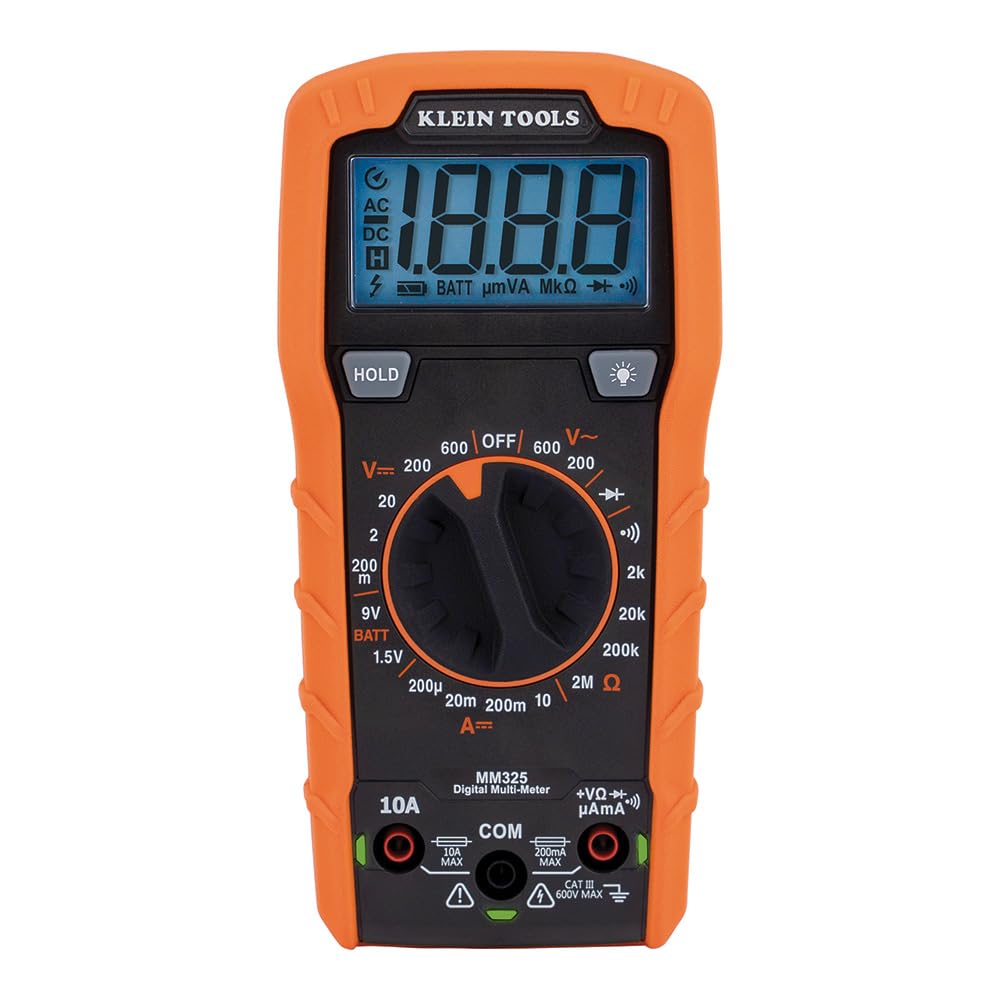
The Klein MM325 stands apart by focusing on physical durability over feature count. With a 6.6-foot drop rating and lead-alert LEDs that warn when probes are in the wrong jack, it's built to survive workshops and garages where other meters might crack. It omits the temperature, capacitance, and auto-ranging functions of the top pick, but those trade-offs keep the design simple and robust — it's a meter you can knock off a workbench and it keeps working.

This meter is best for homeowners and automotive DIYers who prioritize build quality and drop protection over advanced diagnostics. If you're checking outlets, testing batteries, or tracing basic DC circuits, the MM325 gets the job done without extra complexity. The bright backlit display and manual ranging are easy to learn; tasks requiring temperature, capacitance, or quick range changes across many voltages are better served by the auto-ranging top pick.

💡 💡 Tip: Spend a moment learning the manual range settings for common voltages — once set, it stays predictable and avoids the hunting of auto-ranging.

Bottom line: For a durable, no-frills manual-ranging meter that handles drops and daily troubleshooting, the MM325 is the practical choice — just don't expect temperature, capacitance, or auto-ranging.

Check Latest Price
#04

Best for Simple Auto-Testing

TESMEN TM-510

93 /100
Kirk Score Outstanding
True RMS
No
Auto-Ranging
Smart auto
Safety Certification
CAT II 600V
Measurement Functions
NCV
Check Details on Amazon

Pros

  • Smart auto-detection eliminates manual range selection, reducing user error — 263 mentions
  • Compact and lightweight with included case for easy storage and transport — 153 mentions
  • Non-contact voltage detection enables live-wire identification without touching a lead — 133 mentions

Cons

  • No current measurement means you cannot diagnose a battery drain or circuit overload without a separate meter

The TM-510 brings foolproof auto-detection and non-contact voltage sensing at a budget-friendly price, making it a stress-free alternative to traditional multimeters. It automatically identifies whether you're measuring AC or DC voltage, resistance, or continuity, removing mode selection entirely. A 4000-count backlit display and built-in flashlight help in dim panels, and the compact body slips into a pocket or included case.

The tradeoff is absolute: no current measurement. You cannot check a battery drain, compressor amp draw, or circuit overload. The TM-510 is strictly a voltage-and-continuity companion. It fits best as a dedicated quick-check tool kept in a kitchen drawer, toolbox, or glovebox for when you just need to know if an outlet is live or a fuse is blown. Homeowners who already own a clamp meter or never need current readings will appreciate the simplicity; anyone troubleshooting appliances or automotive electrical should consider the top pick instead.

Bottom line: The TM-510 is a dedicated voltage-and-continuity quick-check tool for homeowners who already have a current-measuring meter or never need one.

Check Latest Price
#05

Best Clamp Meter for AC Current

Fluke 323 Clamp Meter

94 /100
Kirk Score Outstanding
True RMS
Yes
Auto-Ranging
Safety Certification
CAT III 600V, CAT IV 300V
Measurement Functions
AC current
Check Details on Amazon

Pros

  • True RMS accuracy handles distorted waveforms from VFDs and LED lighting. — 84 mentions, 87% positive
  • Narrow 30mm jaw and lightweight body enable one-handed use in packed enclosures. — 67 mentions, 99% positive on ease of use
  • Fluke's overmolded housing survives drops and daily truck life without calibration drift. — 33 mentions, 76% positive on durability

Cons

  • Resistance measurement maxes out at 4 kΩ, limiting troubleshooting of motor windings or insulation.

For electricians who spend their days chasing AC motor currents and checking circuit loads, the Fluke 323 strips away the extras found on general-purpose meters and delivers true RMS readings through a 30mm jaw. While feature-stuffed multimeters try to cover every contingency, this clamp meter focuses on the one measurement that demands a non-contact approach — and does it in panels where space is tighter than a breaker box on a Friday afternoon.

The 323 pairs well with a Fluke 117 or similar DMM already in your kit, adding the clamp function that a standard meter can't touch. The key boundary: it cannot measure DC current via the clamp, so automotive diagnostics remain a job for a different tool. For commercial and residential AC work, that limitation rarely surfaces.

💡 💡 Tip: Keep a standard multimeter nearby for voltage, resistance, and temperature checks — the 323 is a current specialist.

Bottom line: When AC current is the daily puzzle, the Fluke 323 solves it fast, fitting in one hand and one tight panel. For mixed AC/DC or resistance-heavy work, a full-service multimeter better serves.

Check Latest Price
#06

Best All-In-One Test Kit

Klein MM320KIT

95 /100
Kirk Score Outstanding
True RMS
No
Auto-Ranging
Manual
Safety Certification
UL/ETL Listed
Measurement Functions
NCV, receptacle tester
Check Details on Amazon

Pros

  • Three essential testers in one kit for outlets, switches, and wiring checks. — 33 mentions, 100% positive on versatility
  • Klein build quality with accurate readings and a solid, durable feel. — 74 mentions, 92% positive on quality
  • Saves money compared to buying the tools separately. — 39 mentions, 97% positive on value

Cons

  • The NCV stick can develop corrosion or break if dropped — it requires careful handling. — 15 mentions, 47% negative — hot stick may break; battery corrosion reported in some units
  • Manual ranging and the absence of capacitance limit the multimeter’s use for electronics or advanced diagnostics.

The MM320KIT sets up a new homeowner with the three tools you actually need to tackle outlets, switches, and wiring: a manual-ranging multimeter, a non-contact voltage tester, and a receptacle tester. Where a single rugged meter focuses on durability, this kit spreads that investment across a full diagnostic suite, letting you check for live voltage without making contact and verify outlet wiring in seconds. Klein’s build quality shows in the dial and leads, and the accuracy holds up well for household AC/DC and continuity checks.

This kit is the right starting point for any first-time homeowner who wants to map circuits, test outlets, and confirm voltage before replacing a switch. The multimeter stays basic — no capacitance and manual ranging only — so electronics projects or detailed troubleshooting are out of scope. The NCV stick is the one piece to treat with care; battery corrosion can appear over time and the plastic housing may not survive a hard drop. If that fragility fits how you’ll use it, the bundled price makes this a smarter buy than assembling separate tools.

Bottom line: For a fresh homeowner tackling basic electrical projects, the MM320KIT delivers the three essential testers you’ll reach for most often, at a clear value over buying individually — just keep the voltage stick protected from moisture and drops.

Check Latest Price
#07

Best Feature-Packed Alternative

KAIWEITS HT118A

93 /100
Kirk Score Outstanding
True RMS
Yes
Auto-Ranging
Auto
Safety Certification
CAT III 1000V, CAT IV 600V
Measurement Functions
NCV, live-wire, flashlight
Check Details on Amazon

Pros

  • Excellent value, bundling NCV, live-wire alert, flashlight, and True RMS at a mid-range price. — 446 mentions, 96% positive on value
  • Non-contact voltage and live-wire detection make identifying energized wires quick and safer. — 196 mentions, 98% positive in Features
  • Auto-ranging and jack LED indicators simplify operation for beginners and occasional users. — 237 mentions, 93% positive

Cons

  • Plastic housing and test lead jacks can wear with rough handling, limiting longevity for daily field work. — 208 mentions, 43% negative — case and terminals can break under regular use
  • Some units may stop working after months of light use, inconvenient for anyone who cannot afford downtime. — 545 mentions, 35% negative — numerous reports of the meter failing completely after light use

The HT118A distinguishes itself from the top pick by prioritizing safety alerts over diagnostic breadth. Non-contact voltage detection, a live-wire alert, and a built-in flashlight join its CAT IV 600V safety rating, while temperature and capacitance measurements are absent. The auto-ranging True RMS core and jack LEDs make operation straightforward, though the feature set leans toward safety convenience rather than electronics troubleshooting.

This meter suits hobbyists and homeowners who want quick confidence around outlets and wiring, and who will appreciate the flashlight during dimly lit checks. It is not for those who depend on a meter daily, need temperature or capacitance functions, or cannot risk a unit that may stop working after months of light use. For those users, the top pick's broader measurement suite and sturdier build are the safer bet.

Bottom line: For hobbyists who will enjoy the extra safety alerts and can accept the possibility of an early quit, the HT118A delivers a compelling mix of features for the price — as long as a backup plan exists.

Check Latest Price
#08

Pro True RMS

Fluke 115 Multimeter

96 /100
Kirk Score Outstanding
True RMS
Yes
Auto-Ranging
Auto
Safety Certification
CAT III 600V
Measurement Functions
Min/Max/Avg, capacitance
Check Details on Amazon

Pros

  • True RMS accuracy holds steady on noisy circuits, giving confidence in every reading. — 145 mentions, 88% positive
  • Tough construction withstands drops and daily job-site abuse without losing calibration. — 71 mentions, 82% positive on durability

Cons

Fluke's 115 delivers the core accuracy and durability professionals demand. True RMS, a large backlit display, and capacitance measurement make it a solid daily driver for electrical troubleshooting. The trade-off: no non-contact voltage detection or low-impedance mode to reject ghost voltages. For field technicians who don't chase live wires in dark panels or battle ghost readings on sensitive circuits, this is a no-nonsense meter that will outlast most toolboxes.

Bottom line: If you're a field technician who prioritizes raw accuracy and durability over advanced safety features like non-contact voltage detection, the Fluke 115 is the uncompromising workhorse — skip it only if ghost-voltage troubleshooting or live-circuit sniffing is a daily requirement.

Check Latest Price
#09

HVAC Techs

Fieldpiece Compact HVACR Clamp Multimeter SC260

95 /100
Kirk Score Outstanding
True RMS
Yes
Auto-Ranging
Auto-select
Safety Certification
CAT III 600V typical
Measurement Functions
Temp, capacitance, NCV
Check Details on Amazon

Pros

  • Purpose-built for HVACR with temperature and capacitance — 92% positive on HVAC use, 97% on build quality
  • Strong magnetic back enables hands-free operation — 18 mentions, 100% positive

Cons

  • Readings may jump before settling, causing trust issues for precise voltage checks — Reports of fluctuating readings leading to trust issues

The Fieldpiece SC260 simplifies HVACR diagnostics by combining temperature, capacitance, and clamp current measurement in one compact tool. The magnetic back enables hands-free operation, and the auto-select mode reduces dial twisting. Trade-off: readings can oscillate before settling, a behavior that erodes confidence for precise electrical measurements—an acceptable exchange for technicians who value speed and convenience over absolute stability.

Bottom line: For HVAC service technicians who prioritize one-tool convenience and hands-free testing over measurement precision, the SC260 streamlines daily tasks.

Check Latest Price
#10

Occasional DIY

AstroAI AM33D

91 /100
Kirk Score Outstanding
True RMS
No
Auto-Ranging
Manual
Safety Certification
IEC 61010
Measurement Functions
Check Details on Amazon

Pros

  • Clear backlit display for easy reading in dim areas. — 214 positive mentions out of 265
  • Simple, intuitive dial for straightforward operation. — 904 mentions, 93% positive

Cons

  • Voltage readings can vary between units, noticeable when checking low-voltage batteries. — 796 mentions, 36% negative
  • Some meters may become unresponsive after light use, limiting utility for any reliability-critical task. — 291 mentions, 80% negative

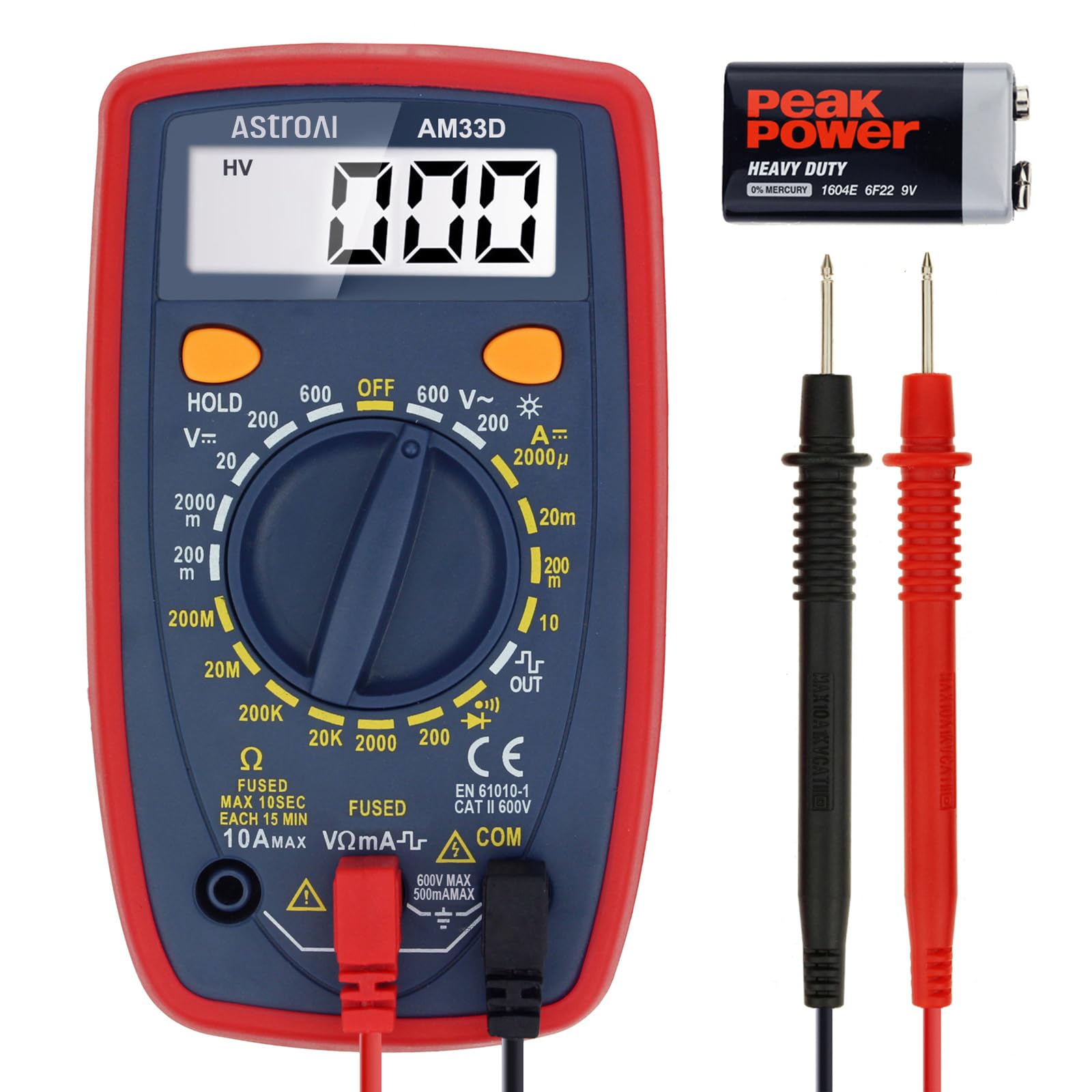
The AM33D's backlit display and straightforward dial make it easy to use for quick battery, fuse, and outlet checks, and its budget-friendly price makes it a low-stakes backup. Manual ranging and a 2000-count display keep tasks to the basics. Accuracy can drift between samples, and some meters may become unresponsive after light use—issues that don't derail an occasional fuse test but rule out any precision or daily work.

Bottom line: If you need a meter only for occasional battery and outlet checks and can accept the possibility of unit variance, the AM33D is a minimal-cost option to keep in the glovebox.

Check Latest Price

How to Choose

Auto-Ranging vs. Manual Ranging

Auto-ranging meters automatically select the correct measurement range, saving time and preventing the blown-fuse frustration that comes with probing an unknown voltage on a manual dial. On the other hand, manual-ranging circuits are simpler, often translating to better drop resistance because there are fewer sensitive components to disrupt. If you troubleshoot electronics with wildly varying voltages, auto-ranging is nearly essential; for occasional outlet checks, manual ranging adds durability without slowing you down.

True RMS for Real-World Accuracy

Standard average-responding meters assume a perfect sine wave, so they can read 30–40% low when measuring non-sinusoidal loads like variable-speed motors, LED dimmers, or UPS outputs. A True RMS meter corrects for that distortion, giving you the true effective voltage. If you mainly test household receptacles with clean utility power, average-responding is sufficient. But as soon as you work on modern appliances or generators, the extra cost of True RMS prevents misdiagnosis.

Safety Certification: CAT Categories Matter

CAT II meters are rated for appliance-level circuits, while CAT III covers distribution wiring up to the breaker panel, and CAT IV handles outdoor service drops. Inside a CAT II housing, the input protection components are smaller and can fail explosively if you accidentally probe a high-energy panel circuit. A CAT III 600V meter includes larger fuses, robust spacings, and high-energy absorption to survive transient spikes. Before opening a breaker panel, ensure the meter body and probe tips carry at least CAT III labeling.

Measurement Functions You’ll Actually Use

Extras like capacitance, temperature, non-contact voltage (NCV), and flashlight add everyday handiness, but they can mask a critical gap: some feature-loaded meters omit current measurement entirely. Always check whether a meter can measure AC and DC amps, because diagnosing a car battery drain or an appliance’s current draw is impossible without that function. Prioritize the measurements your projects demand—no one meter does it all—and treat NCV as a bonus, not a substitute.

Build Quality and Day-to-Day Durability

Behind the plastic shell, rugged meters use gold-plated rotary-switch contacts and shrouded input jacks with alert LEDs that warn when leads are in the wrong socket. Cheaper models use thin PCB traces that wear out after a few hundred dial rotations, leading to intermittent readings. Drop-rating numbers (like 6.6 feet) and visible shunt protection matter if the meter lives in a tool bag, but they also correlate with long-run stability. For garage and field use, pick a meter rated to bounce back.

Frequently Asked Questions