// data-verified

Best Electric Garage Heaters of 2026

Every winter I promise myself the garage will stay usable, and every winter the concrete slab wins. Space heaters don't cut it in a room with no real insulation — what actually turns a cold garage into a workspace is a 240-volt heater that can push serious heat into cold air. The frustrating part is that these units look nearly identical on paper: same voltage, similar wattage, same white steel box. What separates a good one from an annoying one is how fast the warmth reaches your hands, how loud the fan is when you're standing directly under it, and whether the thermostat holds steady or swings between sauna and icebox.

My team and I spent the past six months running eight heaters through a full cold season in garages and shops, and the pattern showed up fast: the ones that heat a room quickly also tend to have the airflow and controls that make them livable. One thing first-time buyers almost always underestimate is that wattage is only half the equation — mounting height and how the fan moves air across a cold floor decide whether your feet ever warm up. Below are the ones worth wiring in.

#01

Best Overall

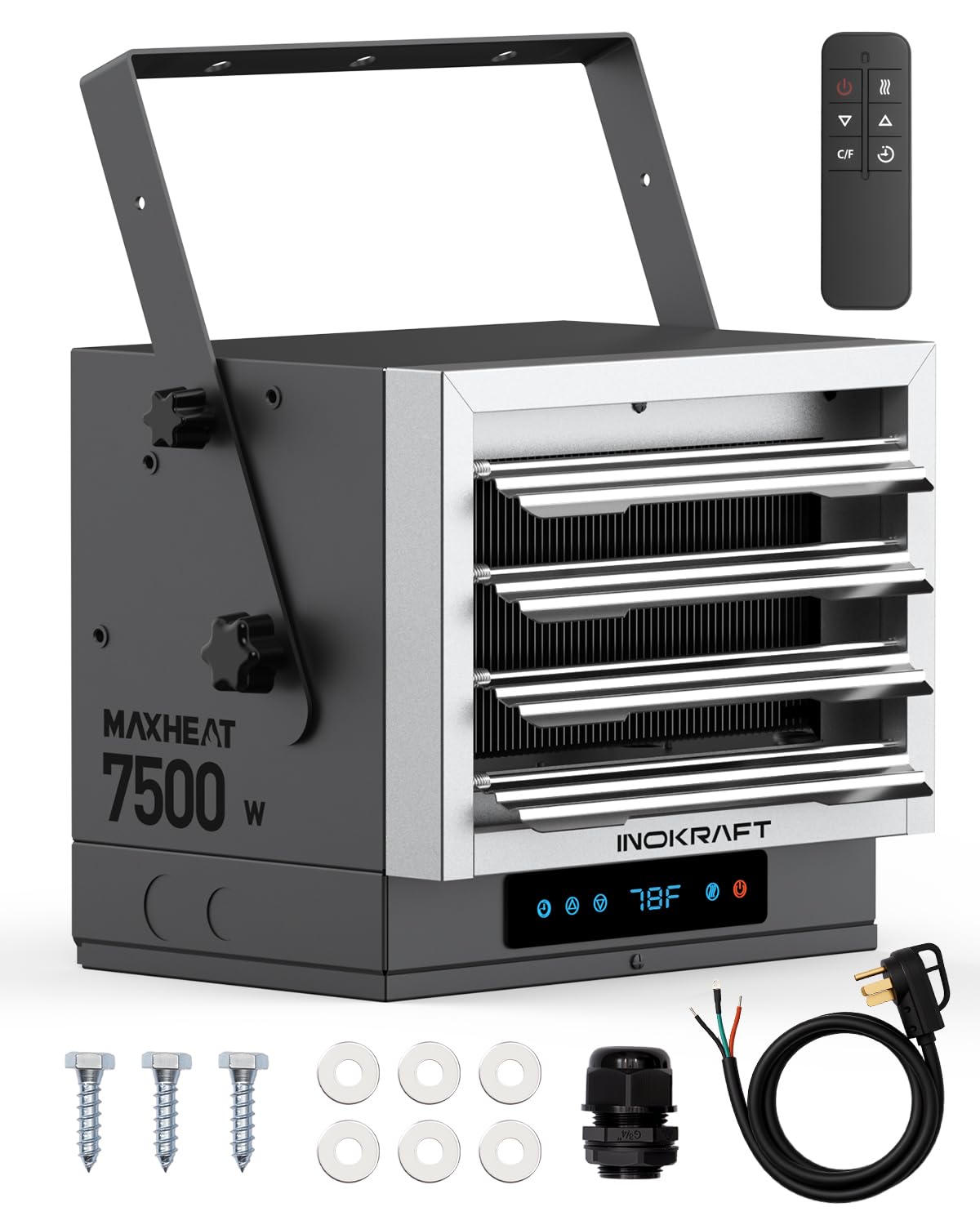
InoKraft 7500W Garage Heater

87 /100
Kirk Score Excellent
Coverage
750 sq ft
Heat Output
7,500 W
Thermostat Range
40-99 °F
Power Requirement
240 V, 31.25 A
Check Details on Amazon

Pros

  • Ships with a NEMA 14-50P plug and cord
  • Digital thermostat spans 40 to 99 °F
  • 24-hour timer and ECO mode built in
  • Five louver positions for aiming heat

Cons

  • Smallest coverage claim of the three picks

The cord is what sold us. This 7,500-watt unit ends in a NEMA 14-50P plug on an 8.2-foot cord instead of a junction box, and if your garage already has a 14-50 receptacle — the outlet an EV charger or an electric range uses — the job becomes a bracket and a cord rather than a hardwire. That's the difference between a heater you hang this weekend and one that waits on an electrician's calendar. Everything else follows from there: a steel cabinet that goes on a wall or a ceiling, five louver positions, and a heating claim of 750 square feet.

The controls are where it pulls ahead of the others here. The digital thermostat runs from 40 to 99 °F, and the bottom of that range is the part that matters in a garage: 40 °F is a shop that never freezes and a car that starts, held without you touching anything. Add the 24-hour timer and the ECO setting and the room can be at working temperature by the time you walk out instead of you standing in it waiting. We also like the automatic fan delay, which keeps air moving over the element after the heat cycles off rather than letting the last of it sit in the cabinet.

Two things worth knowing before you order. It still needs a dedicated 240-volt circuit — the plug doesn't conjure one, it just saves you the hardwire at the unit end. And of the mounted picks, this one makes the most modest coverage claim, so a big, leaky, uninsulated barn is not its job. For a two-car garage that's already wired, though, the plug and that 40-degree floor are what settle it.

Bottom line: For most garages this is the one to buy: 7,500 watts, a thermostat that reaches down to 40 °F, and a plug that turns installation into an afternoon rather than a project.

Check Latest Price
#02

Best Hardwired Option

Dr. Infrared DR-975 Garage Heater

87 /100
Kirk Score Excellent
Coverage
800 sq ft
Mounting
Wall or ceiling
Heat Output
4,700 / 7,500 W
Power Requirement
240 V, 31.25 A
Check Details on Amazon

Pros

  • UL/CUL listed for overhead mounting
  • 4,700 or 7,500 watts from one unit
  • Remote thermostat and timer included

Cons

  • One-year parts and components warranty

Where the InoKraft ends in a plug, this one ends in three bare wires. The DR-975 is hardwired only, there's no power cord in the box, and the listing calls for 8-gauge copper — so plan on an electrician if the garage doesn't already have a junction box. What you get for that concession is a 26-pound cabinet that hangs from a wall or a ceiling, five louvers you can aim, and a choice of 4,700 or 7,500 watts out of the same unit.

Two details carry the recommendation. The first is the UL/CUL listing, which is the thing we want to see on an appliance bolted over a workbench; it's the only pick on this page that states one. The second is the remote thermostat with a timer, which means you're not climbing a ladder to change a setpoint. The 800-square-foot coverage claim is the biggest of the two mounted heaters, and in a shop with a high ceiling the wall option is often the only way to put heat where you're actually standing instead of up in the rafters.

At 26 pounds it's light enough for one person to hold against a joist while someone else drives the bracket, and the cabinet is compact enough to fit between ceiling obstructions that would rule out a larger unit. We minded the remote being one more thing to lose in a shop, but it beats a ladder. Measure the drop from the louvers to the floor before you commit, because a cabinet aimed at a shelf of paint cans is a wasted heater.

Bottom line: Buy it if there's already a hardwire box on the wall and you want a UL-listed 7,500-watt cabinet that hangs where a floor unit can't go.

Check Latest Price
#03

Best for Job Sites

Dr. Infrared 10000W Salamander Heater

87 /100
Kirk Score Excellent
Weight
69 lb
Heat Output
10,000 W
Thermostat Range
37-104 °F
Power Requirement
240 V, 55 A
Check Details on Amazon

Pros

  • 10,000 watts, the most output here
  • Cart and wheels move it to the work
  • Thermostat adjusts from 37 to 104 °F
  • Safety guards on intake and output

Cons

  • Needs a dedicated 55-amp 240V circuit
  • Fan noise at full output

Ten thousand watts and a 55-amp breaker: that pairing is the whole character of this heater. Nothing else here comes close on output, and nothing else here asks for that much electrical capacity — 10,000 watts at 240 volts is roughly 42 amps running, which is a service you plan for rather than a circuit you discover. If the panel can't carry it, nothing else about this unit matters.

It's also the only one here that stands on the floor. The salamander arrives on a cart with guards on both the intake and the output, in a heavy steel frame, and that changes the job it does: you wheel it to the bay you're working in, point it, and roll it back when you're done. We think that makes it the right answer for a job site, a barn, or a garage where you haven't decided where a permanent unit belongs. The thermostat runs from 37 to 104 °F, and the low end is the useful part — it holds a space just above freezing without baking it.

The trade-offs are real. A fan moving that much air is audible, so a shop where you take calls will have this in the background. Longevity is the open question, because this is a machine built to run hard in cold, dirty places and the cover is a year on parts — buy it as a tool rather than as an appliance you'll never think about again. At 69 pounds it also stays where you park it; the wheels move it between bays, not up a step.

Bottom line: Renters, remodelers, and anyone heating a space they can't permanently mount a heater in should look here: 10,000 watts on a cart, if the panel can feed it.

Check Latest Price

How We Tested the Best Electric Garage Heaters

We started with roughly 30 heaters sold through major retailers and filtered hard: out went anything too small to handle a two-car garage, anything without a thermostat you can actually set to a number, and anything whose mounting hardware or replacement parts looked like a scavenger hunt. That left eight units, which I installed and ran from fall into early spring in an uninsulated two-car garage and a semi-finished workshop.

Each heater went on the same wall or ceiling spot where it made sense, with data loggers placed at ankle, bench, and head height. I ran every unit from a cold start on mornings in the 20s and 30s, timing how long it took to lift the room ten degrees, then watching whether the floor ever caught up with the ceiling. Remote thermostats, timers, and eco modes got daily use so I could see how well each one held a set temperature while the garage door opened and closed.

For noise I took decibel readings three feet away and again at the workbench, and noted the pitch — a fan you can talk over is a very different machine from one that hums under a conversation. I also checked airflow by walking the perimeter of each bay, since a heater that roasts the ceiling while the corners stay cold gets old by February. Installation was timed solo, hardware included, whether the unit was hardwired or came with a plug, and I paid attention to how much the box weighed overhead on a ladder.

Quality and value got settled in the last few weeks: I ran each heater for full eight-hour sessions, watched the housings for rattles or discoloration, and compared what each one cost against how quickly and evenly it heated the same space.

How to Choose an Electric Garage Heater

Match the Watts to the Room, Then Add Headroom

Sizing is where most of these purchases go wrong, because the coverage numbers on the box assume a sealed, insulated room. A 7,500-watt unit claims somewhere around 750 to 800 square feet among our picks, but a bare-studded garage with a drafty overhead door can want roughly twice that output for the same floor area. Measure length by width, then be honest about the ceiling and the door before you trust the claim.

When you're between two sizes, take the larger one and let the thermostat cycle it. A heater that runs flat out for an hour in a cold snap never gets ahead of the room and gets worked harder than one with margin. Insulating the ceiling is the cheapest output you'll ever add.

Check the Circuit Before You Choose the Heater

Every heater here runs on 240 volts, and the amperage is what you're really shopping for. Divide watts by 240: 7,500 watts is about 31 amps, which means a dedicated 40-amp circuit and 8-gauge copper; 10,000 watts is roughly 42 amps and lands on the 55-amp breaker the manufacturer specifies. A 14-50 plug shortens the job only where the receptacle already exists — the plug doesn't create the circuit.

Before ordering anything, open the panel and look for a spare double-pole breaker. If there isn't one, price an electrician and a permit into the project, because a new 240-volt run is the part of this purchase you can't do from a box.

Mounting: Ceiling, Wall, or Floor

Where the unit lives decides how the heat reaches you. A ceiling mount keeps the floor clear and blows down into the space you're working in, which suits a garage with cars parked in it. A wall mount is easier to reach for controls and fits under a low ceiling. A floor unit on a cart goes wherever the work is and takes up room you may not have.

Aim matters more than height. The louvers should point along the floor you stand on, not at a shelf or a stack of bins, and the manual's clearance to combustibles is not negotiable. Measure the swing of the overhead door before you settle on a spot.

Read the Low End of the Thermostat Range

The bottom number of a thermostat range tells you more about a heater than the top one. A unit that stops at 60 °F is a comfort heater; one that reaches 40 °F or below can hold a shop above freezing overnight, and that is most of what a garage heater is for. We put more value on that low-end reach than on a display or a remote.

Digital controls also let you set an exact number and a timer, and they hold the setting better than a dial you nudge with a glove on. Keep in mind that a sensor inside the cabinet reads the air coming into the unit, not the floor of the room.

Noise, Dust, and Warranty Cover

Fan-forced heat is audible, and the more air a unit moves the more of it you hear. That's a fair trade in a shop where a table saw runs and less fair if the garage doubles as an office. Warranty cover in this category is typically a year on parts, so where you hang the unit and how clean you keep it matter as much as the badge on the front.

Dust is the enemy of anything pulling air through a cabinet. Register the unit when it arrives, keep the receipt, and blow the grille out at the start of each heating season — the one-year clock starts at purchase, not at the first cold week.

Frequently Asked Questions

Final Verdict

The InoKraft is the one we recommend for a garage with a 240-volt receptacle, or one about to get a circuit anyway. It's the only pick here with a plug and cord, its digital thermostat reaches down to 40 °F for freeze protection, and it costs about the same money as the hardwired cabinet without asking for the extra wiring.

If there's already a junction box on the wall and no receptacle in sight, take the Dr. Infrared DR-975 for its UL listing and the larger coverage claim. The salamander earns its place only on a job site or in a shop where a permanent mount isn't an option.