// data-verified

Best Overhead Garage Storage of 2026

The first thing I did after hanging my first ceiling rack was stand underneath it and wait for something to give. That's the real anxiety of overhead garage storage: you're not buying a shelf, you're suspending a few hundred pounds of bins over the car. Done right, it's the biggest space-saver in the garage — the floor clears, and the stuff you touch twice a year stops being in the way.

My team installed nine different racks over the past eight months and used them the way anyone would: filling bins, hauling them down, watching for sag. The gaps between them rarely came down to capacity on paper — they showed up in the hardware, the instructions, and how far each rack hangs below the joists.

One thing I learned the hard way: measure the drop height before you buy, not just the footprint. A rack that hangs too low fights your garage door track every time you pull in, and no amount of storage capacity makes up for that. The picks below are the ones that made the rest of it easy.

#01

Best Overall

FLEXIMOUNTS 4x8 2-Pack

95 /100
Kirk Score Outstanding
Footprint
4 x 8 ft, two racks
Joist Fit
Up to 24 in.
Drop Range
22 to 40 in.
Load Capacity
600 lb each
Check Details on Amazon

Pros

  • Two 4x8 decks cover a full garage
  • Drop adjusts from 22 to 40 inches
  • 600-pound capacity on each rack
  • Integrated grid and six-post frame

Cons

  • Uses two full 4x8 ceiling bays

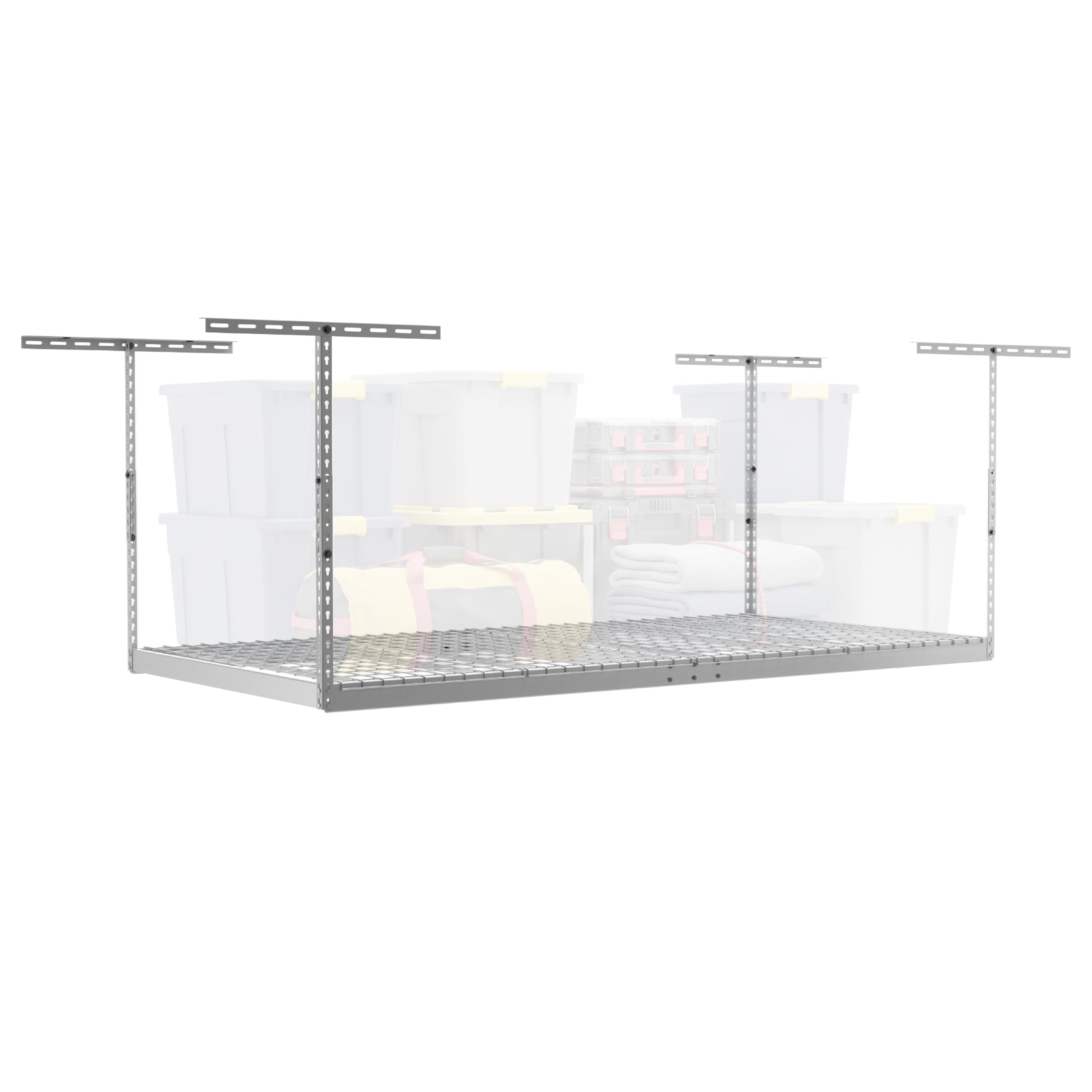
One 4x8 rack makes a dent in garage clutter; two change how the whole room works. That is the appeal of this FLEXIMOUNTS two-pack. With two 4x8 decks, you can put one over the daily driver and the other over a workbench or the garage door, then set their drop heights independently between 22 and 40 inches. It earns our top spot because it treats the ceiling as a storage plan rather than one heroic shelf.

Each rack carries a 600-pound rating, and the integrated steel grid sits on six vertical posts. We appreciate the continuous deck when loading: bins slide across the grid instead of catching on the lip of a separate wire panel. The black finish also looks tidy against open joists, which is a small thing until you are looking up at it every day.

The install is the part to plan. These racks are built around ceiling joists up to 24 inches apart, and wider layouts call for a 48-inch bracket plan, so measure before you order. Then recruit a helper. Holding a 4x8 frame overhead while you find a bolt hole is not a solo job, and the instructions are more of a sketch than a guide. Set aside an afternoon and dry-fit the parts before you drill.

What we keep coming back to is the pair. A single rack tends to become the place where everything lands; two let you separate holiday bins from camping gear and still leave one bay alone. That is the luxury here: not more pounds, but a tidier division of the ceiling.

Bottom line: For a whole-garage reset, we recommend this two-pack: two 4x8 decks, adjustable drop, and 600 pounds per rack make it the most complete ceiling storage here.

Check Latest Price
#02

Best Heavy-Duty Single Rack

SafeRacks 4x8

93 /100
Kirk Score Outstanding
Included
5-piece hook pack
Footprint
4 x 8 ft
Drop Range
24 to 45 in.
Load Capacity
600 lb
Check Details on Amazon

Pros

  • 600-pound capacity on steel C-channel
  • 24-to-45-inch drop range
  • Five hooks included for below-deck storage

Cons

  • Mounting overhead needs two people

The five hooks included with this rack turn the air below the deck into storage. We like that more than another few square feet on top: a hose, an extension cord, or a long-handled tool can hang below without eating shelf space. The hooks are also the easiest way to keep ladders and cords off the floor when wall space is already spoken for.

The deck itself is rated to 600 pounds, and the 24-to-45-inch drop ties for the widest range here. That range is why we choose it for a tall vehicle or a high ceiling: keep the deck up for clearance or bring it down for easier loading. Set it near the top and you will still want a step stool, so treat the range as adjustment, not a substitute for access.

The 4x8 footprint gives a full bay's worth of ceiling storage, while the open wire deck lets dust and grit fall through instead of collecting. Small parts need a bin or liner, which is the trade for that surface. The 14-gauge C-channel frame and powder coat feel purpose-built, and the result is a single rack that stays useful above a car and still has a place for the long stuff below.

Bottom line: For a single 4x8 rack with a wide drop range and five hooks included, we choose SafeRacks as our heavy-duty pick.

Check Latest Price
#03

Best for Open Ceilings

MonsterRAX 4x8

92 /100
Kirk Score Outstanding
Mounting
Open joists or rafters
Footprint
4 x 8 ft
Drop Range
24 to 45 in.
Load Capacity
500 lb
Check Details on Amazon

Pros

  • 4x8 deck fits over a bay or door
  • 24-to-45-inch drop range
  • Mounts across open joists and rafters

Cons

If the garage ceiling is open framing, the installation starts before the rack does. This MonsterRAX is designed to mount across ceiling joists and rafters, including above a garage door, and the 4x8 deck gives you bay-sized storage without a finished ceiling getting in the way. The white frame also keeps the installation visually light, which matters when the rack hangs over the main bay.

The 24-to-45-inch drop matches the SafeRacks range, so the practical difference is the load rating: 500 pounds here versus 600 pounds there. That is still plenty for holiday bins, camping gear, and the odd suitcase, but it is not the rack for a wall of dense tool cases. Set it low over a workbench or high over the car; the adjustment is the useful part. The 4x8 deck has enough room for the bins you stack near the garage door and the gear you only pull down twice a year.

Our read is that the 500-pound rating is the fork in the road, not the deck size. The rack is generous for awkward, bulky things that do not fit on a shelf, and the open-joist installation is easier to map than a finished ceiling. If your storage is mostly heavy square footage, such as tile, paint, or engine parts, step up to a 600- or 750-pound pick.

Bottom line: For open ceiling framing, we point to MonsterRAX: a 4x8 deck, a wide 24-to-45-inch drop, and a 500-pound rating that suits bins and gear.

Check Latest Price
#04

Best for Heavy Loads

Jusgym 4x8

84 /100
Kirk Score Excellent
Footprint
4 x 8 ft
Drop Range
26 to 40 in.
Load Capacity
750 lb
Support Beams
9
Check Details on Amazon

Pros

  • 750-pound load rating
  • Nine support beams under a 4x8 deck
  • 105 cubic feet of storage
  • Eight pre-installed panel hooks

Cons

  • 26-inch minimum drop needs more clearance

The 750-pound figure is why this rack earns a place. Nine support beams run under the 4x8 deck, and that extra bracing is aimed at the sagging that can come from stacking heavy bins in the middle. We choose it for dense loads such as paint, tile, and tool cases, where the 600-pound racks here leave less margin.

The 4x8 deck gives you 105 cubic feet of storage, and the eight pre-installed hooks hold the panels while you fasten them overhead. That last detail is the sort of thing you notice halfway through a solo install. The eight hooks are pre-installed, so the panels do not need a second pair of hands just to stay put. The deck is still a simple steel grid, and the black powder coat keeps it looking purposeful rather than improvised.

Jusgym is not the rack we reach for when the load is light. Its value is margin: the beam count, the load rating, and the confidence to put a heavy row of bins over a car. The 4x8 footprint also means you can divide it into heavy and light zones rather than filling one deck evenly. For holiday decorations alone, the top pick is the more natural fit.

Bottom line: We choose Jusgym when the load is dense and heavy: its 750-pound rating and nine support beams give the 4x8 deck more margin than the 600-pound racks here.

Check Latest Price
#05

Tote storage

HANDT Ceiling Rail System

86 /100
Kirk Score Excellent
Capacity
100 lb per set
Joist Fit
16 in. spacing
Rail Length
17 in. each
Configuration
4 rail sets
Check Details on Amazon

Pros

  • Four 17-inch rail sets for tote storage
  • Holds up to six bins
  • 100-pound capacity per set
  • Drill bit and driver included

Cons

  • No deck for luggage, kayaks, or loose tools

A row of matching totes does not need a full 4x8 deck; it needs rails that catch the bin lips and hold them overhead. That is the idea behind the HANDT system: four 17-inch rail sets, each rated to 100 pounds, with room for up to six bins. Each set is compact enough to fit between door tracks and other ceiling obstacles, which is why it suits a garage that has already given the best wall space to something else.

We like this for a garage that already runs on standardized lidded totes. The rails leave more open air than a deck, so the ceiling feels less heavy and the space around a car stays visually clear. The 17-inch length is sized for 16-inch joist spacing; on 24-inch joists you connect two or more sets to span the gap. That connectable design is the useful trick.

The package includes the drill bit and magnetic driver for the lag screws, which saves a trip to the hardware bin. The rails are also easy to add one at a time, so you can start over the garage door and extend the row later. This is storage for bins you can lift and latch, not a full shelf for everything in the garage.

Bottom line: We like HANDT for a garage already organized in matching lidded totes: four rails, 100 pounds per set, and no full deck blocking the ceiling.

Check Latest Price

How We Tested Overhead Garage Storage Racks

We started by pulling every ceiling-mounted rack we could find that published dimensions for both the frame and its adjustable drop range, then cut anything that listed a footprint with no ceiling-clearance details. Price mattered, but so did what came in the box — a rack that sends you back to the hardware store for fasteners is not a bargain. Nine racks made the cut, and we installed each one in a working garage over the same eight months, including a low-ceiling single bay where the door track ruled out the obvious mounting spot.

Every install was timed, done by two people, and started with a stud finder. We noted whether the instructions accounted for standard joist spacing or assumed a perfect ceiling, whether the screws bit cleanly or cammed out and stripped, and how much of the assembly happened on the ground versus overhead. We measured the real drop against the advertised range and re-checked level once the frame was loaded, since a rack can sit flat when empty and pull out of true under weight.

Then we lived with them. Holiday bins, camping gear, lumber, a stroller — loaded up in fall, pulled down in spring, loaded again. We looked for sag at the frame's midpoint after the first week and again at the eight-month mark, measured the floor area each rack gave back, and gave the finish a fair look after a wrench slipped against a rail more than once. The racks that held up were the ones where the hardware, the instructions, and the drop range all made sense together; the rest became cautionary tales for the next round of installs.

How to Choose Overhead Garage Storage

Size the Deck Before You Fall for the Capacity

The first decision is footprint, not load rating. A 4x8 deck such as the FLEXIMOUNTS or SafeRacks uses a full bay's worth of ceiling; a rail system like HANDT covers only the tote footprint. Measure the clear run between door tracks and light fixtures, then look at the drop range. A 22-inch minimum keeps a deck tight to the ceiling, while a 26-inch minimum costs clearance; a 45-inch maximum makes loading easier but leaves less room below. We start with the car's roof height and the door's travel, then choose the rack that fits around them.

Match Load Rating to the Bins You Actually Own

The load rating is an evenly distributed figure, so a 600-pound rack is not a shelf for one 600-pound item. Spread heavy cases toward the ends and over the brackets, and keep lighter bins in the middle. For holiday decorations and camping gear, the 600-pound 4x8 racks here are already generous. Jusgym's 750-pound rating and nine-beam deck make more sense if you store paint, tile, or dense tool cases. We compare the rating with the weight of a typical loaded tote, then add a margin rather than buying the biggest number in the group.

Decide How You Will Reach the Bins

Access is a separate purchase decision from storage capacity. A static deck loaded from a ladder works for seasonal bins, but the drop height has to match your reach and your car's clearance. A lower setting makes the top of the rack easier to load and leaves less room underneath; a higher setting does the opposite. Hooks below a deck, like the five on SafeRacks, are useful for cords and long-handled tools. If every item is a lidded tote, HANDT's rails avoid a deck entirely, but they leave no shelf for a suitcase or loose gear. We count how often we need each bin before choosing height.

Check the Framing, Then Plan the Install

Overhead racks hang from ceiling joists, not drywall. Confirm the joist spacing before ordering: the FLEXIMOUNTS 2-pack is designed around spacing up to 24 inches, while HANDT's 17-inch rails suit 16-inch joists and connect across 24-inch spacing. A finished ceiling hides the framing, so locate it first and stop if you cannot identify it. The frames are awkward overhead, so line up a second person for the lift. We treat the instructions as a starting point and dry-fit the brackets before driving lag bolts.

Frequently Asked Questions

Final Verdict

The FLEXIMOUNTS 4x8 two-pack is the setup we recommend for most full-garage projects: two decks, 22 to 40 inches of adjustment, and 600 pounds per rack give you a ceiling plan rather than a single shelf. If your ceiling is open framing, MonsterRAX is simpler to map. For one rack with hooks, choose SafeRacks; for dense loads, Jusgym. HANDT is the niche answer for a wall of matching totes.