Can You Paint Particle Board? Yes — Here's How to Do It Right
Particle board can look great painted — but skip the prep and it swells, soaks up paint unevenly, and looks blotchy. Here's the simple process that actually works.
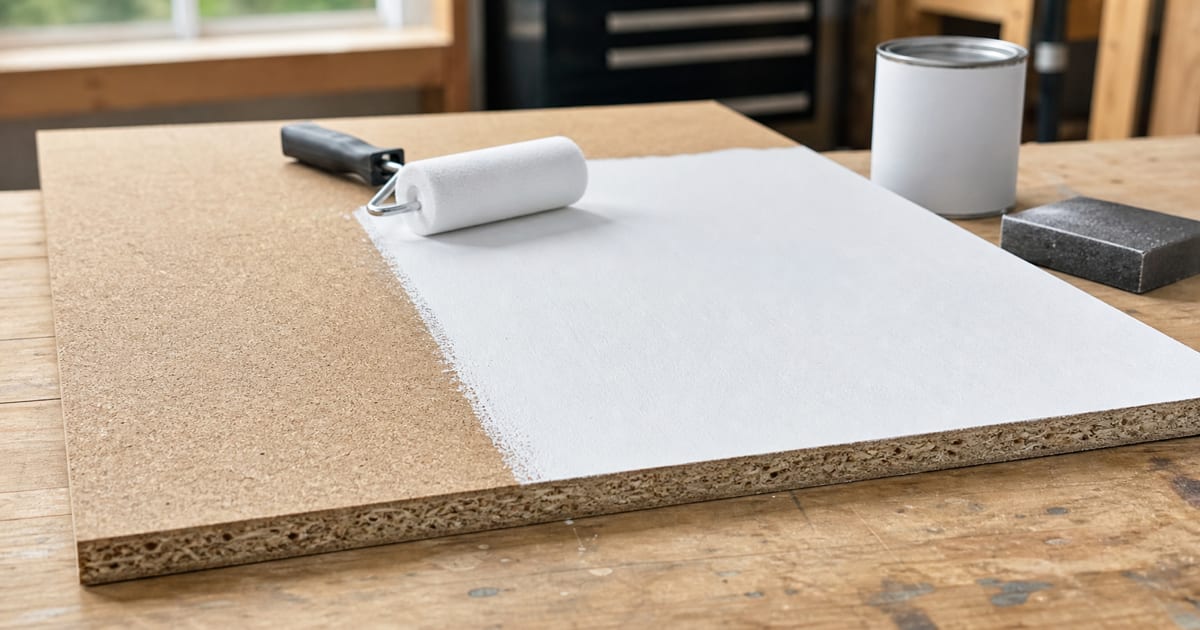
Particle board (and its cousin MDF) is cheap, flat, and everywhere — flat-pack furniture, shelving, cabinets. It paints up nicely, if you respect one thing: it's basically compressed wood dust and glue, so it drinks up liquid and swells when it gets wet. Get the sealing right and the rest is easy.
The catch: porosity and moisture
Raw particle board has two problem areas. The flat faces are often coated with a thin laminate that paint won't grip without sanding, while the cut edges are bare and sponge-like. Brush water-based paint straight onto those edges and they'll puff up and roughen. The fix is sealing everything before color goes on.
Step-by-step
- Clean and lightly sand. Wipe off dust and grease, then scuff the surface with fine sandpaper (220 grit) so primer can bite. Don't sand through any laminate into the core.
- Seal the edges. Hit the porous cut edges with primer (or a thin coat of wood filler sanded smooth) so they don't swell.
- Prime with a stain-blocking primer. An oil- or shellac-based primer (like a BIN or Kilz product) seals the surface without adding the water that makes the board swell. This is the most important step.
- Paint two thin coats. Once primed, almost any quality latex or enamel works. Two light coats give a smoother, more even finish than one thick one.
- Topcoat if needed. For tabletops, shelves, or anything near moisture, add a clear polyurethane to protect against water and wear.
Mistakes to avoid
Don't skip the primer and go straight to paint — you'll get blotchy absorption and poor adhesion. Don't soak it with water-based products on bare edges. And don't rush the coats; let each dry fully so the surface doesn't lift.
A clean finish starts with a clean brush. See our tested paint brush picks for the smooth, streak-free coats particle board needs.
Frequently Asked Questions
-
Yes — priming is the step you can't skip. A stain-blocking, oil- or shellac-based primer seals the porous surface so paint goes on evenly and sticks. Painting bare particle board leads to blotchy absorption and peeling.
-
Water got into the bare core — usually from a water-based primer or paint applied to unsealed edges. Seal all cut edges first and use an oil- or shellac-based primer to keep moisture out.