// data-verified

Best Drywall Knives of 2026

Drywall mud is forgiving stuff right up until it isn't. A seam that feathers out clean in one pass and one that turns into an hour of sanding are usually separated by the blade in your hand — how stiff it is, how the edge is ground, and whether it's the width the joint actually asked for. I've patched ceilings, scraped wallpaper off old plaster, and re-taped seams in a house that had already settled, and the lesson repeats every time: the knife is the cheapest part of the job and the one that decides how the rest of it goes.

We've spent the past four months working 18 taping and putty knives through patches, seams, and scraping jobs, and the pattern is clear. The ones that held up had stiff spines and clean, burr-free edges; the ones that didn't chattered under a full load of mud or dragged and tore the paper face. Here's what first-timers tend to miss: you don't really buy one knife. A narrow putty knife scrapes and handles tight patches, a 6- to 10-inch taping knife runs the seams, and a 12- or 14-inch blade is what feathers a butt joint flat — which is why sets are how most people get there, and why it's worth checking which widths you're actually paying for.

The picks below were chosen for the whole arc of a repair, from scraping to the final pass, and for handles you can grip with mud on your hands.

#01

Best Overall

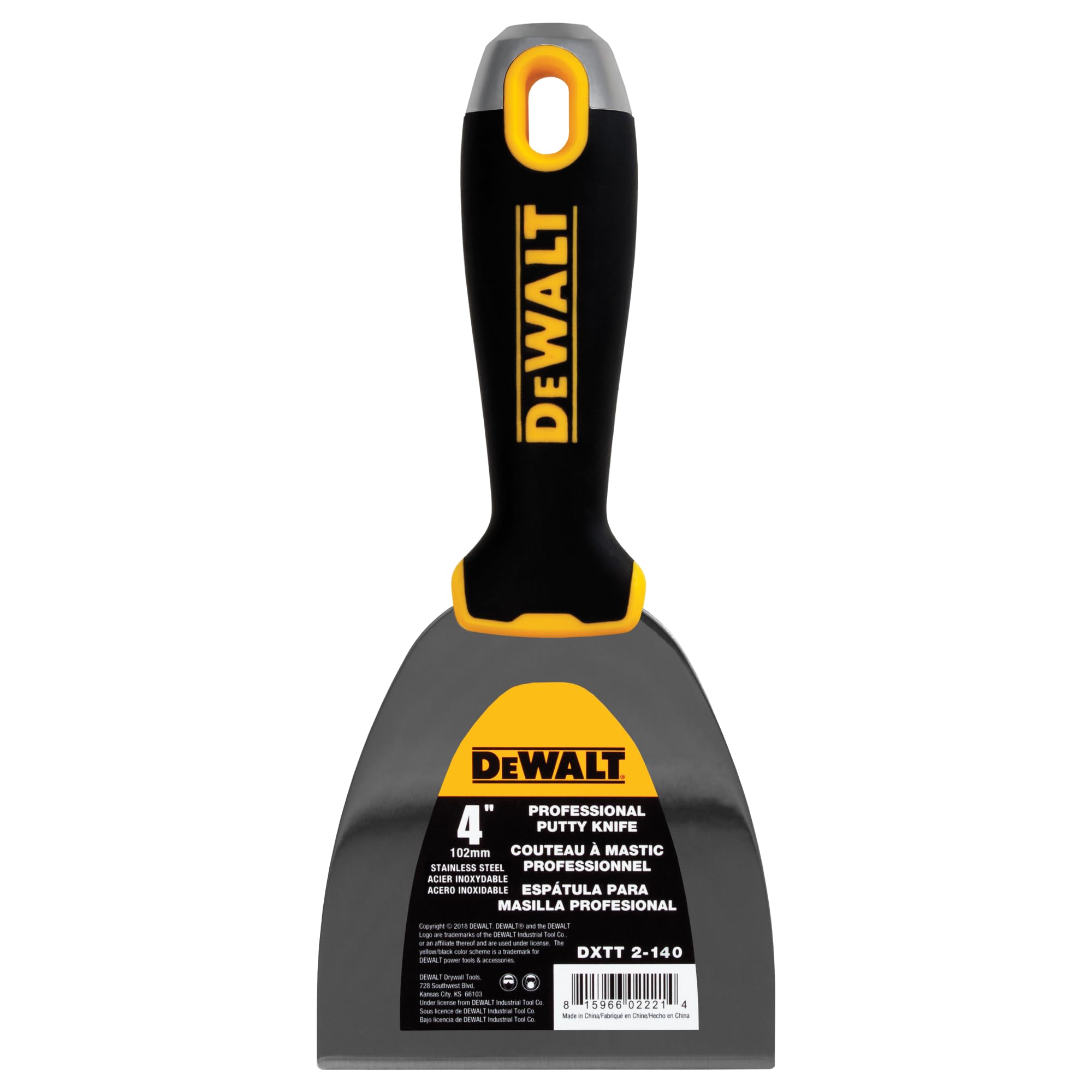
DEWALT 4" Putty Knife

93 /100
Kirk Score Outstanding
Blade
Hollow-ground stainless steel
Handle
Double-riveted nylon soft grip
Hammer End
Alloy metal
Blade Width
4 in
Check Details on Amazon

Pros

  • Hollow grind feathers compound without digging
  • Four-inch width covers patches and short seams
  • Hammer end sets proud nails on ceilings
  • Stainless blade with a lifetime limited warranty

Cons

  • One width only, so taping needs a wider blade

The blade on the DEWALT 4-inch is hollow-ground, which means it thins from the spine down so it flexes partway up the blade rather than right where it meets the handle. That one detail is why it sits at the top of this list: you can pull a pass of compound, feel the blade flatten against the wall, and feather the edge out instead of leaving a ridge. It arrives feeling broken in rather than stiff, which is not true of every knife here.

Four inches is the width we reach for most often. It's wide enough to bridge a taped seam and pull a short coat, and narrow enough to work a patch alongside a door casing without smearing the frame. The handle is nylon over a full tang with two rivets, and at 4.8 ounces the knife stays light enough for ceiling work. The blade is stainless, and it's backed by a lifetime limited warranty.

A hollow grind is a finishing tool, not a scraper. Lean on it to lift cured compound and the blade flexes away from the wall instead of getting under the lump, so keep a stiff putty knife beside it for removal and let this one do the spreading. That division of labor is what the grind is for, and fighting it is how people end up with a wavy edge and a bad temper.

The detail we've come to appreciate most is the alloy hammer end. Finishing a ceiling means finding proud nails, and setting them with the butt of the knife saves a trip down the ladder; the same end takes the impact when a tool lands blade-first on a floor, which is how a bent tip usually happens.

Bottom line: For patching, short seams, and general finishing, this is the knife we hand people first: the hollow grind feathers compound cleanly and the hammer end earns its keep.

Check Latest Price
#02

Best for Patching and Detail

LEVEL5 2" Joint Knife

93 /100
Kirk Score Outstanding
Blade
Hollow-ground stainless steel
Handle
Glass-reinforced nylon soft grip
Hammer End
Alloy metal
Blade Width
2 in
Check Details on Amazon

Pros

  • Flex point sits mid-blade for control
  • Corners arrive de-burred and ready to use
  • Grip resists twisting with a nylon core
  • Hammer end for setting nails

Cons

  • Two inches only, so patches and detail rather than taping

Our top pick is four inches wide; this one is two, and that half-width is the entire argument. Two inches slides into the corner where a casing meets a wall, presses a patch flat over a doorknob-sized hole, and works compound into a crack you can barely see without dragging mud across the surrounding paint.

LEVEL5 grinds the blade hollow so the flex point sits midway up rather than at the handle, and that's the part we noticed in use: the blade lies flat and feathers instead of hinging. The glass-reinforced nylon core keeps the handle from twisting when you roll the knife onto its edge. It also arrives with the sharp corners of the blade already knocked off, which matters more than it sounds — the cheaper stamped sets here can bite the hand that wipes them down.

The soft grip runs the full length of the handle and stays usable when your palm is slick with compound, and the alloy hammer end lets you set a proud nail without putting the knife down. It's the blade we pull out after the four-inch, once the broad work is done and the detail starts.

Bottom line: The best small knife here for filling, patching, and detail: a properly ground flexible blade that arrives ready to work instead of needing a file first.

Check Latest Price
#03

Best for Taping Wide Seams

LEVEL5 10" Taping Knife

93 /100
Kirk Score Outstanding
Blade
Stainless steel, precise flex
Handle
Glass-reinforced nylon soft grip
Blade Width
10 in
Item Weight
9.17 oz
Check Details on Amazon

Pros

  • Ten-inch blade covers a seam in one pass
  • Even flex in a corrosion-resistant blade
  • Light for its size at 0.26 kg
  • Hammer end and large hang hole

Cons

  • Wide blade is clumsy in closets and around door frames

A ten-inch blade isn't a bigger version of a small one; it does a different job. You load the edge and pull the full height of a taped seam in one pass, then lay the blade down and feather the outside edges so the next coat has something to blend into. Every stop halfway across a seam leaves a ridge you sand later, and that's the argument for width. The LEVEL5 has the flex to follow a slightly bowed stud without chattering, and the stainless blade tracks flat.

At 0.26 kg it's light for its size, and the full soft grip with a glass-reinforced nylon core is built for the long pulls where a wrist starts to complain. The alloy hammer end and the large hang hole are the right extras on a tool this big. It's the second knife you buy, not the first: a ten-inch blade is a poor choice for a doorknob patch and needs a 2- or 4-inch beside it to make a kit.

Bottom line: If you're taping or floating whole seams, this is the blade: wide, evenly flexible, and light enough to pull a full coat with less fighting.

Check Latest Price
#04

Best Set for a Whole Room

Goldblatt 5-Piece Taping Set

93 /100
Kirk Score Outstanding
Blade
Tempered stainless steel, aluminum backing
Handle
Polypropylene soft grip
Pieces
5
Blade Widths
6, 8, 10, 12, and 14 in
Check Details on Amazon

Pros

  • Five widths cover taping through finish coats
  • Flex right for feathering and control
  • Hammer end and hang hole on every knife
  • Carries in one hand at 3.2 lb

Cons

  • No blade under 6 in for cracks and small patches

Five knives is a different purchase from one, and this is the most expensive item here. What the money buys is the whole ladder — 6, 8, 10, 12, and 14 inches — which is the range you work through as a job goes from bare tape to a finish coat you can sand lightly.

The blades are tempered stainless with an aluminum backing, and they flex the way a finishing blade should: enough to press flat for feathering, with a stiff heel that keeps the coat under control. The set weighs 3.2 pounds, light enough to carry in one hand, and every handle is polypropylene with an alloy hammer end and a large hang hole.

The 6- and 8-inch knives do most of the work in a normal room, the 10-inch pulls a full-height coat, and the 12 and 14 are for the wide, thin passes that decide how much you sand. Working through them in order is the closest thing to a system in this category.

For a room's worth of new drywall, this is the set we point people to — buying the widths one at a time costs more, and the sizes match the way the work actually progresses. On a hallway wall or in a closet, though, the 14-inch blade runs out of room to lie flat and you'll finish the pass with the 8.

Bottom line: For taping and finishing a whole room, this is the set: every coat has a blade, the flex is right, and you stop improvising with the wrong width.

Check Latest Price
#05

Best Midrange Set

DEKEones 4-Piece Set

94 /100
Kirk Score Outstanding
Handle
PP and TPR soft grip
Material
3CR13 stainless steel
Blade Widths
2, 4, 6, and 8 in
Blade Thickness
0.8 mm, full flex
Check Details on Amazon

Pros

  • Full-flex blades taper a patch out cleanly
  • Corrosion-resistant 3CR13 stainless blades
  • Finger rails keep your grip from sliding
  • Four useful widths in one purchase

Cons

  • Full-flex blades skate over cured compound

Eight inches is where this set stops, and that tells you the job: nail holes, patch panels, a couple of seams. Within that job there's a lot to like, starting with four widths — 2, 4, 6, and 8 inches — that cover the repairs most people actually make.

The blades are 0.8 mm, the thinnest here, ground full-flex, and the difference shows when you lay the knife down to feather: the coat tapers out instead of ending in a ridge. The 3CR13 stainless is mirror-polished and wipes clean easily, and the handle is TPR over PP with a finger rail along each side that keeps your thumb from sliding forward into the mud. A storage bag comes with it.

Something to keep in mind: a blade this flexible is for spreading, not scraping. It will skate over a cured lump rather than lift it, so keep a stiff 2-inch for removal work. For patching around a house — the dings in a hallway, a moved outlet, a doorknob hole — the four blades are the whole kit.

Bottom line: The best value here for patches and small repairs: four flexible, polished blades at roughly what one premium knife costs.

Check Latest Price
#06

Cracks and detail

Rerdeim 5-Piece Putty Set

93 /100
Kirk Score Outstanding
Handle
Rubber and plastic
Pieces
5
Material
Stainless steel
Blade Widths
1, 2, 3, 4, and 5 in
Check Details on Amazon

Pros

  • Sizes down to 1 inch for cracks and detail
  • Stainless blades that resist corrosion
  • Five widths for very little money

Cons

  • Handles feel basic during long overhead work

The 1-inch knife is why this set is here. Nearly everything else on this list starts at 2 inches, and 1 inch is the blade that gets into a hairline crack, works along a popped seam, or cleans paint out of a hinge mortise. You get every width from 1 to 5 inches for less than the midrange single knives here.

The blades are stainless, the handles are rubber over plastic with hang holes, and the whole set weighs 12.7 ounces. The edges are the catch: the sides of these blades come sharp enough to nick a thumb when you wipe them down, and the working edge isn't always honed straight out of the package. Ten minutes with a fine file along the two sides and a few strokes on the edge changes the set completely.

What we appreciate is that the set removes the excuse. With every width on the rail you stop improvising with the wrong knife, and the small sizes the other sets skip turn out to be the ones you reach for on repairs. That's worth ten minutes of prep.

Bottom line: Buy this for the width range: five sizes down to 1 inch at the bottom of the price range here.

Check Latest Price
#07

Occasional patch jobs

Beyotool 4-Piece Set

93 /100
Kirk Score Outstanding
Handle
Rubber and plastic
Pieces
4
Material
Stainless steel
Blade Widths
2, 3, 4, and 5 in
Check Details on Amazon

Pros

  • One-piece body with no joint to loosen
  • Stainless blade resists corrosion
  • Four widths at the cheapest price here

Cons

  • Sizes stop at 5 in, so no taping widths

The blade and handle on these are formed as one piece rather than riveted together, so there's no joint to work loose. That's the real appeal of a set priced below everything else here: fewer parts, nothing to wobble.

Two things to know before the first coat. The working edge comes square from the press rather than honed, so it pushes compound ahead of it until you run a file along the edge, and the side edges can be sharp enough to catch a finger. Ten minutes of dressing fixes both, and the stainless blade and rubberized handle are decent once you've done it. Sizes are 2, 3, 4, and 5 inches.

For occasional patching — a rental, a first apartment, a wall full of anchor holes — four widths for the least money here is a sensible buy, and the sizes match the repairs most people actually make. If the work might grow into taping, spend the difference on the DEKEones set: the blades are better finished and go wider.

Bottom line: A good buy for a renter with a list of small holes to fill: four widths that match the repairs most people make, at the least expensive end of the range.

Check Latest Price
#08

Small wall repairs

Amazon Basics 2" Putty Knife

93 /100
Kirk Score Outstanding
Blade
Taper-ground carbon steel
Handle
Nylon
Blade Width
2 in
Construction
Full tang, two rivets
Check Details on Amazon

Pros

  • Riveted full tang holds the blade straight
  • Carbon steel takes a fine edge
  • Light and short for small repairs
  • One-year limited warranty

Cons

  • Patch-size blade only, with no seam coverage

The job this knife is built for is the doorknob hole. A 2-inch blade fits inside the crater, lays compound over the patch, and feathers the repair flat without dragging mud onto the surrounding paint. At 7.25 inches long and a couple of ounces, it disappears into a tool bag until you need it.

The blade is taper-ground, mirror-polished carbon steel on a full-length tang with two rivets through a nylon handle. Carbon steel takes a keener edge than most stainless, and it also rusts if you put it away damp — rinse it, dry it, and it will outlast the handle.

Construction is where this one punches above its price. Two heavy-duty rivets through a full tang is the same approach the more expensive knives here take, and the 55/45 steel-to-nylon build keeps the weight down without making the handle feel hollow. It's backed by a one-year limited warranty.

We keep this one in the house rather than the toolbox: for two or three wall repairs a year it's all the knife you need, and the polished face wipes clean with a thumb where a rougher blade would hold compound.

Bottom line: For a handful of wall repairs a year, this is plenty of knife: a keen carbon steel blade on a riveted tang for very little money.

Check Latest Price

How We Chose and Tested the Best Drywall Knives

We started by gathering every taping and putty knife we could find that named its blade steel, offered a real spread of widths, and had a handle that wouldn't turn slick once mud was on it. Anything with vague blade specs or no size options got filtered out, then we bought 18 knives — singles and sets — and put them to work over four months.

They lived in a bucket, not on a lab bench. We used them to patch nail holes and fist-sized dents, tape fresh seams on scrap drywall panels, feather out finishing coats, and scrape wallpaper and old adhesive off plaster in a stairwell. After each session every knife was rinsed, dried, and put back wet-handed the way it happens on a real job.

At each step we noted what the blade actually did. We looked at whether the edge arrived ground clean or with a burr that dragged and scored the paper, whether the corners were sharp enough to gouge a fresh patch, and whether the handle seams had flashing that cut into a palm. Flexible blades got wrapped over curves to see if they chattered; stiff ones got loaded with mud to see if they stayed flat. The hammer-end butts were used to seat nails and knock out old fasteners, which told us quickly whether they'd mushroom. Over the following weeks we watched for rust spotting and loose handles, judged each set on whether its widths were useful or just filler, and weighed the per-knife cost against how the thing finished.

How to Choose a Drywall Knife

Match the Blade Width to the Coat

A 1- to 2-inch blade is for cracks, doorknob holes, and detail work. Three to 5 inches covers patch panels and short seams. Six to 8 inches is the working range for taping and the second coat, and 10 inches and up is for pulling a full-height coat and feathering it wide enough that sanding stays light.

The trap is the word complete. Sets built around taping start at 6 inches and have nothing for the hole you need to fix first; sets built around putty work stop at 5 inches and can't tape. If you're buying one knife, 4 inches is the most versatile width. If you're buying one set, make sure a 2-inch blade is in it.

Flex and Grind Decide the Finish

A flexible blade lies flat and feathers compound out to nothing; a stiff blade scrapes and pries. You want flex for smoothing and stiffness for lifting, and no single knife does both well. The grind sets where the bend happens: a hollow grind thins the blade so it flexes partway up, keeping the working edge flat against the wall, while a plain stamped blade tends to hinge near the handle and dig.

Buy flex for finishing and keep a separate stiff scraper for cured mud. A full-flex blade of about 0.8 mm is a smoothing tool, and leaning on one to lift a lump rolls the edge and takes the flat out of it.

Check the Edges Before the First Coat

Stainless, including 3CR13, shrugs off compound and damp; carbon steel takes a keener edge but rusts when it goes away wet. Either is workable — the difference is a rinse and a dry rather than a soak.

The edges matter more than the steel. Stamped blades often arrive with side edges sharp enough to nick a finger and a working edge that is square rather than honed, so the knife pushes compound ahead of it instead of laying it down. Ten minutes with a fine file along both sides and a few strokes on the edge is the difference between a set that frustrates you and one you keep.

Handles, Hammer Ends, and Sets Versus Singles

Over an hour of overhead work the handle earns its keep: a soft grip over a rigid core, glass-reinforced nylon or TPR over PP, resists twisting when your palm is slick. A double-riveted full tang and a one-piece stamped body both hold up, so pick on feel rather than construction alone. A metal hammer end is genuinely useful on a ceiling, where proud nails show up on every pass.

Then decide scope. One well-ground 4-inch knife plus a 10-inch taping knife covers more real work than five poorly finished blades, but a room's worth of new drywall goes faster with every width on the rail.

Frequently Asked Questions

Final Verdict

The DEWALT 4-inch is the knife we recommend as a default. The hollow grind feathers compound instead of digging, the hammer end saves trips up a ladder, and 4 inches covers both patches and short seams without being clumsy at either.

If you're taping a room rather than patching one wall, buy widths instead: the Goldblatt set runs 6 through 14 inches and takes a whole job from bare tape to finish coat, while the LEVEL5 10-inch is the single blade to add beside a 4-inch knife when the work is seams rather than holes.