// data-verified

9 Best Drywall Screw Guns in 2026: Cordless Speed, Corded Steadiness

Find the right drywall screw gun for your project, from cordless speed demons to rock-steady corded workhorses that never bog down.

Nothing slows down a drywall job like a screw gun that won't hold its depth setting. One screw sinks too deep, the next stands proud—forcing you to stop and readjust. This inconsistency is a frequent grievance among DIYers and pros alike, often tied to finicky depth collars or weak locking mechanisms.

This guide cuts through that noise by focusing on tools where depth control stays locked in, whether you're hanging a single room or a whole addition. You'll also confront the cordless-versus-corded decision: battery-powered guns offer freedom to move but may fade on large jobs, while corded models provide unlimited runtime at the cost of a power cord. The right choice comes down to your project's square footage and your patience for battery swaps.

#01

Best Overall

Milwaukee 2866-20

91 /100
Kirk Score Outstanding
RPM
4500 RPM
Weight
2.5 lbs
Power Source
Battery 18V
Depth Adjustment
Adjustable nosepiece
Check Details on Amazon

Pros

  • Magnesium gear housing and all-metal gear case stand up to daily jobsite abuse.
  • 4,500 RPM delivers fast, consistent screw driving, matching corded speed.
  • At just 2.5 lbs, it’s exceptionally light for all-day overhead use.

Cons

  • Auto-start sensor can miss screw engagement at certain angles, requiring a manual trigger pull.

The Milwaukee 2866-20’s brushless motor spins at 4,500 RPM, delivering a pace that keeps up with corded guns while ditching the cord. At 2.5 pounds, the tool balances effortlessly overhead, and the depth-adjustment collar stays put once set — a small detail that prevents overdrives across hundreds of screws. The magnesium gear housing and all-metal gear case shrug off jobsite bumps. Auto-start spins the motor only on contact, so you hear the tool only when it’s working, and battery drain stays low.

The auto-start sensor may not pick up every screw at sharp angles, requiring an occasional trigger pull, but in flat wall and ceiling work this is rarely a problem. Overhead, the 2.5-pound weight reduces shoulder fatigue across long days. The gun is a natural fit for M18 users who hang drywall daily and want top-tier speed without cord tangle. It’s not aimed at buyers without existing M18 batteries or those tackling a single room — a corded screw gun would be a more cost-effective choice.

💡 Tip: Keeping the nosepiece flush against the surface helps the auto-start engage consistently.

Bottom line: For M18 users hanging drywall professionally, the 2866-20’s cordless speed and feather-light balance make the occasional auto-start hiccup a reasonable tradeoff.

Check Latest Price
#02

Best Combo Kit

DEWALT DCK265D2

88 /100
Kirk Score Excellent
RPM
4400 RPM
Weight
2.6 lbs
Power Source
Battery 20V
Depth Adjustment
Adjustable nosepiece
Check Details on Amazon

Pros

  • Brushless motors in both tools deliver longer runtime and less maintenance
  • Complete kit includes screw gun, cut-out tool, two 2.0Ah batteries, and charger
  • Good entry point for the DEWALT 20V platform, offering two tools at a mid-range price

Cons

  • The screw gun trigger may fail or jam during extended use, requiring early testing

The DCK265D2 bundles the DCF630 screw gun and DCE555 cut-out tool, giving you two essential drywall tools on the DEWALT 20V platform from a single box. The screw gun spins at 4400 RPM for fast screw driving, while the cut-out tool handles outlet boxes and fixture openings. Two 2.0Ah batteries and a charger mean you can start a drywall hanging and cutting project immediately — no separate battery purchases needed.

New DEWALT users or DIYers who need both tools will find good value in this kit, especially for one-room or occasional projects. The screw gun's trigger mechanism may fail or jam in some units, so this setup suits lighter use rather than continuous daily production. If you already own DEWALT batteries and need only a screw gun, the single tool is a better fit.

💡 Tip: Run a batch of test screws to check the trigger and depth adjustment before beginning finished work; this catches early issues while return options are open.

Bottom line: For a DIY drywall project where both a screw gun and cut-out tool are needed and you're starting on the DEWALT platform, this kit offers practical value. The trigger concern is manageable by testing during the return window and using for occasional jobs.

Check Latest Price
#03

Best Auto-Feed System

DEWALT DCF620CM2

87 /100
Kirk Score Excellent
RPM
3500 RPM
Weight
Power Source
Battery 20V
Depth Adjustment
Collated depth set
Check Details on Amazon

Pros

  • Collated auto-feed system nearly doubles screw driving speed over single-feed guns.
  • Brushless motor delivers 3500 RPM without a cord, matching corded gun pace.
  • Kit includes two 4.0Ah batteries and charger, keeping downtime minimal on extended jobs.

Cons

  • Collated attachment can misfeed or jam if the tool isn't held at the correct angle

The DCF620CM2 centers on a collated attachment that feeds screws in rapid succession, turning drywall hanging into a smooth one-handed rhythm. A 3500 RPM brushless motor matches corded pace without the cord drag, and two 4.0Ah batteries and charger are included to sustain long shifts.

This kit is aimed at professional crews hanging hundreds of sheets a week. The time saved per sheet makes the premium cost easy to absorb. The tradeoff is that the collated mechanism is sensitive to gun angle — tilt it and you will get jams. The technique builds over a few jobs, making it the wrong tool for a one-off basement or small-room patch.

💡 Tip: Practice on scrap drywall until the 90-degree angle becomes muscle memory — consistent pressure eliminates most jams.

Bottom line: A production tool that earns its keep on high-volume drywall jobs, but the learning curve makes it overkill for occasional use.

Check Latest Price
#04

Best Corded Reliability

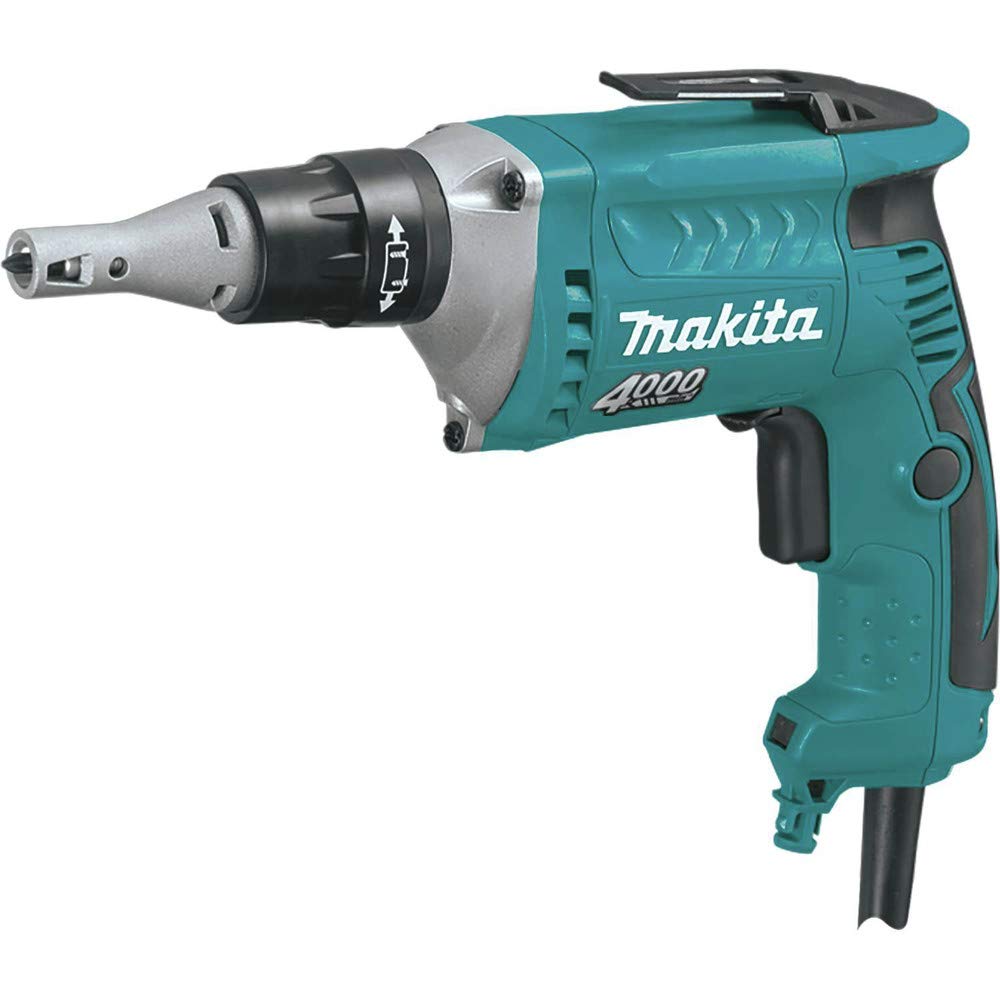
Makita FS4200

91 /100
Kirk Score Outstanding
RPM
4000 RPM
Weight
3.0 lbs
Power Source
Corded 6.0A
Depth Adjustment
Standard nosepiece
Check Details on Amazon

Pros

  • Flawless performance across extended daily use
  • 3.0-lb weight significantly reduces overhead fatigue
  • Straightforward setup and depth adjustment right out of the box

Cons

  • Lacks auto-start and push-drive; depth adjustment is simple nosepiece only

Flawless performance at 3.0 pounds makes this Makita a standout for ceiling work. The 6.0-amp motor spins at 4,000 RPM steadily, without the sag or battery swaps of cordless guns. Build quality stands up to thousands of screws, and the LED light helps in dim corners.

This tool suits professional drywallers who value lightweight handling and consistent power over extras like auto-start or push-drive. The depth nosepiece is straightforward and holds its setting. If your workflow already uses extension cords and you want a gun that keeps going without interruption, this mid-range Makita is the practical choice.

Bottom line: For drywall crews who plug in and don't look back, the FS4200 delivers consistent lightweight performance that outlasts gimmicks.

Check Latest Price
#05

Best Budget Cordless

RYOBI P225

86 /100
Kirk Score Excellent
RPM
4700 RPM
Weight
2.7 lbs
Power Source
Battery 18V
Depth Adjustment
Adjustable nosepiece
Check Details on Amazon

Pros

  • Performs better than expected for its price class
  • Simple setup and operation, ideal for drywall beginners

Cons

  • Magnetic bit holder can let bits slip off screw heads during use

The RYOBI P225 spins up to 4700 RPM from a brushless motor, delivering speed that punches above its budget class. Compared to the top pick’s cordless speed king, this one trades auto-start smart features for a simple trigger and a price that’s easier on the wallet. It’s a natural fit for DIYers already invested in Ryobi ONE+ batteries who want a solid drywall driver without spending much. However, the magnetic bit holder can let bits slip off screw heads, so if you need flawless bit retention for production work, this isn’t your tool.

Bottom line: A cost-effective cordless choice for Ryobi ONE+ users, but the weak magnet means you’ll occasionally chase a bit — acceptable for DIY, not for all-day pros.

Check Latest Price
#06

Makita cordless users

Makita XSF03Z

90 /100
Kirk Score Outstanding
RPM
4000 RPM
Weight
3.0 lbs
Power Source
Battery 18V
Depth Adjustment
Adjustable nosepiece
Check Details on Amazon

Pros

  • Brushless motor provides enough power for drywall and light framing.
  • Battery life can stretch a full workday, reducing charger dependency.

Cons

  • Dropping the tool can cause nose cone or drive shaft breakage.

The brushless motor and push-drive mode deliver excellent battery life and quiet operation for light to moderate drywall work. However, the nose cone and drive shaft may break if the tool is dropped, limiting its suitability for daily professional use.

Bottom line: Fits Makita 18V owners doing occasional drywall work where cordless convenience matters, as long as the tool is handled with care.

Check Latest Price
#07

Budget auto-feed

Senco DS342-AC

89 /100
Kirk Score Excellent
RPM
2500 RPM
Weight
6.6 lbs
Power Source
Corded
Depth Adjustment
Collated depth set
Check Details on Amazon

Pros

  • Auto-feed design saves significant time driving hundreds of screws per day
  • One-handed operation simplifies positioning material and reduces fatigue

Cons

  • Early failure has been noted on some units, which can interrupt a workday

The Senco DS342-AC auto-feed screwdriver handles screws up to 3 inches, a reach missing from typical collated tools. Its one-handed auto-feed speeds up drywall and decking jobs. Durability is less predictable than pricier rivals; a unit may fail early. This tool suits contractors who need the extra length occasionally and can tolerate that risk, not high-stakes production.

Bottom line: A practical option when you need an auto-feed driver that handles 3-inch screws occasionally, and the occasional DOA unit won't stop the job. For daily high-volume production, the pricier DEWALT system provides more peace of mind.

Check Latest Price
#08

Subfloor fastening

Senco DS232-AC

89 /100
Kirk Score Excellent
RPM
2500 RPM
Weight
5.8 lbs
Power Source
Corded
Depth Adjustment
Collated depth set
Check Details on Amazon

Pros

  • Collated screw feed runs smoothly without jamming, minimizing downtime.
  • Delivers fast, consistent screw placement to speed up large flooring jobs.

Cons

  • Accepts only 2-inch screws, excluding drywall applications that require longer fasteners.

The DS232-AC drives collated 2-inch screws into subfloor and decking without jamming, keeping work moving at a steady pace. It is not built for drywall — no depth-sensing nosepiece and a 2-inch screw limit rule it out for hanging sheetrock. For deck crews who work exclusively with short fasteners, this corded driver offers consistent speed.

Bottom line: A specialized workhorse for decking and subfloor crews who rely on 2-inch collated screws and want a no-fuss, jam-free auto-feed.

Check Latest Price
#09

Metal fastening

DEWALT DCF622B

90 /100
Kirk Score Outstanding
RPM
2000 RPM
Weight
2.8 lbs
Power Source
Battery 20V
Depth Adjustment
Check Details on Amazon

Pros

  • High torque and Versa-Clutch allow precise depth control in steel and thick metal fastening.
  • Robust construction withstands repetitive metal-to-metal driving without premature wear.

Cons

  • Cannot set screw depth consistently for drywall

The DEWALT DCF622B delivers 2000 in-lbs of torque with a Versa-Clutch adjustable clutch for precise control when fastening metal roofing and steel framing. Its solid build holds up to heavy-duty use. It lacks a drywall depth-sensitive nosepiece, so it cannot set screws consistently for drywall finishing — it is strictly a metal-to-metal screw gun.

Bottom line: For metal roofing and steel framing crews, this tool provides the torque control needed, but drywall installers should choose a dedicated screw gun with a depth stop.

Check Latest Price

How to Choose

RPM

Higher RPM drives screws faster, but the speed can drive a screw too deep before the depth stop engages, especially on softer studs. 4000-4500 RPM is the sweet spot for drywall; a 6000 RPM gun demands careful pressure control to avoid blowing through the paper face.

Power Source

Cordless guns offer mobility for room-to-room work, but a compact 2.0Ah battery can die before you finishing hanging a single room. Keep a charged 4.0Ah or larger spare on hand. Corded models never run out of power, but you'll manage a cord around ladders and scaffolding.

Weight

A 2.5-lb gun feels nimble overhead for hours; a 6.6-lb auto-feed system will fatigue your shoulders and degrade screw consistency on ceilings. If your project includes overhead work, every ounce matters.

Depth Adjustment

A nosepiece with a positive lock and marked detents stays put after adjustment. Cheaper collars can rotate unintentionally, causing screw heads to sink too deep or stand proud. Test on scrap drywall and check flushness after a dozen screws.

Auto-Feed Capability

Collated attachments speed up screw placement dramatically, but the strips cost more per screw and jams often stem from inconsistent angle or drywall dust. For a single room, a manual gun is often faster once you factor in setup and jam-clearing time.

Frequently Asked Questions