// data-verified

Best Porcelain Repair Kits of 2026

A chip in a porcelain sink is a small thing that gets bigger every time you look at it. Repair it badly and a two-minute accident becomes a permanent reminder: a cloudy blob on the enamel, a handle that lets go when the mug is full of hot coffee, a patch that yellows inside a month. A good kit does the opposite — the color disappears into the fixture, the bond outlasts the glaze around it, and nobody but you knows the piece was ever broken.

Format matters more than the label. A thin liquid glue wicks into a hairline crack and holds like a weld, but it can't rebuild a missing corner; a two-part putty sculpts a new edge, but it won't seep into a tight fracture. White isn't one color either — the shade that vanished against my sink looked grey against a friend's tub.

We spent four months with 14 kits, from runny cyanoacrylates to kneadable epoxies, repairing mugs, a serving bowl, and a chipped bathroom sink. These are the ones that held.

#01

Best Overall

LOOCTOT Ceramic Glue 30g

89 /100
Kirk Score Excellent
Volume
1.05 oz
Set Time
10–30 seconds
Cured Finish
Transparent
Water Resistance
Waterproof
Check Details on Amazon

Pros

  • Anti-clog cap keeps the bottle usable
  • Sets in 10 to 30 seconds
  • Cures transparent on visible repairs
  • Fine applicator tips for tight breaks

Cons

  • Won't fill a gap or rebuild a chip
  • Small 1.05 oz bottle

A bottle of ceramic glue usually dies at the nozzle. The cap welds itself shut between repairs, the tip skins over, and by the second chip you're poking at it with a pin. The LOOCTOT bottle is built around that annoyance: an anti-clogging cap and a set of fine applicator tips that put the glue exactly on the break instead of around it. That sounds like a small detail until you're holding two halves of a saucer in one hand.

It earns the top spot because it handles the repair most people actually have — a clean break or a hairline crack where the two surfaces still mate. The tensile number on the label matters far less than the 10-to-30-second set: fast enough to hold a chip in place with fingertip pressure, slow enough to nudge the pieces into alignment before it grabs. It cures transparent, which counts for more than any strength figure when the repair is on a mug handle or a figurine.

Where it earns its keep is control. The glue is liquid enough to wick into a tight crack without flooding a small repair, and the tips let you lay a bead along one edge rather than across the whole break. The technique we settled on: a thin film on one side, press, hold, and wipe the squeeze-out before it sets.

What it won't do is rebuild. If the chip took material with it, there's nothing here to fill the void, and a putty like Milliput is the right tool. The bottle is 1.05 ounces, which is plenty for a handful of small repairs and tight if you're working through a set — buy two if that's the job.

Bottom line: Our pick for most repairs: a fast, clear-setting ceramic glue whose anti-clog cap means the bottle still works the next time you need it.

Check Latest Price
#02

Best for Filling Chips

Milliput Superfine White

92 /100
Kirk Score Outstanding
Form
Two-part epoxy putty
Cure Time
3–4 hours
Total Volume
8 oz (two 4 oz packs)
Heat Resistance
Up to 266°F
Check Details on Amazon

Pros

  • Rebuilds chips and missing corners
  • Sands and paints to a flush finish
  • Waterproof and heat resistant to 266°F
  • Two 4 oz packs plus gloves

Cons

  • Can't wick into a tight hairline crack
  • Bright white reads cooler than a porcelain glaze
  • Three to four hours before you can sand

A chip is not a break, and it needs a different product. When a corner of a sink or the rim of a teapot has lost material, there are no two surfaces to pull together — you need something you can press into the gap, shape while it's soft, and sand flush once it hardens. Milliput Superfine White does that better than anything else here, which is why a pack of it lives in our workshop drawer despite costing more than every glue on this list.

The pack gives you two 4 oz bars of two-part epoxy putty plus two pairs of gloves. Knead equal parts until the color is uniform, press it into the chip, and you have generous working time to shape it before it goes rock hard in three to four hours. Once cured it sands, takes paint and stands up to water and heat, which is why it suits a sink edge or a shower tray as readily as a display piece.

Mixing is the whole technique: work the two parts until the color is even, press the putty in slightly proud of the surface, and leave it a little high so you have something to sand back. The two bars plus gloves make this the most complete kit here for filling work, and the white takes paint well enough to blend into a glazed finish.

Bottom line: Buy this when a piece of the object is missing rather than split — a sandable white putty that rebuilds chips, corners and gouges.

Check Latest Price
#03

Best for Tubs and Sinks

HT Hometinker Tub and Tile Kit

86 /100
Kirk Score Excellent
Form
Two-part epoxy gel
Volume
3.7 oz
Color Matching
Tintable colorants
Water Resistance
Waterproof
Check Details on Amazon

Pros

  • Tintable colorants for common fixture whites
  • Fills chips, dents and small holes
  • Bonds porcelain, fiberglass, acrylic and enamel
  • Resealable containers keep leftovers usable

Cons

  • Color match takes trial and error
  • Patch can lift where the fixture flexes

A clear glue closes a crack; it can't hide one. On a white tub or a porcelain sink, a chip leaves a shadow that no transparent adhesive will cover, and the repair has to match the fixture as well as fill it. That's the whole case for this kit: a 3.7 oz two-part epoxy gel sold with colorants you blend into the mix before it sets.

Matching is the part that decides whether the repair reads or disappears. Mix a small amount of the two parts, add tint a little at a time — it goes much further than you expect — and test the shade on paper or on the underside of the fixture before you commit it to the chip. Press it in, smooth the edges, and leave it alone until it cures.

We like it for sanitaryware: tubs, shower trays, sink rims and tile, on fiberglass, acrylic, enamel, porcelain and gel coat. A tub of tintable filler makes more sense there than a bottle of glue, because you're filling a shallow crater and matching it rather than closing a joint.

One limit worth knowing: it isn't for hairline cracks, where there's nothing for the gel to grip. Thin glue handles those. For a chip with depth, the resealable containers mean leftovers stay workable, which is more than you can say for a tube that sets in the nozzle.

Bottom line: The kit to buy when the chip is in a white tub or sink and has to match, thanks to colorants you blend into a two-part epoxy filler.

Check Latest Price
#04

Best for Bigger Jobs

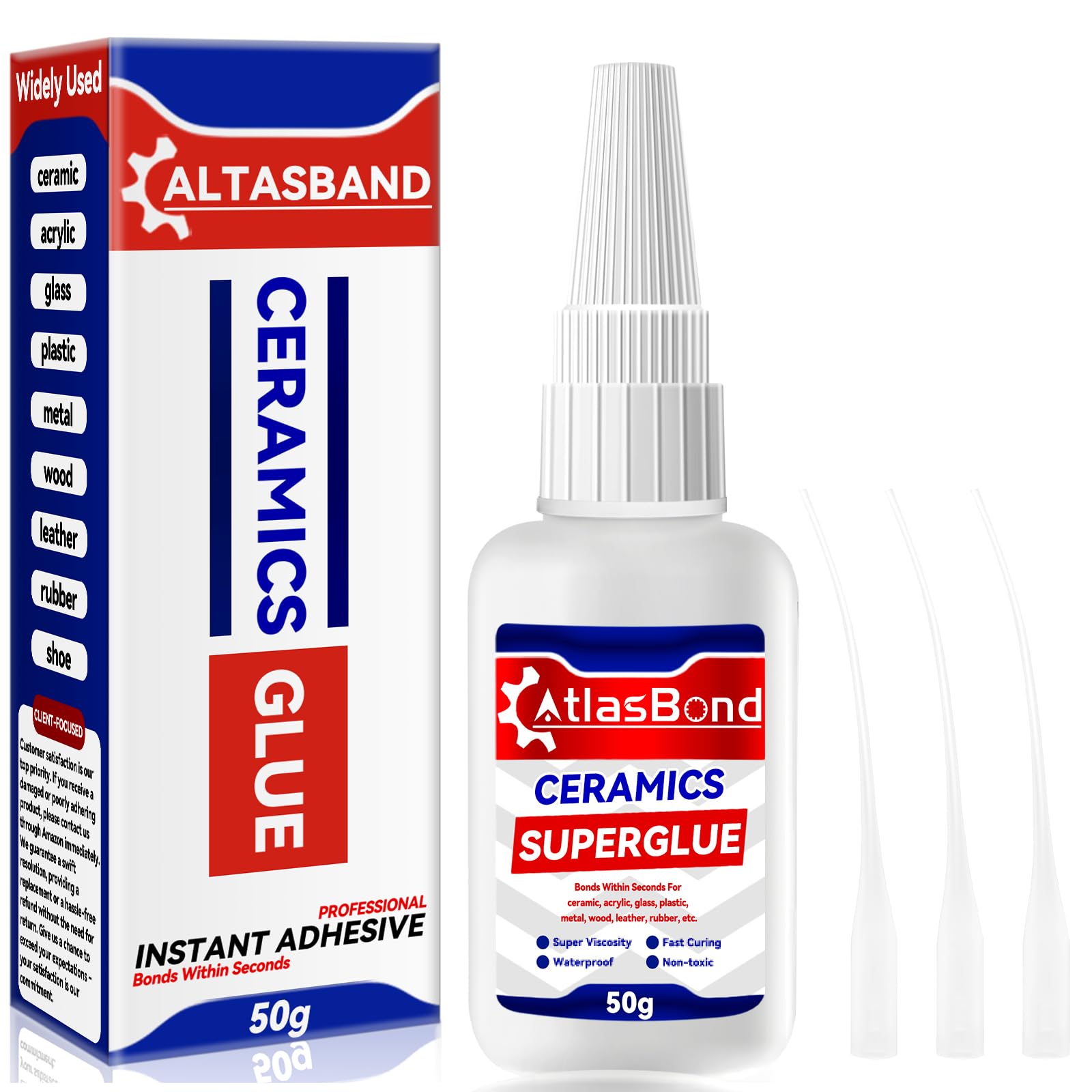
ATLASBOND Ceramic Glue

89 /100
Kirk Score Excellent
Volume
1.76 fl oz
Set Time
15 seconds
Cured Finish
Clear
Water Resistance
Waterproof
Check Details on Amazon

Pros

  • 1.76 fl oz
  • Sets in about 15 seconds
  • Three precision dispensing tubes
  • Waterproof and heat resistant

Cons

  • Little time to reposition multi-piece breaks
  • Cured line can look white on glazed ware

Volume is the quiet difference here. At 1.76 fluid ounces this bottle holds roughly one and a half times what the 30 ml bottles on this list do, and that changes how you use it: you stop rationing drops. For a repair that's really a dozen small ones — a shattered figurine, a stack of chipped saucers, a mosaic project — that's the difference between finishing the job and running out.

The 15-second set is quicker than the LOOCTOT and the SWIFFAR, and we count that as both the appeal and the catch. On a clean two-piece break you're done almost immediately. On anything with three or more pieces you need to dry-fit first, because there is very little time to slide a piece into position; tape, a stand or a second pair of hands helps more here than with the slower bottles.

It cures clear and holds through washing, and the three dispensing tubes get into narrow breaks. On a glazed cup, though, the cured line can read white rather than invisible, so it's better suited to a joint you'll see edge-on or a piece that will be painted or hidden.

Bottom line: A bigger bottle with a very fast set — ideal when you're gluing a lot of small pieces and can dry-fit before the glue grabs.

Check Latest Price
#05

Best Budget

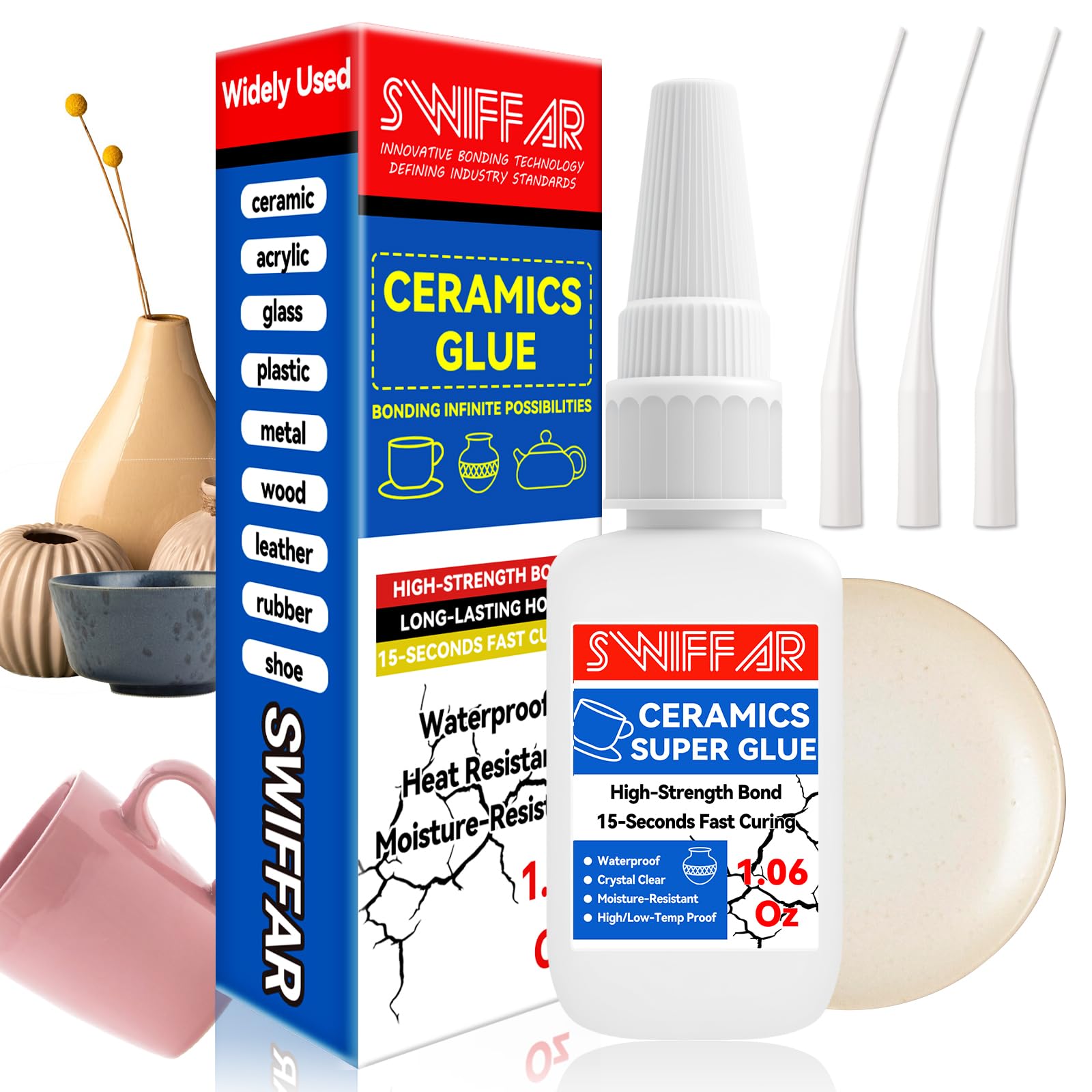
SWIFFAR Ceramic Glue

88 /100
Kirk Score Excellent
Volume
1.06 fl oz
Set Time
30 seconds
Viscosity
Low to medium
Cured Finish
Clear
Check Details on Amazon

Pros

  • Thin formula wicks into hairline cracks
  • Least expensive glue here
  • Sets in about 30 seconds
  • Three dropper tips included

Cons

  • Runs on vertical or porous surfaces
  • Small 1.06 fl oz bottle

This is the least expensive bottle here, and it behaves like a thin glue should: low-to-medium viscosity, a 30-second set, and a bead you can put exactly where you want it. On a hairline crack running across a plate or a fine split at a cup rim, thin is the advantage — the glue wicks into the crack and the joint closes almost invisibly. We rate it the best value of the clear glues here for exactly that reason.

The formula is an ethyl cyanoacrylate, so it's the same chemistry as most of the glues on this list; what your money buys is the bottle, the three droppers and a cure that stays colorless. It's waterproof and heat resistant once set, and it stays clear, which is what you want on anything white or translucent.

Where it's less forgiving is the thinness. A runny glue travels on a vertical face and soaks into unglazed clay or porous bisque, so keep the piece flat while it sets and use less than you think. On a vertical repair, a gel or a putty does a better job of staying where it's put.

The cap and the droppers are the practical part: the glue stays in the bottle between repairs, and the tips reach a split rim without flooding it. For a first repair, that makes it a low-risk way to find out whether you need anything more.

Bottom line: The best value of the clear glues here, thin enough to wick into a hairline and quick enough to finish in a minute.

Check Latest Price
#06

Mixed-material repairs

LMQ Lash Ceramic Super Glue

91 /100
Kirk Score Outstanding
Volume
30 ml
Set Time
30–60 seconds
Full Cure
24 hours
Water Resistance
Waterproof
Check Details on Amazon

Pros

  • 30 ml covers more repairs than most
  • Bonds ceramic, glass, wood and metal
  • Stated 4,347 psi tensile strength
  • Anti-clog cap

Cons

  • Cured seam can dry slightly hazy
  • Microtips don't always seat on the nozzle

One bottle for everything is the pitch here, and it mostly holds. This is a 30 ml medium-viscosity cyanoacrylate that bonds ceramic to glass, wood, plastic and metal, which is broader material coverage than the dedicated ceramic glues offer. If your repair list includes a chair leg and a picture frame as well as a plate, that breadth is worth something.

The working time is generous for a cyanoacrylate — 30 to 60 seconds before it grabs, with a full cure in 24 hours. Treat the listed 4,347 psi tensile figure lightly: a brittle joint on glazed porcelain fails at the glaze interface long before it approaches a number like that, so how well the two surfaces mate matters more than the label.

We place it behind the top pick because of the finish. The cured seam can dry slightly hazy instead of water-clear, which is fine on a dark or painted surface and disappointing on a white plate you'll look at every day. Set against that, the anti-clog cap works, the bottle is larger than most, and it costs about the same as the rest of the glues here.

Bottom line: A versatile 30 ml glue for ceramic, glass, wood and metal, if you can live with a seam that may dry slightly hazy.

Check Latest Price
#07

Chipped edges and gaps

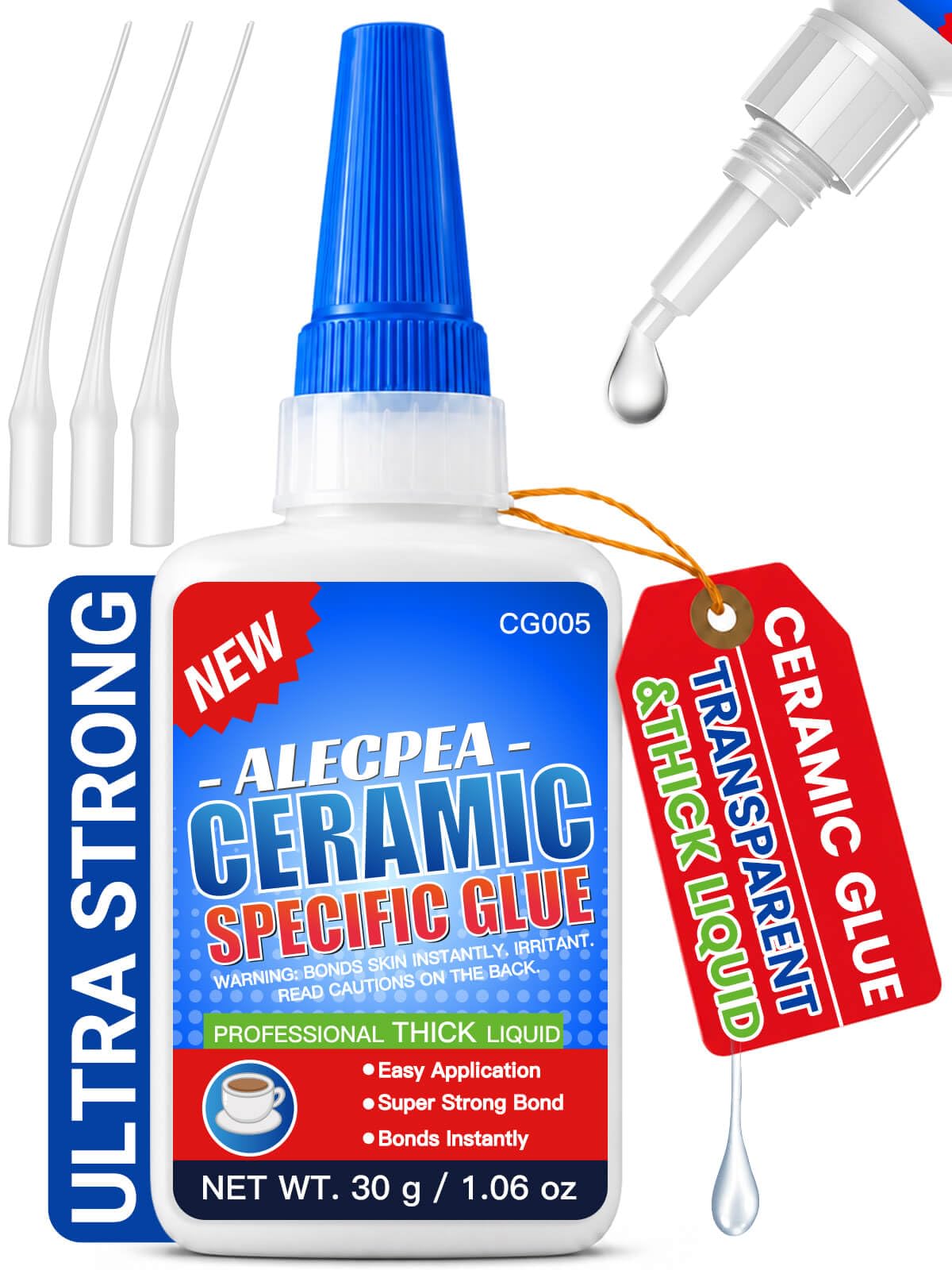
ALECPEA Thick Ceramic Glue

89 /100
Kirk Score Excellent
Volume
1.06 oz
Included
3 precision dropper tips
Full Cure
24 hours
Viscosity
High (thick gel)
Check Details on Amazon

Pros

  • Designed to stay put on vertical repairs
  • Three precision dropper tips
  • Covers tile and bathroom fixtures too

Cons

  • Consistency can run far thinner than a gel

Vertical repairs are where thin glue embarrasses itself. A crack down the side of a vase, the inside shoulder of a mug, a chip on a tiled wall: the adhesive runs, pools at the bottom and leaves the top of the joint starved. The pitch here is a thick, high-viscosity ceramic glue meant to sit where it's placed and fill chipped edges, small gaps and uneven breaks, and we can see why the idea appeals.

The kit is a 30 g bottle with three precision dropper tips, a clear cure and a 24-hour full cure after the initial grab. It's listed for mugs, bowls, vases, planters, tile and bathroom fixtures, so it's aimed at the same shelf-and-sanitaryware repairs as the rest of this list.

The catch is that the thickness isn't consistent. It can come out much closer to water than a gel, and when it does, the whole advantage runs down the side of the piece. Test a drop on scrap before you commit it to a vertical repair and keep the work flat for the first few minutes; on a horizontal chip, where running doesn't matter, it's a perfectly serviceable 30 g bottle.

Bottom line: Worth trying for a chipped edge or a vertical repair, provided the bottle you get is as thick as it's supposed to be.

Check Latest Price
#08

Flush white repairs

Keeney Tub and Shower Repair Kit

86 /100
Kirk Score Excellent
Form
Two-part putty
Cured Color
White
Kit Contents
Putty, hardener, sandpaper, polishing compound
Check Details on Amazon

Pros

  • Includes sandpaper and polishing compound
  • Levels flush with the surrounding surface
  • Works on porcelain, fiberglass, acrylic and enamel

Cons

  • Bright white reads as a patch on off-white
  • Strong solvent smell during application
  • Sandpaper in the kit runs out early

Sandpaper is the tell. Almost every product here is a liquid you squeeze and hope; the Keeney kit is the one that assumes you'll sand afterward, and it ships with a rough sheet, a smooth sheet and a polishing compound to finish the job. That's the difference between a repair that sits level with the surrounding surface and a bump you can feel with a fingertip.

Inside is a two-part white putty and hardener, formulated for nicks, gouges and scratches on porcelain, fiberglass, acrylic, gel coat, formica, granite and resin — and, less obviously, for boats and RVs, which tells you something about how it's meant to hold up.

The method is simple and mostly sanding: mix, spread thin, let it set, then work down through the papers and polish. Spread it thinner than feels right, because a thick blob means a long session with the rough sheet.

We keep it on the list for a white fixture with a small chip or gouge where you want a flush, finished repair rather than a fast one. It's a poor fit for a crack that flexes, though, because a rigid putty has nothing to move with — that's a job for a flexible filler or a replacement.

Bottom line: The kit to choose for a white fixture if you want a flush, sanded finish and don't mind the smell or extra sandpaper.

Check Latest Price

How We Tested Porcelain Repair Kits

We started with research rather than a shopping cart: reading listings and spec sheets, then filtering out anything that didn't claim to be waterproof for sink and tub work, anything that couldn't be used near a mug rim, and any color-match kit that offered only one shade when bathroom fixtures come in half a dozen off-whites. That left 14 kits, which we used over four months.

Then we broke things on purpose. Each kit got a chipped stoneware mug, a cracked bowl, a chipped enamel edge on a bathroom sink, a tile corner, and a hairline fracture in a pottery vase. We timed how long each one took to mix and apply, and noted consistency as we went — whether the glue ran down the side of the mug before we could set the piece, whether the putty crumbled when rolled, whether the nozzle clogged between uses or the dropper delivered one controlled drop.

Hold came next. We let each repair cure untouched, checked set time with a fingertip, then hung a full mug from its repaired handle over the counter and filled the sink basin so water sat against the patch for an hour. Repaired mugs went through repeated dishwasher cycles, and we ran hot water over the sink repairs to see if anything softened or lifted. For color, we held every patch against the fixture in daylight and under bathroom light, then looked again a week later to catch anything that dried lighter or yellower than it went on.

Ease of use and value came down to arithmetic and smell: how many repairs one tube or pack covered, whether gloves and applicators were included or had to be scavenged, how strong the odor was mid-cure, and how easily stray adhesive wiped off glaze before it set.

How to Choose a Porcelain Repair Kit

Glue or filler: match the product to the damage

Two surfaces that still mate — a cup handle snapped off cleanly, a plate split in two — want a thin clear adhesive that wicks into the joint and pulls it shut. A chip that took material with it, or a gouge in a sink, wants a filler you can press in, shape and sand. Glue there has nothing to bond, and you'll see the hollow under the repair.

The mistake we see most is buying one and needing the other. Look at the damage before you shop: if the two pieces fit back together with no gap, buy glue; if a piece of the object is missing, buy a two-part putty or a tinted epoxy. When it's both — a break with a nibbled edge — a filler and a thin glue used together will do more than either alone.

Clear, white, or matched to the fixture

Visibility decides the finish. A clear cure is right for a mug, a figurine or a china plate, where a white seam draws the eye. A white or tintable filler is right for sanitaryware, where clear glue on a white tub shows as a grey shadow and a stark white patch shows just as badly on almond or biscuit.

If you're matching a fixture, buy the version with colorants rather than a fixed white, and test the shade on paper before it goes anywhere near the chip. A little tint goes further than you expect, and most matching failures are over-colored rather than under.

Working time, cure time and how confident you are

Cyanoacrylate glues grab in seconds, which is wonderful on a clean two-piece break and unforgiving on anything with three pieces. Dry-fit first, tape or prop the pieces, and work in stages. A 15-second set leaves no room to slide a piece into place; a 30-to-60-second set gives you a nudge.

Two-part putties and epoxies run the other way: minutes of working time, hours before you can sand or put load on the repair, and a much more forgiving learning curve. Choose the set time deliberately. If you're repairing something you care about, slower is usually better.

Water, heat and food contact

Hot water, detergent and a dishwasher are the harshest conditions a home repair meets. A waterproof label covers a splash and a wash; dishwasher-safe is a stronger claim, and it's the maker's claim rather than a guarantee. Hand-washing repaired pieces sidesteps the question entirely.

For anything that touches food, keep the repair out of the food path. A handle, a base or the outside of a bowl is a very different proposition from the inside of a mug or the rim of a plate, where a glue line sits against what you're eating and drinking. A cracked dish that has lost its structural soundness is a piece to retire rather than repair.

Tips, volume and what you actually get

Two bottles with similar glue inside behave completely differently because of the nozzle. A fine tip lets you lay a bead along one edge; a blunt bottle mouth floods the joint, and a clogged one ends the job. Spare tips and an anti-clog cap matter more than an extra half ounce of liquid.

Check volume against the work in front of you: a 30 ml bottle handles a handful of small repairs, while a larger bottle makes sense if you're working through a set. Beyond the liquid, what you're paying for is control — and for a repair you'll look at every day, control is what decides whether the seam shows.

Frequently Asked Questions

Final Verdict

If you want one bottle in the drawer for the ordinary broken cup, chipped plate or snapped handle, the LOOCTOT 30g is what we recommend: it sets in seconds, cures clear, and the anti-clog cap means the second repair is as easy as the first.

Buy the Milliput Superfine White instead when material is missing rather than split — a chip, a corner, a gouge — and reach for the HT Hometinker kit when the repair sits in a white tub and has to match the fixture. That's the whole decision: split, missing, or color-matched.