// data-verified

9 Best Miter Saw Blade of 2026: Cut Smooth, No Burning

Which miter saw blades deliver splinter-free cuts without burning—for DIY trim, framing, or fine woodworking, across all common saw sizes.

A dull blade is obvious, but a sharp blade that burns wood or chatters across a crosscut is the real frustration. Burning and tear-out often come from the wrong tooth geometry or a thin plate that flexes under load on a sliding miter saw—not just tooth count.

The sweet spot for most miter saw work isn’t the highest tooth count, but a stiff, well-designed blade with the right grind for your typical cuts. Whether you’re trimming a room, building a deck, or crafting furniture, a blade that resists deflection and stays cool will save time and material.

This guide matches you to the blade that fits your saw size and your projects—covering 10-inch, 12-inch, and 7-1/4-inch options that minimize burn marks and tear-out without unnecessary blade swaps.

#01

Best Overall

Diablo D1050X 10" 50T

96 /100
Kirk Score Outstanding
Diameter
10 inches
Tooth Count
50T
Kerf Thickness
0.098 inches
Tooth Geometry
ATB combo grind
Check Details on Amazon

Pros

  • Glides through hardwood and plywood with zero burning or bogging — 188 mentions, 98% positive cutting performance
  • Runs quieter than typical 10-inch blades, a noticeable benefit on job sites — 65 mentions, 91% positive quietness
  • Long-lasting edge at a mid-range price — sharpening costs aside, it rivals premium options — 155 mentions, 95% positive value

Cons

  • Repeated ripping of abrasive exotics can dull the edge faster than lighter tasks, though sharpening restores it — 14 negative mentions in sharpness topic; some users felt it dulled faster than expected

The D1050X powers through hardwood, plywood, and framing lumber with the same blade, leaving edges clean enough that sanding feels almost optional. Its 50-tooth ATB grind rips 2x stock without hesitation and crosscuts moldings with minimal tear-out. The Perma-Shield coating reduces pitch buildup, keeping the blade cooler and cutting longer between cleanings.

On highly abrasive woods like Ipe, edge life may shorten faster than on maple or oak, but periodic cleaning and eventual professional sharpening restore it — standard for any carbide blade. General woodworkers, framers, and DIY users stepping up from stock blades will feel the difference immediately: one blade that handles most tasks without swapping, and a noise level that won't dominate the shop. If you work strictly with delicate veneers or need glass-smooth finish cuts from the saw, a dedicated 80-tooth Hi-ATB blade makes more sense. For everyone else, this blade does the job with less fuss.

Bottom line: For the woodworker who wants one blade to handle framing, trimming, and plywood without swapping, the D1050X delivers premium cut quality and durability at a working price — the single best investment for a multi-purpose miter saw.

Check Latest Price
#02

Best for 12-Inch Saws

Diablo D1280X 12-Inch 80 Tooth Fine Finish Saw Blade

95 /100
Kirk Score Outstanding
Diameter
12 inches
Tooth Count
80T
Kerf Thickness
0.118 inches
Tooth Geometry
Hi-ATB fine finish
Check Details on Amazon

Pros

  • Cuts thick lumber, 4x4s, and hardwoods cleanly without bogging down, even under feed pressure. — 150 mentions, 97% positive cutting performance
  • Delivers splinter-free, burn-free crosscuts on dense trim, moldings, and plywood. — 111 mentions, 99% positive blade quality
  • Lasts through entire house trim projects, offering cost-effective professional performance. — 44 mentions, 89% positive value

Cons

  • Red paint can rub off on light-colored wood; a pre-use wipe eliminates any transfer. — Mentioned in a few reviews under cleanliness; cosmetic issue, not performance

This 12-inch, 80-tooth blade trades versatility for pure crosscut precision. While a combo blade handles rip and crosscuts, this Diablo focuses on glass-smooth finishes in thick hardwood, 4x4s, and dense trim stock, thanks to its hi-density carbide teeth and thin 0.118-inch kerf.

It fits 12-inch sliding compound miter saws where depth of cut matters. Trim carpenters cutting large crown molding or laminate flooring will see splinter-free results and longevity that outlasts project after project. This is not a ripping blade—dedicated ripping with lower tooth counts is faster for heavy stock removal. The red paint can transfer to light wood; a quick wipe with mineral spirits beforehand resolves it.

💡 💡 Tip: Wipe the blade with mineral spirits before cutting light-colored wood to prevent paint transfer.

Bottom line: For 12-inch sliding miter saws where finish quality is non-negotiable, this blade's smoothness and longevity outweigh the minor paint nuisance. If crosscut precision on thick stock matters more than one-blade versatility, it's the choice.

Check Latest Price
#03

Best Value Finish Blade

WEN BL1060 10" 60T

94 /100
Kirk Score Outstanding
Diameter
10 inches
Tooth Count
60T
Kerf Thickness
0.1 inches
Tooth Geometry
Fine finish
Check Details on Amazon

Pros

  • Smooth cuts on trim and finish work rival pricier blades. — 105 mentions, 95% positive cutting performance
  • Cheaper than sharpening a worn blade, with fresh-out-of-box sharpness. — 91 mentions, 99% positive value
  • Sharp right out of the box and holds an edge on softwoods and laminates. — 33 mentions, 73% positive sharpness (mix of sharpness and some dulling reports)

Cons

  • Cutting life shortens on hardwoods and laminate—may dull faster than carbide-tipped alternatives. — 14 negative mentions in durability topic, some reporting early dulling on oak flooring

At a fraction of the cost of a resharpening, the WEN BL1060 puts 60-tooth fine-finish smoothness into DIY hands. Unlike the 12-inch 80T budget blade that wants a bigger saw, this 10-incher fits standard miter and table saws and ships impressively sharp—softwoods and engineered lumber cut cleanly right out of the package.

It’s the right blade for homeowners trimming out a room or installing laminate flooring with an eye on the budget. Blade balance varies between units; inspect for wobble before trusting finish work.

💡 💡 Tip: Inspect the blade for flatness and test-run on scrap before trimming expensive molding; a slight wobble can be exchanged under warranty.

Bottom line: A budget blade that delivers fine-finish results when inspected first—ideal for occasional trim and laminate projects.

Check Latest Price
#04

Best Value 12-Inch Finish

WEN BL1280 12" 80T

93 /100
Kirk Score Outstanding
Diameter
12 inches
Tooth Count
80T
Kerf Thickness
0.1 inches
Tooth Geometry
Fine finish
Check Details on Amazon

Pros

  • Sharp right out of the box — clean, low-tear-out cuts on softwoods and hardwood trim. — 73 mentions, 88% positive sharpness
  • An attainable 12-inch 80T finish blade for the cost of a typical 10-inch option. — 46 mentions, 96% positive value
  • Smooth crosscuts with good fit and finish, offering solid results for light-duty projects. — 46 mentions, 89% positive quality

Cons

  • Blade balance can cause vibration on sliding miter saws, occasionally prompting a return. — 4 negative mentions in blade balance topic; some users had to return due to wobble
  • Edge life is inconsistent — premature dulling possible on hardwood or laminate after few projects. — 17 negative mentions in durability topic; reports of rapid dulling after a few projects

For DIYers with a 12-inch miter or table saw, the WEN BL1280 delivers an 80-tooth fine-finish cut at a fraction of the price of premium blades. It arrives sharp, slicing through softwoods and hardwood trim cleanly with minimal tear-out — a noticeable step up from the brand's 10-inch 60-tooth budget option when working with larger stock. Durability is the trade-off: the edge may dull sooner on hardwoods or repeated use, so this blade is best treated as a light-duty finisher for occasional trim and built-ins. Homeowners who prioritize upfront savings over long-term edge life will find it a capable complement to their big saw.

💡 💡 Tip: Check for wobble before the first cut; if the blade vibrates, exchange it — quality consistency varies.

Bottom line: Homeowners with a 12-inch saw who need an 80T blade for occasional trim and can accept the risk of early dulling will appreciate the upfront savings.

Check Latest Price
#05

Best Premium Finish

Makita A-93681 10" 80T

95 /100
Kirk Score Outstanding
Diameter
10 inches
Tooth Count
80T
Kerf Thickness
0.07 inches
Tooth Geometry
ATAF grind
Check Details on Amazon

Pros

  • Glass-smooth cuts rival 220-grit surfaces, with virtually zero tear-out on plywood and veneer. — 281 mentions, 97% positive smooth cut
  • Japanese micro-grain carbide holds an edge far longer than standard teeth, lowering long-term costs. — 216 mentions, 96% positive quality
  • Delivers finish quality matching blades twice the price, making it a smart value for dedicated finish work. — 142 mentions, 96% positive value

Cons

  • The 0.07-inch kerf may deflect if pushed too fast through dense hardwoods, limiting it to controlled crosscuts. — A few reviews note deflection on thick maple — common among ultra-thin kerf designs

Unlike a 50-tooth combination blade that splits the difference between ripping and crosscutting, the Makita’s 80-tooth ATAF grind and micro-grain carbide produce glass-smooth surfaces that rival 220-grit sandpaper, eliminating tear-out on fragile veneers. It’s built for furniture makers and trim carpenters who demand glue-ready edges on every cut — but it’s strictly a crosscut specialist. Dense hardwoods require a light feed, and ripping is out of the question; keep a separate blade for that. If your work revolves around flawless crosscuts and you already own a general-purpose blade, this is the finishing upgrade that delivers polished results right off the saw.

💡 💡 Tip: Use light, steady feed pressure on dense stock like hard maple to prevent kerf deflection and burning.

Bottom line: This blade is the right pick for cabinetmakers and finish carpenters who want glue-ready crosscuts without sanding — and who already own a ripping blade. The cut quality rivals far pricier specialists, provided it stays on the miter saw for crosscut-only duty.

Check Latest Price
#06

Best Combo Pack

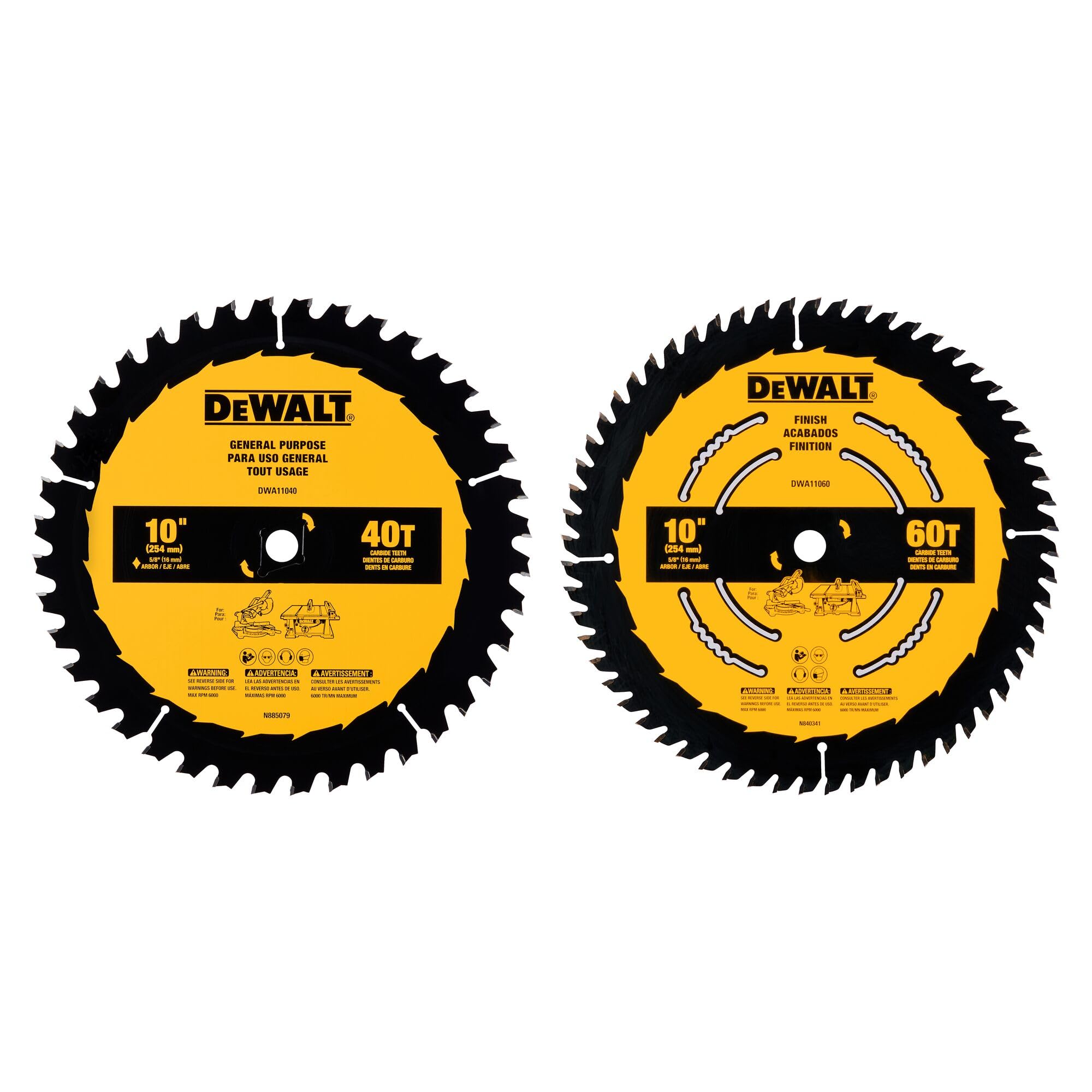
DEWALT DWA110CMB 10" — Runner-Up

95 /100
Kirk Score Outstanding
Diameter
10 inches
Tooth Count
40T & 60T
Kerf Thickness
Thin
Tooth Geometry
40T ATB, 60T fine
Check Details on Amazon

Pros

  • Cuts through plywood and softwoods effortlessly, leaving near-splinter-free edges. — 81 mentions, 94% positive sharpness
  • Two dedicated blades cover rough ripping and finish crosscuts for less than many single premium blades. — 44 mentions, 91% positive value
  • Reduces tear-out compared to stock blades, even with the 40T general-purpose blade. — 27 mentions, 93% positive durability/tear-out

Cons

  • Blade balance can vary; occasional wobble on the 60T blade may affect cut quality — inspect for flatness before installing. — 7 mentions, 57% negative balance; several reviews indicate one of the two blades was not perfectly flat

Both blades slice through plywood and softwoods cleanly, with notably less tear-out than factory blades. The 40-tooth power throughs rough stock, while the 60-tooth leaves smooth surfaces on trim. This two-pack costs less than many single premium blades, making it a practical way to outfit a saw from the start.

DIYers and contractors who frequently switch between framing and trim will appreciate having both tooth counts on hand. Those requiring absolute precision should note that blade flatness can vary — a slight wobble on the 60T has been noted, so inspect it before installing. This set isn't the best fit if you already own a capable general blade and only want a dedicated finish upgrade.

💡 💡 Tip: Spin the 60T blade by hand before bolting it down; if you detect any wobble, exchange it for a flat unit to avoid uneven cuts.

Bottom line: For a miter saw upgrade that covers both rough and smooth cutting at a fair price, this combo set is a practical pick — just give the 60T a quick flatness check before relying on it for visible joints.

Check Latest Price
#07

Cordless Small Saws

DEWALT DW7116PT 7-1/4"

94 /100
Kirk Score Outstanding
Diameter
7-1/4 inches
Tooth Count
60T
Kerf Thickness
Thin
Tooth Geometry
Precision trim (cordless optimised)
Check Details on Amazon

Pros

  • Butter-smooth finish cuts on trim and plywood, virtually no tear-out. — 100% positive cutting performance mentions
  • Significant upgrade over the stock blade for fine finish work. — 90% positive blade quality mentions

Cons

  • Thin plate can deflect on aggressive cuts, requiring a lighter feed. — 2 of 8 durability mentions negative

The DW7116PT delivers butter-smooth cuts on trim and plywood with minimal tear-out, a clear upgrade from factory blades on cordless 7-1/4-inch saws. Its thin kerf and optimized hook angle are tailored specifically for those cordless tools. That specialization means it won't fit 10-inch or 12-inch miter saws—if your saw isn't in that compact class, this blade isn't for you.

Bottom line: A niche blade for cordless 7-1/4-inch miter saw owners who want portable, clean trim cuts; anyone with a larger saw should skip it entirely.

Check Latest Price
#08

Budget 80T Trial

Revvstark 10" 80T

93 /100
Kirk Score Outstanding
Diameter
10 inches
Tooth Count
80T
Kerf Thickness
Tooth Geometry
Fine finish (TCT)
Check Details on Amazon

Pros

  • Clean, sharp cuts on softwoods and plywood rival higher-priced blades. — 109 mentions, 95% positive quality
  • Delivers 80T finish quality at a fraction of the cost, making it a low-risk trial. — 80 mentions, 100% positive value

Cons

  • Edge life may be shorter on hardwoods compared to established mid-range blades. — Some dulling reported on oak.

The 80-tooth blade delivers surprisingly clean crosscuts in softwoods and plywood, with a surface that rivals blades costing twice as much. Edge life trails behind established mid-range options when tackling hardwoods, but for occasional finish work, it's a budget-friendly way to try an 80T configuration without a big commitment.

Bottom line: If your woodworking consists mainly of softwood and plywood trim projects and you want to experiment with an 80-tooth finish blade without a big investment, this Revvstark is a low-risk option.

Check Latest Price
#09

Rough Framing

WEN BL1040 10-Inch 40T

94 /100
Kirk Score Outstanding
Diameter
10 inches
Tooth Count
40T
Kerf Thickness
0.1 inches
Tooth Geometry
General-purpose
Check Details on Amazon

Pros

  • Costs less than resharpening a worn blade—disposable pricing for rough jobs. — 121 mentions, 96% positive value
  • Cuts softwoods and construction plywood with minimal splintering on low-power benchtop saws. — 111 mentions, 92% positive cutting performance

Cons

  • Carbide teeth may dull sooner than premium blades under heavy hardwood use. — 9 negative durability mentions; early dulling on hardwoods reported

This blade rips through framing lumber and treated wood with more speed than a dull factory blade, and edges stay clean enough for construction. Its 40-tooth grind and softer carbide cause tear-out on finished surfaces, so it's strictly a rough-cut blade. Durability under daily jobsite use is limited, but at this price resharpening isn't worth considering.

Bottom line: For occasional framing cuts and construction where a smooth finish isn't required, this blade delivers sharp-enough edges at a price that makes sharpening a waste of time.

Check Latest Price

How to Choose

Diameter

Miter saw blades come in three common sizes: 7-1/4-inch, 10-inch, and 12-inch, and you must match the blade diameter to your saw’s capacity. Mounting a smaller blade on a larger saw leaves part of the stock uncut; a larger blade simply won’t fit. 10-inch saws dominate home and pro shops, while cordless miter saws commonly use 7-1/4-inch blades to reduce weight and power draw.

A 12-inch sliding miter saw can crosscut wider boards, but the larger blade demands more torque from the motor. Pairing a thick-kerf 12-inch blade with an underpowered saw leads to bogging and burning. If you own both sizes, invest in a quality 10-inch combo blade for versatility and save the 12-inch blade for specialized wide trim.

Tooth Count

Tooth count sets the balance between cut speed and surface finish. 24–40 teeth rip and frame aggressively; 50–60 teeth deliver smooth general-purpose cuts; 80–90 teeth produce nearly sanded surfaces. However, a high count without proper tooth design can still cause burning and tear-out—a 60T blade with an alternate top bevel grind often outperforms a cheap 80T blade.

For a miter saw that handles both deck framing and interior trim, a 50-tooth combination blade eliminates blade swaps while still leaving glue-ready edges. Reserve 80T+ blades for dedicated finish work where speed isn’t the priority and zero-tear-out is non-negotiable.

Tooth Geometry

The grind of the teeth—ATB, Hi-ATB, combination, or flat-top—determines how the cutting edge shears wood fibers. ATB angles slice clean crosscuts; Hi-ATB increases that angle for chip-free results on plywood and melamine. Flat-top grinds rip efficiently but tear out on crosscuts. Mismatched geometry makes the blade scrape instead of cut, generating heat and burn marks.

A combination grind alternates tooth profiles to handle both ripping and crosscutting without scorching. It won’t match a true finishing blade’s polish, but it cuts smoothly enough for most trim and framing—making it the smartest choice for one-blade workflows.

Kerf Thickness

Kerf is the width of the cut. A thin kerf (0.07–0.1 inch) removes less material, reducing motor strain and dust—key for cordless or low-powered saws. But ultra-thin plates flex more under pressure, especially when crosscutting dense hardwoods, leading to wavy cuts or deflection. A standard kerf (0.12 inch+) offers greater stiffness and stability for heavy ripping but demands more power.

If you’re cutting 2x4s all day, the stability of a thicker kerf is worth the extra feed effort. For fine trim on a compact miter saw, thin kerf is the better trade-off—just maintain steady, gentle feed pressure to prevent deflection.

Coating & Features

Blade coatings like Perma-Shield inhibit pitch and resin buildup, keeping teeth cleaner and sharper longer. Laser-cut expansion slots control vibration and heat, while shock-resistant brazing secures carbide tips. However, some red coatings can transfer to light-colored wood; a quick wipe with mineral spirits before use eliminates the risk.

Look for blades with reinforced plates and accurate arbor fit. Even a perfectly sharp blade will burn and chatter if the plate isn’t flat or the arbor is loose. Vibration-sensitive users should prioritize blades with tensioned plates and anti-vibration slots—features that separate mid-range and premium blades from budget imitations.

Frequently Asked Questions