// data-verified

11 Best PVC Pipe Cutter of 2026: The Ones That Cut Straight Every Time

Find a handheld PVC pipe cutter that delivers square, clean cuts for glue-ready joints, not ragged angled edges — whether you're doing irrigation, PEX, or schedule 40 plumbing.

A PVC pipe cutter looks simple — squeeze the handle and the blade shears through the plastic. Yet too many cutters leave behind an angled, ragged edge that will not glue square, turning a quick plumbing fix into a frustrating re-cut. The problem is rarely the blade's sharpness; it's the frame flexing or the blade drifting mid-cut, a hidden flaw that emerges after a few uses.

This guide identifies the handful of cutters that combine a rigid body with a reliably guided blade to deliver clean, straight cuts project after project. Whether you're running irrigation lines, installing new PEX, or repairing schedule 40, the right tool saves time and wasted pipe. We focus on the mechanisms and materials that separate the tools built to last from those that feel good in the store but disappoint on the job.

#01

Best Overall

RIDGID 23498 RC-1625

92 /100
Kirk Score Outstanding
Body
Aluminum
Blade
Replaceable X-CEL quick-change
Mechanism
Ratchet, burr-less cut
Max O.D. Capacity
1-5/8 in.
Check Details on Amazon

Pros

  • All-aluminum frame delivers consistently straight, burr-free cuts on PVC, PEX, and CPVC. — 128 mentions, 95% positive on Quality; 99 mentions, 84% positive on Cutting Performance
  • Effortless one-handed ratchet action reduces hand fatigue during repetitive cuts. — 44 mentions, 98% positive on Ease of Use
  • Sharp, long-lasting blade with tool-free replacement; built-in scale speeds pipe marking. — 20 mentions, 85% positive on Sharpness

Cons

  • Blade may develop rust if left wet in humid environments without regular drying and oiling. — 37 mentions on Durability, 32% negative — some users report blade rusting quickly without maintenance

The RC-1625's cast-aluminum body locks the blade in alignment, eliminating the wobble that plagues cheaper plastic-body cutters. The ratchet mechanism clicks through four stages, requiring only light hand pressure to shear through schedule 40 PVC, CPVC, and PEX up to 1-5/8 inches. Cuts come out square and clean with no pipe deformation. Unlike saws, it leaves no debris inside the pipe. The X-CEL blade stays sharp through hundreds of cuts, and when replacement is needed, it snaps in without tools — job site downtime is measured in seconds.

This cutter is aimed at plumbers, irrigation installers, and serious home renovators who demand repeatable, professional-quality cuts day in and day out. The aluminum build and lifetime warranty justify the premium price. The one trade-off: the blade can rust if left damp in a humid truck or workshop — drying and oiling it takes seconds but must become a habit. Buyers who only occasionally cut pipe may find it more tool than they need, and those who routinely work above 1-5/8 inches will need the larger model in this comparison.

💡 💡 Tip: Wipe the blade dry after use and apply a light oil if stored in a humid shop — this preserves the edge and prevents surface rust.

Bottom line: For professionals who reach for a pipe cutter daily and need straight cuts without second-guessing, the RC-1625 is the standard against which every other ratchet cutter is measured — just keep the blade dry.

Check Latest Price
#02

Best for Large Diameter Pipes

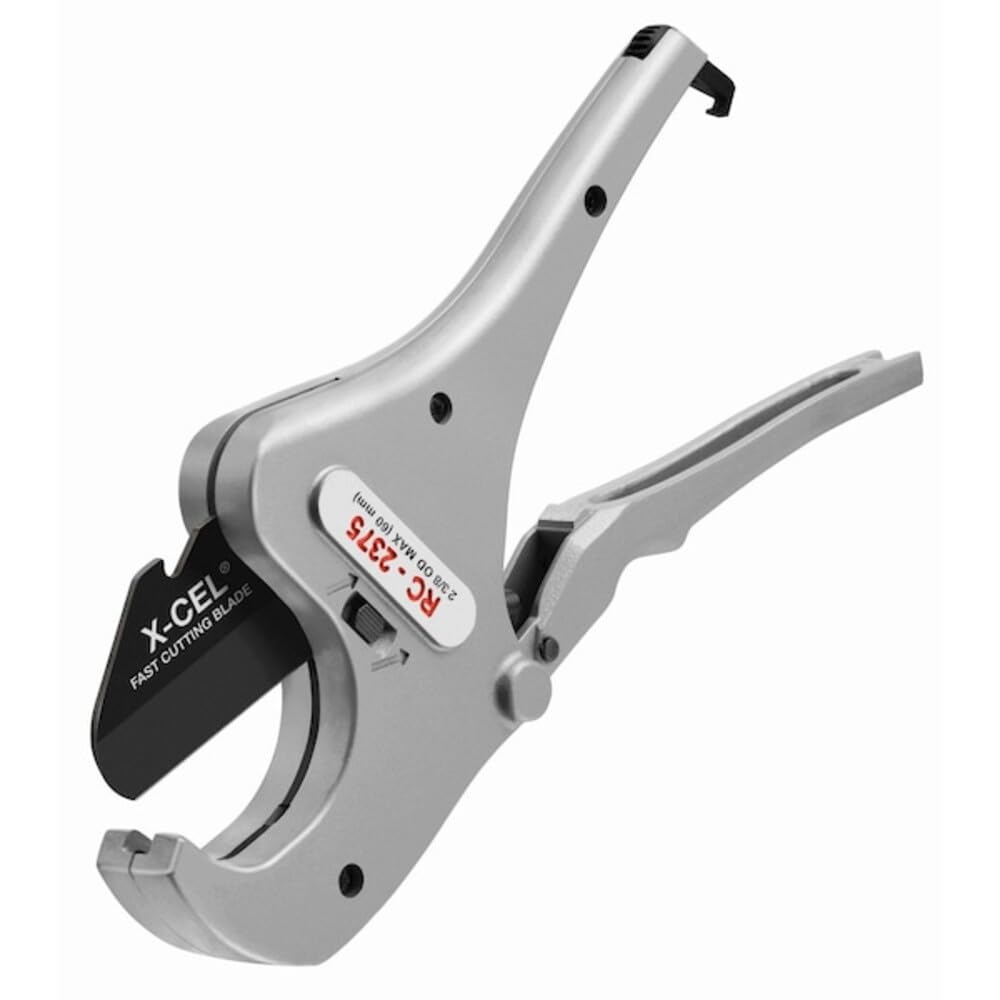
RIDGID 30088 RC-2375 Aluminum Ratchet Pipe and Tubing Cutter

92 /100
Kirk Score Outstanding
Body
Aluminum, powder-coated
Blade
Tool-free X-CEL quick-change
Mechanism
Ratchet, burr-less cut
Max O.D. Capacity
2-3/8 in.
Check Details on Amazon

Pros

  • Cuts plastic pipe up to 2-3/8 in. O.D., the widest jaw opening among premium ratchet cutters. — 74 mentions on Quality, 92% positive
  • Tool-free X-CEL blade changes take seconds, minimizing downtime on the job. — 9 mentions on Blade Changes, 89% positive
  • Handles PVC, PEX, and multilayer tubing in one tool without swapping jaws. — 14 mentions on Versatility, 93% positive

Cons

  • Hard schedule 80 PVC can chip the blade or shatter the pipe, particularly when cold; warming the material reduces that risk. — 35 mentions on Durability, 71% negative

The largest cutting capacity among premium ratchet cutters at 2-3/8 in. O.D. sets this RIDGID apart, extending well past the 1-5/8 in. limit of the smaller, more refined ratchet in the lineup. Its aluminum body and smooth ratcheting mechanism deliver clean, square cuts on PVC, PEX, and multilayer tubing without blade chatter, and tool-free X-CEL blade swaps keep you working.

This tool targets plumbers and renovators who routinely saw through 2-inch and larger plastic pipe. The trade-off: hard schedule 80 PVC can chip the blade or shatter the pipe when cold, so warming the material is essential. For work that stays under 1-5/8 in., the smaller RIDGID ratchet is a more forgiving and cost-effective choice.

💡 💡 Tip: Warm hard schedule 80 PVC before cutting to prevent shattering and blade chipping.

Bottom line: If you need to cut pipes larger than 1-5/8 in. regularly, this RIDGID’s extended reach is worth the premium. Keep a heat gun handy for schedule 80 PVC, and the blade will hold up.

Check Latest Price
#03

Best Value Ratchet Cutter

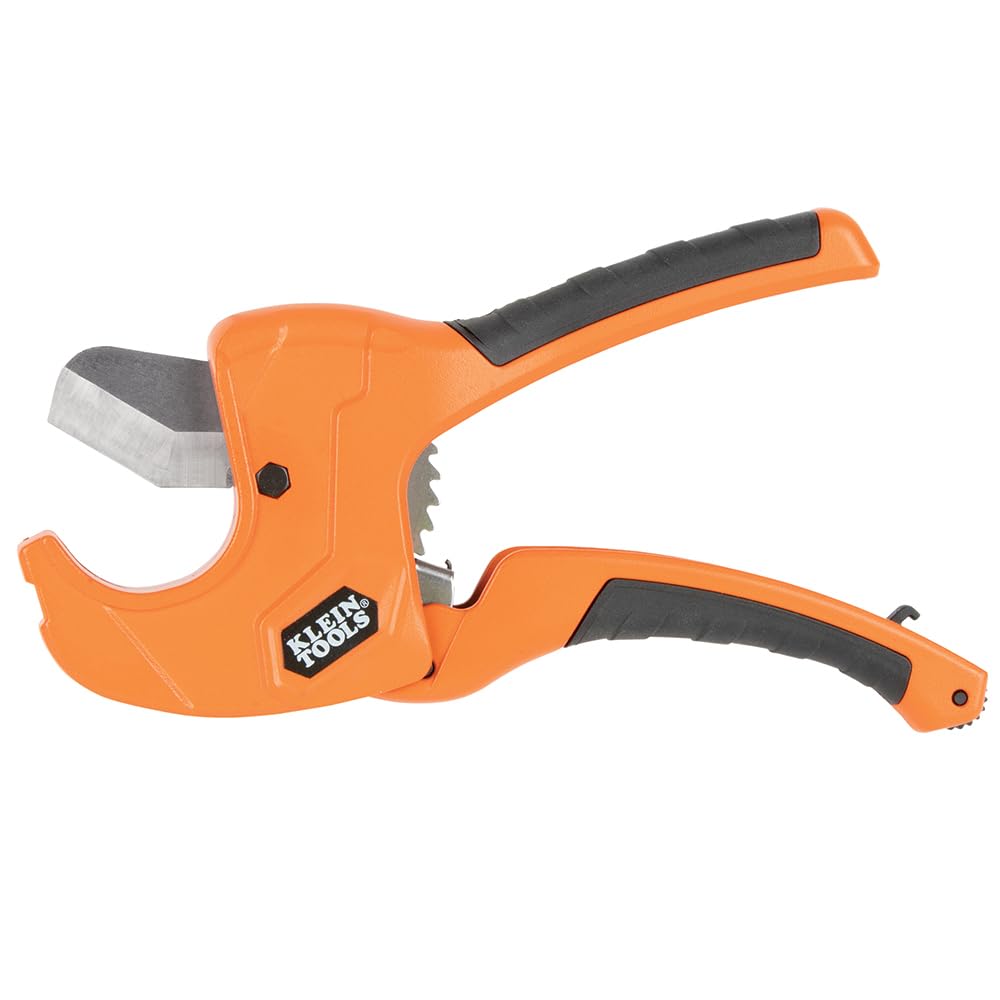
Klein Tools 50063

89 /100
Kirk Score Excellent
Body
Die-cast aluminum
Blade
Replaceable (Cat. No. 50064)
Mechanism
Ratchet, soft-molded handles
Max O.D. Capacity
1-5/8 in.
Check Details on Amazon

Pros

  • Clean, effortless cuts on PVC and PEX — build quality matches premium tools. — 39 Quality mentions (95% positive), 27 Functionality mentions (100% positive)
  • Smooth one-hand ratcheting for tight plumbing spaces. — 7 Ease of Use mentions (100% positive)
  • Mid-range pricing with professional-level performance. — 15 Value mentions (93% positive)

Cons

  • The safety latch can release during handling, requiring a manual reset. — 7 Control mentions (43% negative)
  • Blade may chip when cutting harder PVC, though replacements are available. — 13 Durability mentions (38% negative)

The die-cast aluminum body and smooth ratchet mechanism deliver cuts that rival more expensive models, making this a standout for 1-1/4-inch I.D. PVC and PEX. It suits DIYers and pros who need one-hand operation in tight spots and value Klein's build quality at a mid-range price. The latch can be overly sensitive, and rare blade chipping on hard PVC exists — these are manageable tradeoffs for those who prioritize value and compact performance over absolute ruggedness.

💡 💡 Tip: Engage the latch deliberately and check it's locked before setting the tool down.

Bottom line: If you want a quality ratchet cutter without stretching to the premium price tier, the Klein 50063 hits the sweet spot for typical household plumbing — just be gentle with the latch.

Check Latest Price
#04

Best for Small PVC & Flexible Tubing

Klein Tools 50506SEN

87 /100
Kirk Score Excellent
Body
Steel
Blade
Reversible (replacement avail.)
Mechanism
Single-stroke, spring-loaded
Max O.D. Capacity
3/4 in. PVC; 1-3/8 in. flex
Check Details on Amazon

Pros

  • Sharp, compact cutter that excels on small PVC flexible pipe and irrigation tubing — 16 mentions on Sharpness, 75% positive; 13 mentions on Functionality, 85% positive
  • Very lightweight and easy to use in tight locations — 6 mentions on Ease of Use, 83% positive

Cons

  • Hand strength needed can be surprising on rigid PVC, and soft tubing may flatten if squeezed too hard — 16 mentions on Sharpness, 25% negative — some users report difficulty achieving straight cuts on PVC

Unlike bulkier ratchet cutters, this single-stroke shear prioritizes speed and access in cramped spaces. The steel body and 3/4-inch PVC capacity make it a favorite for flexible pipe, PEX, and poly tubing, where a quick, guided squeeze produces clean cuts without the multi-step ratcheting action.

Irrigation techs, HVAC installers, and electricians working with 3/4-inch conduit in confined areas will find it a fast, lightweight companion. Hand strength can become a factor on rigid PVC, and softer tubing may flatten if you aren't deliberate with pressure — a manageable trade-off for the tool's compact agility.

💡 💡 Tip: Support the pipe with your off hand and use a quick, decisive stroke to avoid squashing soft tubing.

Bottom line: If your work revolves around irrigation lines or flexible conduit in tight spots, this shear delivers clean, fast cuts — just expect to supply the grip strength on anything over 3/4-inch rigid PVC.

Check Latest Price
#05

Best Budget Large-Capacity Cutter

SHALL PVC Pipe Cutter, 2-1/2 inch

87 /100
Kirk Score Excellent
Body
Die-cast aluminum
Blade
SK5 steel, Teflon-coated
Mechanism
Ratchet, safety lock
Max O.D. Capacity
2-1/2 in.
Check Details on Amazon

Pros

  • Budgets stay intact: 2-1/2-inch capacity in an aluminum frame for well under premium alternatives. — 22 mentions on Value, 91% positive
  • Ratchet mechanism dramatically reduces hand strain compared to using a hacksaw. — 24 mentions on Ease of Use, 100% positive
  • Cuts PVC without binding, adequate for tasks where a slight angle won't compromise the connection. — 50 mentions on Functionality, 94% positive

Cons

  • Cuts can come out noticeably angled, especially on 2-inch and thicker pipe. — 78 mentions on Sharpness, 35% negative; many reviews report crooked cuts
  • The ratchet mechanism can seize or the blade can chip after a handful of cuts. — 12 mentions on Durability, 58% negative — some units break after 6 cuts

Where premium ratchet cutters top out around 1-5/8 inches, this SHALL stretches capacity to 2-1/2 inches in an aluminum frame at a budget price — a tempting option for those rare big-pipe tasks.

The tradeoff is accuracy. The blade can drift during the cut, leaving a slight angle that weakens glue joints in pressure applications. Durability is also unpredictable; it may handle a few dozen cuts rather than a full renovation. That suits cost-conscious DIYers tackling a quick drain or conduit run where a slightly off-square end won't cause a problem.

💡 💡 Tip: For better squareness, rotate the pipe as you cut and apply gentle, steady pressure — but perfect 90° ends aren't guaranteed.

Bottom line: If you're facing a one-time drainage or conduit project and accept that squareness isn't guaranteed, this cutter's low price makes it a reasonable throwaway tool — just don't lean on it for a full plumbing job.

Check Latest Price
#06

Light DIY use

Bates 1-1/4 inch Ratchet Cutter

91 /100
Kirk Score Outstanding
Body
Blade
Manganese steel
Mechanism
Ratchet drive
Max O.D. Capacity
1-1/4 in.
Check Details on Amazon

Pros

  • Ratchet mechanism reduces effort when cutting schedule 40 PVC up to 1-1/4 in.
  • Rubber-textured grip and safety latch give secure control during use.

Cons

  • Cut quality and blade longevity are unverified; there is no way to confirm it delivers straight cuts before buying.

The Bates cutter combines a manganese steel blade, ratchet action, and rubber grip in a budget-friendly 1-1/4 in. tool. It's a gamble for anyone who needs proof of straight, durable cuts: no detailed customer feedback exists to verify blade alignment or longevity. This fits very light, non-critical work where a low price outweighs uncertainty.

Bottom line: If you need a disposable cutter for a one-off task and can accept the gamble on straightness, the low price keeps the risk small.

Check Latest Price
#07

Budget large-capacity

Libraton 2-1/2" Ratchet Cutter

88 /100
Kirk Score Excellent
Body
Aluminum alloy steel
Blade
SK5 steel, Teflon-coated, 3mm
Mechanism
Ratchet, quick-change blade
Max O.D. Capacity
2-1/2 in.
Check Details on Amazon

Pros

  • Cuts 2-1/2" PVC at a fraction of the cost of premium ratchet cutters. — 94 mentions on Value, 83% positive
  • Ratchet action requires little hand force, even through thick schedule 40 pipe. — 96 mentions on Ease of Use, 97% positive

Cons

  • Ratcheting teeth may snap or chip after limited use, causing tool failure. — 191 mentions on Durability, 70% negative

The Libraton offers a budget-friendly way to cut pipe up to 2-1/2 inches, with ratcheting action that makes slicing PVC feel effortless. But the blade can drift off square, especially on larger diameters, and durability is a question mark — a gamble for projects that need straight, clean cuts.

Bottom line: This cutter fits DIYers tackling a one-off job with large PVC who can accept angled ends and the possibility it won't survive the project.

Check Latest Price
#08

Small PEX cuts

SHALL PEX Cutter 1-3/8"

87 /100
Kirk Score Excellent
Body
Aluminum alloy
Blade
3Cr13 stainless steel
Mechanism
Single-stroke, spring-loaded
Max O.D. Capacity
1-3/8 in.
Check Details on Amazon

Pros

  • Very affordable and sharp — clean cuts on PEX and thin PVC up to 1/2 inch — 18 mentions on Sharpness, 89% positive; 9 mentions on Value, 89% positive
  • Lightweight and easy to handle in tight under-sink spaces — 7 mentions on Ease of Use, 86% positive

Cons

  • Handles can flex and the blade may chip when used on schedule 40 PVC — 7 mentions on Durability, 71% negative

The SHALL's single-stroke shear cuts 1/2" PEX and soft tubing cleanly, with a sharp 3Cr13 blade and light aluminum body that's easy to maneuver under sinks. It's not for PVC schedule 40 over 3/4" — forcing it on harder plastic can flex the handles and chip the blade edge. For occasional soft-tube repairs and irrigation, it's a cost-effective disposable backup.

Bottom line: A disposable cutter for soft tubing only — it's fine for a few PEX or irrigation repairs when you need something cheap and lightweight.

Check Latest Price
#09

Occasional rough pipe

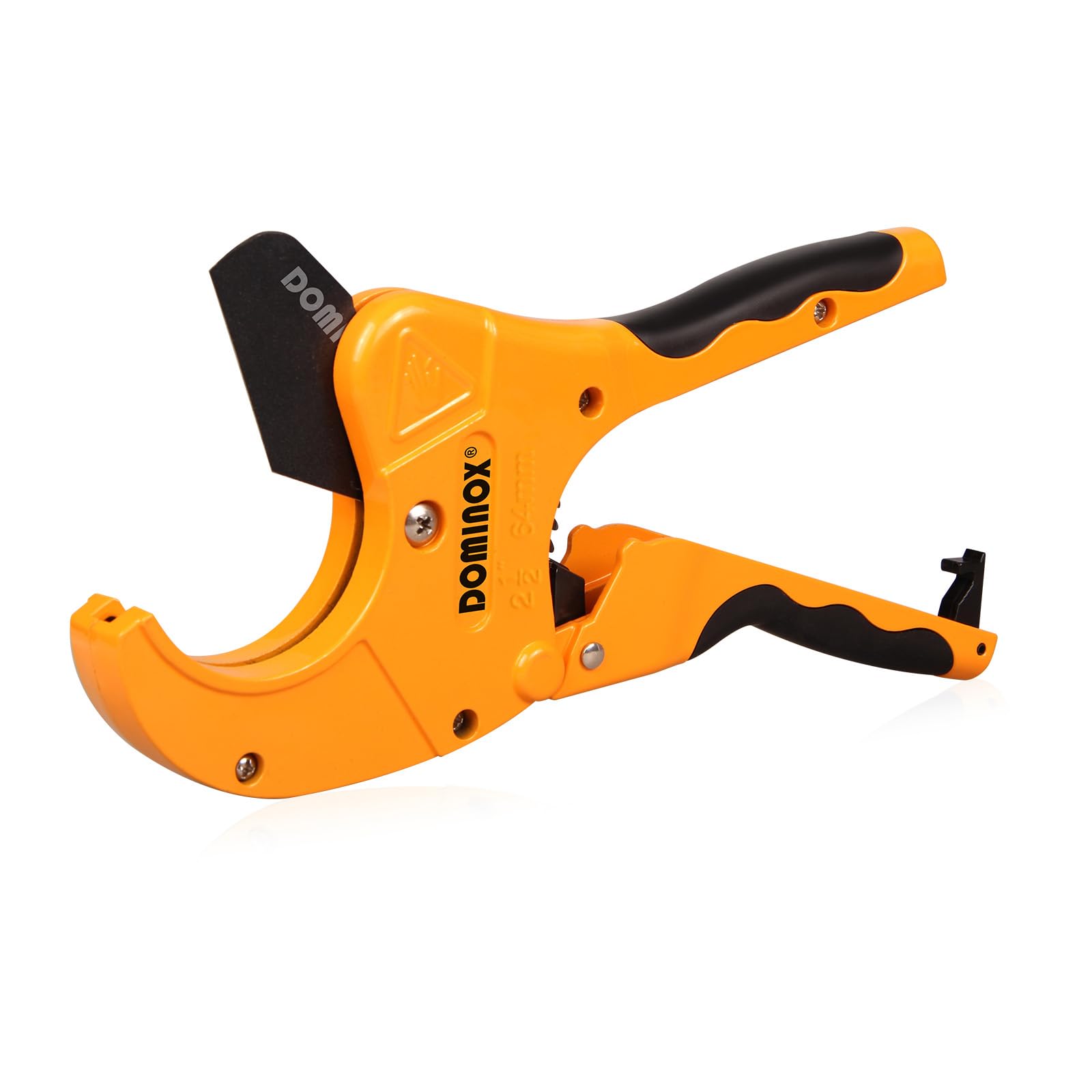
DOMINOX 2-1/2" Ratchet Cutter

86 /100
Kirk Score Excellent
Body
Aluminum alloy
Blade
SK5 steel
Mechanism
Ratchet drive
Max O.D. Capacity
2-1/2 in.
Check Details on Amazon

Pros

  • Smooth cutting with reduced hand strain across pipe sizes — 52 mentions on Functionality, 96% positive
  • Comfortable grip and ratchet action minimizes fatigue during longer cuts — 27 mentions on Ease of Use, 85% positive

Cons

  • Blade tends to drift left during the cut, often producing angled ends — 86 mentions on Cutting Performance, 38% negative; 7 mentions on Blade Angle, 71% negative

The DOMINOX ratchet cutter handles PVC up to 2-1/2 inches with less hand strain than a saw. But the blade tends to drift left, producing crooked cuts, and the ratchet mechanism may break under moderate use. This suits occasional rough plumbing jobs where square cuts aren't mandatory.

Bottom line: For occasional rough plumbing fixes where a slightly angled cut is acceptable — not for precision work or frequent use.

Check Latest Price
#10

Non-critical tasks

WORKPRO 1-5/8" Ratchet Cutter

86 /100
Kirk Score Excellent
Body
Aluminum alloy steel
Blade
Stainless steel
Mechanism
Ratchet, safety lock
Max O.D. Capacity
1-5/8 in.
Check Details on Amazon

Pros

  • Effortless ratcheting mechanism cuts PVC and ABS up to 1-5/8 inches without binding. — 34 mentions on Functionality, 91% positive
  • Intuitive design includes a comfortable grip and safety lock for straightforward operation. — 16 mentions on Ease of Use, 94% positive

Cons

  • Cuts can come out angled, particularly on larger pipes, making glue joints less reliable. — 34 mentions on Cut Quality, 32% negative; 18 mentions on Sharpness, 39% negative
  • Handle lock may snap and blade dulls quickly under anything beyond light use. — 24 mentions on Durability, 75% negative

The WORKPRO cutter’s stainless steel blade and aluminum frame feel solid for the cost, and the ratchet mechanism eases through PVC pipe up to 1-5/8 inches. Cut squareness can drift, and the handle lock or blade may not survive repeated moderate use. This tool suits light DIY jobs where glue joints don’t require absolute straightness, but anyone whose plumbing projects demand consistent precision should step up to a more robust ratchet.

Bottom line: When your tasks are occasional and non-critical — like building a PVC garden trellis or repairing a sprinkler line — this cutter delivers basic function for the price. For plumbing where square ends are essential, invest in a tougher cutter.

Check Latest Price
#11

Temporary replacement

DEWILL 1-5/8" Ratchet Cutter

88 /100
Kirk Score Excellent
Body
Blade
SK5 Teflon-coated, 2.5mm
Mechanism
Ratchet, safety buckle
Max O.D. Capacity
1-5/8 in.
Check Details on Amazon

Pros

  • Cuts soft PVC and PEX cleanly with little effort when new — 29 mentions on Sharpness, 90% positive
  • Budget price makes it a low-risk option for non-critical jobs — 57 mentions on Value, 91% positive

Cons

  • Blade wobble can develop early, causing angled cuts that require extra finishing — 32 mentions on Blade Stability, 81% negative

DEWILL's cutter glides through soft tubing at first with a sharp SK5 blade, but wobble can set in early, producing skewed cuts. Some units may jam or break after light use. This is a stopgap for occasional, non-critical tasks.

Bottom line: Pick this only as a temporary fix for soft tubing where exact squareness does not matter; if a straight joint matters, skip it.

Check Latest Price

How to Choose

Maximum O.D. Cutting Capacity

Pipe cutters are rated by the outside diameter they can handle. A 1-5/8-inch cutter covers most home plumbing and irrigation, but if you work with 2-inch or larger PVC, you'll need a model rated to at least 2-3/8 inches. Using a smaller cutter on a large pipe forces the blade to pinch at an angle, producing crooked ends and stressing the mechanism.

Measure your pipe before buying — schedule 40 PVC's O.D. is larger than its nominal size. A cutter that maxes out at 1-5/8 inches will not safely cut 2-inch PVC, even if the ID sounds close.

Mechanism: Ratcheting vs. Single-Stroke

A ratchet mechanism clicks through small increments, multiplying hand force so you can cleanly shear through rigid PVC with minimal grip strength. This is the better choice for any pipe over 3/4 inch or when you want consistent square ends. Single-stroke shears close the blade in one motion — fast and compact, but they demand more hand power and are best limited to soft PEX, flexible tubing, or thin PVC under 3/4 inch.

Blade Material and Replaceability

SK5 and stainless steel blades hold an edge longer, but the real asset is a replaceable blade system. Once a cheap fixed blade dulls or chips, the tool is scrap. A tool-free quick-change blade lets you swap in a fresh edge in seconds, extending the cutter's life indefinitely. Look for blades with anti-friction coatings (like Teflon) to reduce binding.

Body Material: Die-Cast Aluminum vs. Plastic

When you squeeze, the body takes the load. Plastic frames can flex enough to tilt the blade off-square, leading to the dreaded angled cut. Die-cast aluminum bodies resist twisting and keep the blade tracking straight, even on thick schedule 40. If you need repeatable, glue-ready ends, skip plastic-bodied cutters.

Warranty Length

Premium brands often back their cutters with a lifetime warranty, covering defects in materials and workmanship. This is a signal that the company expects the tool to last under daily professional use. A missing or short warranty doesn't guarantee failure, but it's a factor when comparing a mid-range model to a budget one with a similar parts list.

Frequently Asked Questions